🔍 Read the full analysis: 10 Best Mesh WiFi Systems For Reaching Beyond Your Router In 2027 on ThorstenMeyerAI.com

Get business pricing on tech for your team
- Business-only prices and quantity discounts
- Tax-exempt purchasing
- Multiple users, one account, clear invoices
TL;DR
The supplied 2027 guide names 10 mesh Wi-Fi systems, but its source material provides detailed comparisons for only a few models and does not substantiate a complete, tested ranking. It highlights a practical choice between lower-cost dual-band systems, Wi-Fi 6E models with a separate band for node traffic, and pricier Wi-Fi 7 systems whose advantages depend on compatible equipment and internet service.
A 2027 mesh Wi-Fi buying guide identifies the TP-Link Deco XE75 as its overall value choice and points to the NETGEAR Orbi 770 Series and Amazon eero Pro 7 for buyers considering Wi-Fi 7. The guide describes a tradeoff between paying for more backhaul capacity and choosing less expensive dual-band systems, a key consideration when comparing mesh Wi-Fi systems for whole-home coverage. However, the supplied guide does not provide enough model-specific test data to verify a ranked list of 10 products.
The guide says its selection criteria are coverage consistency, backhaul efficiency and setup simplicity. It describes assessing coverage against advertised area and node count, and backhaul according to whether node-to-node traffic has a dedicated band or shares spectrum with household devices. The supplied material gives no measured throughput results, test locations, prices or detailed product scores.
Among the examples named in the guide, the TP-Link Deco XE75 is described as a Wi-Fi 6E system with a third band; the NETGEAR Orbi 770 Series is presented as a Wi-Fi 7 option; and the Amazon eero Pro 7 is highlighted for smart-home integration. The guide also mentions the Deco X55, eero 6+ and Deco S4, without providing full specifications or comparative test findings for them.
The supplied guide does not name 10 distinct systems or provide enough evidence for reliable, separate verdicts on 10 picks. The recommendations below therefore distinguish the products and characterizations it does provide from broader shopping criteria, rather than treating them as a verified ranking.
The 10 picks
- 1
 Amazon eero Pro 7 tri-band mesh Wi-Fi 7 router (newest model) – Supports inte…View on Amazon →
- 2
 NETGEAR Orbi 770 Series WiFi 7 Tri-Band Mesh System, 3-Pack, Covers Up to 8,0…View on Amazon →
- 3
 Amazon eero 7 dual-band mesh Wi-Fi 7 router (newest model) – Supports interne…View on Amazon →
- 4
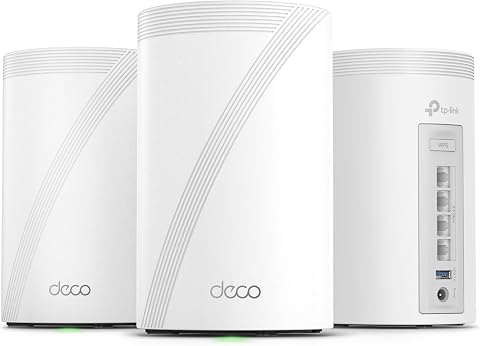 TP-Link Deco 7 Pro Tri-Band WiFi 7 BE10000 Whole Home Mesh System (3-Pack)View on Amazon →
- 5
 Amazon eero 6+ Dual-Band Wi-Fi 6 Mesh System, 3-PackView on Amazon →
- 6
 NETGEAR Orbi 370 Series WiFi 7 Mesh System for Home (RBE373) – Wireless Route…View on Amazon →
- 7
 TP-Link Deco 7 BE5000 Dual-Band Wi-Fi 7 Mesh SystemView on Amazon →
- 8
 TP-Link Deco XE75 AXE5400 Tri-Band Wi-Fi 6E Mesh System, 3-PackView on Amazon →
- 9
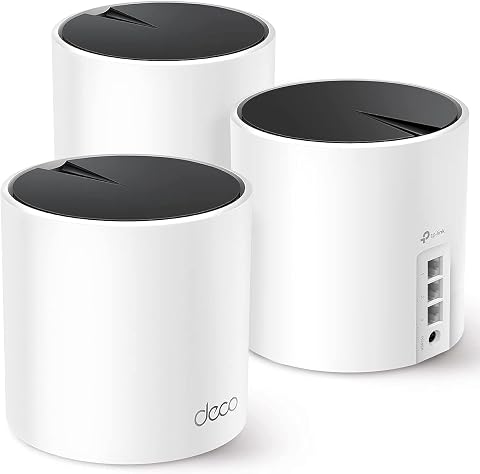 TP-Link Deco X55 AX3000 Wi-Fi 6 Mesh System (3-Pack)View on Amazon →
- 10
 TP-Link Deco S4 AC1900 Mesh Wi-Fi System (3-Pack)View on Amazon →
How Backhaul Shapes Home Coverage
Mesh systems can extend wireless coverage by linking multiple units, but adding nodes does not guarantee that a distant room will receive the same speeds as the router. The guide identifies backhaul capacity—the connection between nodes—as a factor that can affect performance when traffic is heavy or nodes are far apart. That consideration may matter in homes with multiple floors, thick walls, video calls, gaming or high-bandwidth streaming.
The guide’s central buying point is to match a system to a home and internet service rather than choose by Wi-Fi generation alone. It says a Wi-Fi 7 label does not by itself establish a speed improvement for every household: compatible client devices and an internet plan capable of supplying the extra bandwidth also matter. The supplied material does not include independent tests verifying the size of any such improvement.
Products Worth Considering

Amazon Kindle Paperwhite (2024, 16 GB) – 7-inch Display, Black

Bose Smart Dolby Atmos Soundbar, All-in-One Soundbar for TV, A.I. Dialogue Mode, Voice Control and Amazon Alexa Built-in, Supports Bluetooth
Amazon Kindle Paperwhite (12th Generation, 2024), 16GB, 7-Inch Display, Raspberry
As an affiliate, we earn on qualifying purchases.
The Models Named in the Guide
The guide positions the Deco XE75 as a mid-range Wi-Fi 6E choice, saying its additional 6GHz band can serve as backhaul at a lower cost than Wi-Fi 7 alternatives. It describes the Orbi 770 Series and eero Pro 7 as Wi-Fi 7 options, and cites eero’s connection to Alexa and smart-home devices as a reason some buyers may prefer that ecosystem. These are the guide’s descriptions, not findings substantiated by test data in the supplied material.
The guide also mentions the Deco X55 and eero 6+ as dual-band options for smaller homes with moderate device use, and notes the compact Deco S4 for easier placement. It provides no complete assessment or independent test results for these models. The guide cautions that advertised coverage figures may assume open layouts and can overstate performance in homes with dense walls or multiple levels.
What the Product Evidence Leaves Open
The supplied guide does not establish a complete 10-system shortlist: it names fewer than 10 distinct products and provides no full product-by-product rankings. It also does not document independent testing, exact coverage measurements, current prices, firmware versions, port configurations for each model, or the conditions behind its performance claims. The guide’s overall pick therefore cannot be confirmed as best for an individual home based on the supplied material alone.
Some comparisons in the guide are broad recommendations rather than conclusions tied to disclosed tests. For example, it says dual-band systems can suit homes under 2,500 square feet but provides no test method or household layout supporting that threshold. The supplied text also does not verify 2027 availability or current model specifications; buyers should check those details with manufacturers and retailers.
Checks to Make Before Buying
The guide advises checking current specifications, node compatibility and prices with manufacturers or sellers, then comparing independent tests that disclose home layout, distance and client devices. Buyers should consider where coverage is weak and account for floors and wall materials rather than rely on advertised coverage figures alone.
For multi-gigabit internet, the guide recommends checking router and satellite Ethernet ports as well as wireless capabilities, since a slower wired port can limit a connection. It says a dual-band model may be adequate for a smaller home with moderate use, while shoppers with larger homes or busier networks can compare tri-band options. The supplied material does not independently verify these recommendations, so buyers should check how each system uses its bands and whether their devices can benefit from them.
Key Questions
Does the source establish a definitive list of 10 mesh systems?
No. The supplied guide names several systems but does not provide 10 distinct picks or enough model-specific information for a verified ranking of 10.
Do most households need Wi-Fi 7?
The guide says Wi-Fi 7 benefits depend on compatible devices and a suitable internet plan. It presents Wi-Fi 6E as a balance of capability and cost for many buyers, but the supplied material includes no independent tests establishing what most households need.
What is a dedicated backhaul band?
In the guide’s description, it is a wireless band reserved for communication between mesh nodes instead of being shared with ordinary device traffic. The guide says this can help maintain performance as network use grows, but provides no test results; actual performance depends on placement and conditions.
Can a mesh system cover the area on its box?
Not necessarily. The guide warns that advertised coverage may assume open layouts; walls, floors and building materials can reduce real-world reach. It recommends checking independent tests and planning placement for the home.
Source: ThorstenMeyerAI.com