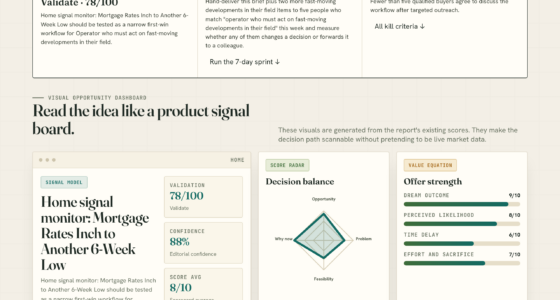
📊 Full opportunity report: $965B and Climbing: Anthropic’s Series H Is Really a Compute Bet on ThorstenMeyerAI.com — validation score, market gap, and execution plan.
TL;DR
Anthropic closed a $65 billion Series H funding round at a $965 billion valuation, making it the most valuable private company. The round signals a focus on expanding compute infrastructure, not just valuation growth.
Anthropic announced today it has closed a $65 billion Series H funding round at a $965 billion post-money valuation, making it the most valuable private company in history.
The round was led by major institutional investors including Sequoia, Dragoneer, Greenoaks, and Altimeter, with additional participation from Baillie Gifford, Blackstone, Fidelity, and others. Notably, Amazon committed $5 billion, and Microsoft and Nvidia remain strategic partners.
This funding is characterized less as a valuation boost and more as a capacity expansion, with Anthropic securing over 10 gigawatts of compute commitments from chipmakers Micron, Samsung, and SK hynix. The company’s revenue growth has been extraordinary, reaching an estimated $47 billion annualized run-rate in June, up from just $1 billion in December 2024, representing a 5.4× increase in roughly 14 weeks.
Despite the massive valuation, the multiple based on revenue has decreased from roughly 27× at Series G to approximately 20.5× now, indicating that revenue growth is outpacing valuation increases, a sign that the company is expanding its capacity rather than inflating its valuation through hype.
$965B and climbing — it’s really a compute bet
The viral headline is the valuation. The interesting story is in the press release’s middle paragraphs — and in three chipmakers Anthropic just named as strategic partners. This is a capacity round dressed as a funding round.
The numbers nobody can quite parse in sequence
Read together they describe a trajectory with no precedent in enterprise software. Read individually, each looks like a typo.
From $61.5B to $965B in fourteen months
Salesforce took roughly two decades to reach revenue numbers Anthropic just blew past. The sequence below is the part most coverage skips — it’s not the size, it’s the shape.
Anthropic’s valuation ladder · Mar 2025 → May 2026
Five rounds, fourteen months. Bar height is the valuation; the climb itself is the story. Tap any milestone for context.
The multiple actually got cheaper
Bubbles look like multiples expanding while revenue lags. Anthropic’s pattern is the inverse — the valuation tripled, but revenue grew faster, and the multiple compressed.
Revenue-to-valuation multiple · Series G → Series H
Same company, three months apart. The denominator (revenue) is outrunning the numerator (valuation) — exactly the opposite of what a bubble narrative predicts.
10+ gigawatts and three chipmakers
When you name Micron, Samsung & SK hynix alongside your equity backers, you’re saying the binding constraint isn’t demand or model quality — it’s the physical supply of memory chips. The Series H is a capacity round.
Compute commitments backing Anthropic’s capacity bet
$200B+ in announced compute spend across multi-year contracts. The $65B Series H raise has to be read against that bill, not against operating losses.
A genuinely durable bet — or a structural exposure?
Both readings can be true at once. The answer arrives over the next 18–24 months as the gigawatts come online and either fill with paying demand or don’t.
Revenue growth has no precedent in B2B software ($1B → $47B in 17 months). The multiple is compressing, not expanding. Claude is the only frontier model on all 3 major clouds. Enterprise AI spend share went from ~10% to >65% in a year. Compute commitments are tied to specific contracts with capacity dates.
20× revenue is not cheap by any historical software-investing standard. Revenue is reported gross of cloud-reseller pass-throughs, which inflates the top line. Profitability is 2 years out. Amodei’s own warning: a 12-month delay in AI progress “would make him bankrupt” — the compute commitments are a structural exposure to demand persistence.
The valuation race — and the IPO context
Anthropic shipped Opus 4.8 the same morning as Series H — not a coincidence. One week after OpenAI filed confidentially for IPO. The late-2026 frame is set: two frontier AI companies racing to public markets, each pitching durability.
Why the Capacity Focus Changes AI Investment Dynamics
This round signals a shift in AI startup funding from valuation speculation toward infrastructure investment, emphasizing compute capacity as the bottleneck for scaling AI services. It suggests that future growth depends heavily on hardware expansion, not just software development.
For investors and industry watchers, this indicates a recognition that AI’s scalability hinges on massive compute resources, which require significant capital commitments from chipmakers and cloud providers. It also positions Anthropic as a leader in this capacity race, with implications for how AI giants will compete and expand.

Hewlett Packard Enterprise ProLiant DL320 Gen11 Rack Server w/one Intel Xeon Scalable 5416S Processor, 2.0GHz 16‑core 1P 64GB‑R 8SFF 800W PS (HPE Smart Choice P69302-005)
- Processor: Intel Xeon Gold 5416S, 16-core, 2.0GHz
- Memory: 64GB DDR5 Smart Memory, expandable to 2TB
- Storage Bays: Supports up to 8 SFF drives
As an affiliate, we earn on qualifying purchases.
As an affiliate, we earn on qualifying purchases.
The Rapid Rise of Anthropic and Industry Funding Trends
Anthropic’s valuation has surged from $61.5 billion in March 2025 to $965 billion in May 2026, driven by extraordinary revenue growth and strategic infrastructure investments. Its revenue growth has outpaced valuation increases, with recent estimates indicating over $47 billion in annualized revenue as of June 2026.
This rapid escalation follows a pattern of aggressive fundraising, with previous rounds raising billions and major tech firms like Amazon, Microsoft, and Nvidia investing heavily. The focus on compute capacity reflects a broader industry trend where hardware bottlenecks are now seen as the primary hurdle to AI scaling.
Prior to this, OpenAI was considered the dominant private AI company, but Anthropic’s recent valuation and revenue figures now position it as a close rival, with a different strategic emphasis on hardware infrastructure.
“Our revenue and usage have grown 80× in the first quarter of 2026, underscoring the demand for compute resources.”
— Dario Amodei, Anthropic CEO

GPU Computing Gems Emerald Edition (Applications of GPU Computing Series)
As an affiliate, we earn on qualifying purchases.
As an affiliate, we earn on qualifying purchases.
Unclear Sustainability of Revenue Growth and Infrastructure Investment
While revenue growth and compute commitments are impressive, it remains uncertain whether this trajectory is sustainable long-term. The reliance on chipmakers and hardware infrastructure raises questions about supply chain risks, chip costs, and actual capacity deployment timelines. Additionally, the impact of this capacity expansion on AI performance and market competition is still developing.

9VDC 1A Arduino Compatible Power Supply Adapter 110V AC 5.5 x 2.1mm Tip Positive Part#LJH -186
- Plug Type: 2-flat-pin plug
- Input Voltage: 110V AC
- Output Voltage: 9V DC 1A
As an affiliate, we earn on qualifying purchases.
As an affiliate, we earn on qualifying purchases.
Next Steps in Capacity Expansion and Industry Impact
Anthropic is expected to continue scaling its compute infrastructure, with detailed deployment timelines and capacity milestones likely to be announced in upcoming quarters. Industry observers will watch how this infrastructure investment influences AI model development, pricing, and competitive positioning. Further, the company’s ability to maintain rapid revenue growth while expanding hardware capacity will be a key indicator of its long-term strategy.

AI Data Center Infrastructure Engineering: Power Distribution, Liquid Cooling, High-Density Networking, and Energy Efficiency for GPU Training … Hardware & Compiler Engineering Series)
As an affiliate, we earn on qualifying purchases.
As an affiliate, we earn on qualifying purchases.
Key Questions
Why is Anthropic raising such a large amount of capital now?
The company views compute capacity as the primary bottleneck for AI scaling and is investing heavily in infrastructure to support future growth, rather than focusing solely on valuation metrics.
How does this funding round compare to other AI companies?
Anthropic’s $965 billion valuation makes it the most valuable private company, surpassing OpenAI. The focus on capacity and infrastructure is a different strategic approach compared to previous valuation-driven rounds.
What does the focus on chipmakers indicate about AI development?
It suggests that hardware supply chains and chip manufacturing are now seen as critical to AI progress, with companies investing directly in infrastructure to avoid bottlenecks.
Is this growth sustainable for Anthropic?
It remains uncertain. While revenue growth has been rapid, maintaining this pace depends on hardware deployment, supply chain stability, and continued demand for AI services.
What is the significance of the multiple decreasing despite valuation rising?
This indicates that revenue growth is outpacing valuation increases, suggesting a focus on capacity expansion rather than valuation inflation, which is atypical in bubble scenarios.
Source: ThorstenMeyerAI.com