TL;DR
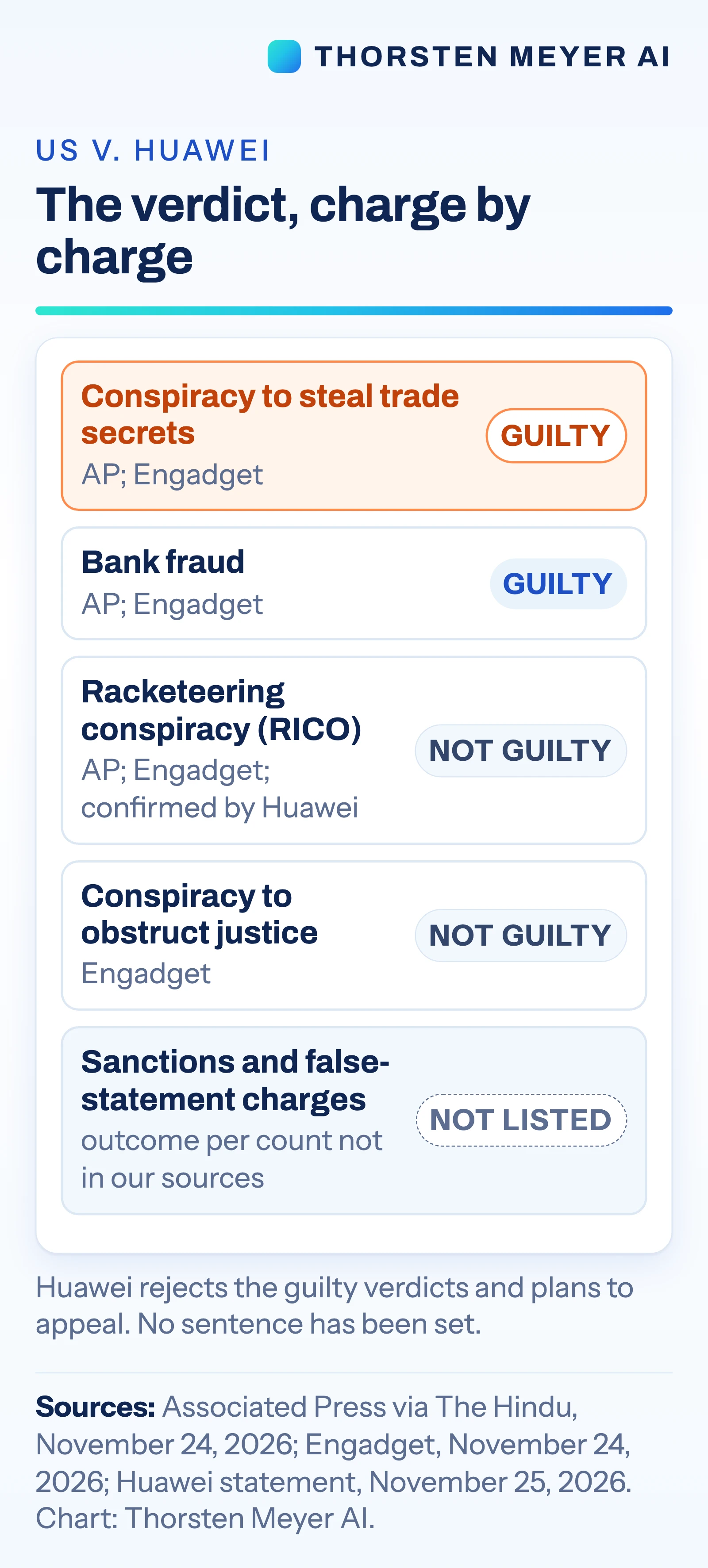
A jury in federal court in Brooklyn found Huawei guilty of conspiring to steal trade secrets and of bank fraud, while acquitting it of racketeering conspiracy, the most serious charge. Huawei rejects the remaining charges and plans to appeal, according to its lawyer; no sentencing date or penalty was reported in the available sources.
A federal jury in Brooklyn found Huawei guilty of conspiring to steal trade secrets and of bank fraud on November 24, while acquitting the Chinese technology company of racketeering conspiracy, the most serious charge, the Associated Press reported. Huawei says it rejects the remaining charges and plans to appeal, leaving the case’s penalty and next court dates unresolved.

Get business pricing on tech for your team
- Business-only prices and quantity discounts
- Tax-exempt purchasing
- Multiple users, one account, clear invoices
The verdict followed an 11-week trial in federal court in Brooklyn. Prosecutors accused Huawei of a pattern of seeking confidential technology from U.S. companies and of misleading banks and officials about its business dealings. The jury convicted the company on the trade secret conspiracy and bank fraud charges, according to the AP. The available reporting does not specify the precise scope of the jury’s findings on each underlying allegation.
The jury found Huawei not guilty of racketeering conspiracy. That charge alleged a broader criminal enterprise and was described in coverage by Engadget as the heaviest charge in the case. Huawei said it welcomed the acquittal. In a statement, the company called the remaining charges “without legal or factual merit,” and its lawyer told the AP Huawei intends to appeal.
Prosecutors’ examples, as summarized by the AP, included source code allegedly copied into routers, photographs secretly taken of a competitor’s device at a Chicago trade show, and a robotic arm allegedly removed from a rival’s laboratory to be photographed and measured. These were allegations presented in the case; the source material does not establish that the jury separately affirmed each example. Companies identified as alleged victims included Cisco Systems, Motorola Solutions, T-Mobile, Quintel USA and Fujitsu, according to court records cited by the AP.
The Verdict’s Reach for Huawei
The split verdict draws a line between specific convictions and prosecutors’ broader racketeering theory. Huawei was convicted of trade secret conspiracy and bank fraud, but the jury did not find it guilty of the racketeering conspiracy charge. That distinction matters to the company’s legal exposure and to how the case can be described: the acquittal does not erase the convictions, while the convictions do not establish every allegation prosecutors made.
The case also puts a prominent technology company’s handling of competitors’ confidential know-how under a U.S. criminal law spotlight. The allegations involved access to source code, equipment and technical designs. For companies that rely on proprietary engineering, the proceedings show why the boundary between studying public products and obtaining protected information can carry legal consequences. The verdict itself does not set a new rule, and its broader effect will depend in part on the court’s eventual sentence and the appeal.
Huawei’s role in China’s technology sector adds a commercial dimension. The AP describes the company as one of the principal alternatives to Nvidia chips within China. However, the verdict does not itself change U.S. trade restrictions or establish an immediate change for Huawei products outside the United States. Huawei was already barred from selling its equipment in the U.S., according to the source material.
Products Worth Considering

LG UltraGear 34G600A-B 34-Inch Curved WQHD Gaming Monitor, 160Hz, FreeSync Premium, HDR10

Bose TV Speaker (2nd Gen) Compact Soundbar with Bluetooth, HDMI-ARC, and Remote

Kindle Paperwhite Signature Edition (2024), 32 GB, Metallic Black
As an affiliate, we earn on qualifying purchases.
How the Brooklyn Case Developed
The U.S. announced criminal charges against Huawei in early 2019 and later expanded them, the AP reported. The case combined allegations about trade secrets with claims involving dealings with countries under U.S. sanctions, including Iran and North Korea, and alleged false statements to banks and U.S. officials. Huawei denied wrongdoing during the trial.
At trial, prosecutors argued that the alleged conduct formed a repeated pattern. Prosecutor Meredith Arfa told jurors, “The tone was set at the top,” according to the source material. Huawei’s defense, as described there, disputed the government’s account and focused on the distinction between legitimate competition and obtaining information a company was not entitled to possess. The jury’s mixed decision resolved some charges while rejecting the racketeering theory.
A trade secret is commercially valuable information kept confidential, such as source code, a circuit design or a testing method. A conspiracy charge concerns an agreement to commit a crime and steps taken toward it. Racketeering conspiracy alleged a wider pattern of criminal activity. These definitions explain the categories at issue; they do not determine what conduct the jury found proven in this case.
““without legal or factual merit””
— Huawei
Sentencing and Appeal Still Pending
The available sources do not identify a sentencing date or state what penalty Huawei may face. They also do not describe the exact basis or timetable for the planned appeal. Huawei’s intention to appeal was reported by the AP through the company’s lawyer; the source material does not indicate that an appeal has already been filed.
The verdict establishes the jury’s decisions on the charges, but the supplied reporting leaves open how the court will calculate any sentence and how the convictions may fare on appeal. It also does not resolve the separate policy questions around U.S. restrictions on Huawei or the company’s position in China’s chip market.
Court Sets the Next Milestones
The next known legal milestones are sentencing and Huawei’s planned appeal. The court will need to set a sentencing date; none was listed in the available sources as of November 27, 2026. Huawei’s lawyer has said the company plans to challenge the remaining convictions, but the timing and grounds are not yet clear.
Until the court announces those steps, the immediate record is the mixed verdict: convictions for trade secret conspiracy and bank fraud, an acquittal on racketeering conspiracy, and a company that rejects the convictions. Further reporting will be needed to establish the sentence, appeal schedule and any effect beyond the case itself.
Key Questions
What did the jury find Huawei guilty of?
The jury convicted Huawei of conspiring to steal trade secrets and bank fraud, according to the Associated Press.
What charge did Huawei beat?
The jury acquitted Huawei of racketeering conspiracy, the most serious charge in the case as described by the source material.
Will Huawei appeal?
Huawei’s lawyer told the AP that the company plans to appeal. The available sources do not say that an appeal has been filed or give a timetable.
Has the court set a penalty or sentencing date?
No sentencing date or penalty was reported in the available sources as of November 27, 2026.
Does the verdict change Huawei’s U.S. sales restrictions?
The source material reports no change to U.S. restrictions from this verdict. Huawei was already barred from selling its equipment in the United States.
Source: Thorsten Meyer AI