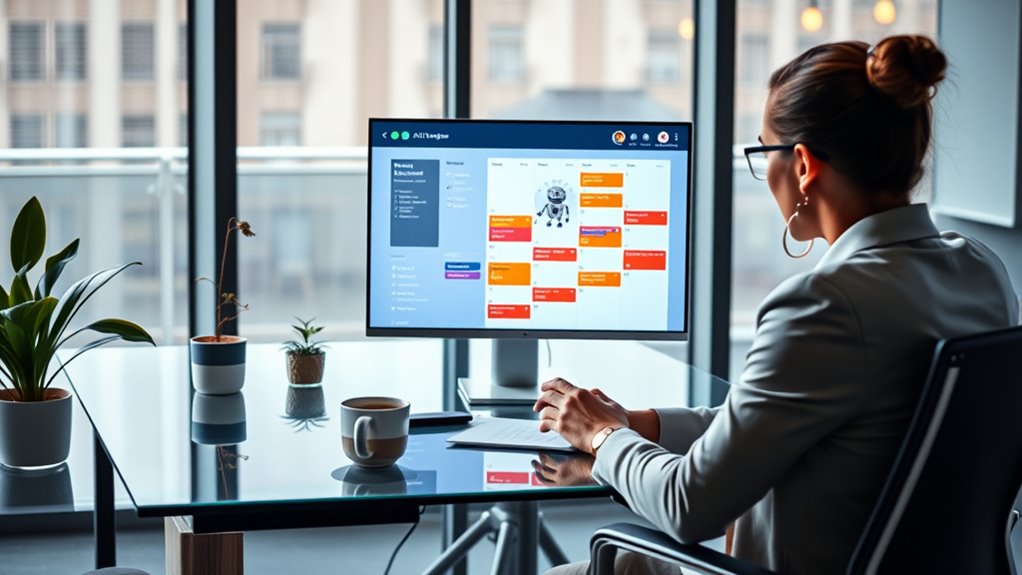

Managing your workload with AI scheduling helps you stay organized and boost productivity. It analyzes your tasks, deadlines, and work habits to create balanced schedules that prevent burnout. AI tools identify conflicts, suggest ideal times, and sync with your calendars and email for real-time updates. By automating routine planning and adjusting based on your energy levels, you can focus on high-impact tasks. Keep exploring how these smart systems can transform your workday even further.
Key Takeaways
- AI analyzes tasks and deadlines to prioritize and create balanced, stress-reducing schedules.
- It monitors workload distribution to prevent overloading and improve consistency.
- AI detects scheduling conflicts, automatically rescheduling or suggesting optimal times.
- It syncs with calendars and tools for real-time updates, reducing missed appointments.
- Personalized scheduling adjusts based on work patterns to boost productivity and focus on high-impact tasks.

Managing a heavy workload can feel overwhelming, but AI scheduling tools are transforming how you organize and prioritize tasks. These tools harness AI efficiency to analyze your tasks, deadlines, and work habits, giving you a smarter way to manage your time. Instead of manually juggling multiple deadlines and meetings, AI algorithms assess the urgency and importance of each item, helping you create a balanced schedule that reduces stress and boosts productivity. With AI handling the heavy lifting, you gain a clearer picture of your workload and can make better decisions about what to focus on first.
AI tools analyze tasks and deadlines to help you prioritize effectively and reduce workload stress.
One of the biggest advantages of AI scheduling is its ability to maintain workload balance. Traditional methods often lead to overloading on certain days or neglecting critical tasks, which can cause burnout or missed deadlines. AI tools continuously monitor your commitments and suggest adjustments to evenly distribute your workload throughout the week. This proactive approach guarantees you’re not overwhelmed on busy days and have enough breathing room for more complex or urgent tasks. By promoting workload balance, these tools help you stay consistent and prevent last-minute scrambles, giving you peace of mind that your schedule is realistic and manageable.
AI efficiency also extends to identifying potential conflicts or bottlenecks before they become issues. If you’ve got overlapping meetings or tight deadlines, AI scheduling software can automatically reschedule or suggest ideal times, saving you hours of manual coordination. It learns from your patterns over time, understanding when you’re most productive and when you need breaks. This personalized insight allows you to optimize your work periods, ensuring that your energy is directed toward high-priority tasks when you’re most capable. As a result, you become more efficient and your workload becomes more manageable.
Moreover, AI scheduling tools often integrate with other apps and platforms you use daily, creating a seamless workflow. Whether it’s syncing with your calendar, email, or project management tools, AI ensures your schedule reflects real-time updates and changes. This integration reduces the risk of missed appointments or forgotten tasks, freeing you to focus on the work itself rather than the logistics. As your schedule adapts dynamically, you stay on top of your responsibilities without feeling bogged down by administrative tasks.
In essence, AI efficiency and workload balance work hand-in-hand to help you regain control of your busy days. By automating routine planning and intelligently adjusting your schedule, AI tools empower you to work smarter, not harder. They provide clarity and structure amid chaos, making managing a heavy workload less intimidating and more achievable. A key factor contributing to this effectiveness is understanding your work habits, which AI tools analyze to optimize your productivity. By analyzing your patterns over time, AI can tailor recommendations that align with your most productive periods. As a result, you can focus your energy on high-impact tasks when you’re at your best, leading to greater success with less stress and greater confidence.
AI scheduling software for productivity
As an affiliate, we earn on qualifying purchases.
As an affiliate, we earn on qualifying purchases.
Frequently Asked Questions
How Does AI Scheduling Adapt to Sudden Workload Changes?
AI scheduling adapts to sudden workload changes through dynamic adjustments and real-time responsiveness. When unexpected tasks or spikes occur, the system quickly reallocates resources, shifts priorities, and updates schedules on the fly. You’ll notice it seamlessly responding to these shifts, ensuring your team stays on track without manual intervention. This flexibility helps maintain productivity and prevents bottlenecks, making sure your workload stays manageable despite sudden changes.
What Industries Benefit Most From AI Workload Management?
You’ll find industries like healthcare and manufacturing benefit most from AI workload management. While healthcare optimization ensures patient care remains seamless, manufacturing efficiency speeds up production lines. These sectors face constant demand fluctuations, and AI helps adapt quickly. By balancing workloads intelligently, AI reduces errors and delays, allowing you to focus on strategic growth. The juxtaposition of complex patient needs and fast-paced manufacturing highlights AI’s essential role in transforming operational efficiency.
Can AI Scheduling Prioritize Tasks Based on Employee Skills?
Yes, AI scheduling can prioritize tasks based on employee skills through effective employee skill matching. It analyzes each worker’s strengths and expertise, then uses task prioritization algorithms to assign tasks accordingly. This guarantees that the right people handle the right jobs, boosting efficiency and productivity. By aligning tasks with skills, AI scheduling helps you optimize workflows, reduce errors, and meet deadlines more consistently.
How Secure Is Data Used in AI Scheduling Systems?
Your data in AI scheduling systems is generally secure, thanks to strict data privacy measures and advanced encryption standards. Companies implement encryption to protect sensitive information during transmission and storage, reducing risks of unauthorized access. However, it is crucial to choose providers with transparent security policies and regularly update systems. By staying vigilant, you can guarantee your data remains protected while benefiting from efficient AI-driven scheduling.
What Are the Initial Costs of Implementing AI Scheduling Tools?
The initial costs of implementing AI scheduling tools vary, but you’ll need to contemplate a thorough cost analysis to cover software licensing, hardware upgrades, and staff training. Expect some implementation challenges like integrating the system with existing workflows and ensuring data security. While upfront expenses might seem high, the efficiency gains and automation benefits often justify the investment, making it a smart move for streamlining your workload management.
calendar integration tools for work
As an affiliate, we earn on qualifying purchases.
As an affiliate, we earn on qualifying purchases.
Conclusion
Remember, Rome wasn’t built in a day. By integrating AI scheduling into your workflow, you streamline tasks and stay organized, making heavy workloads manageable. Embrace this technology to boost productivity and reduce stress. With AI as your partner, you’ll find it easier to prioritize and meet deadlines. Stay proactive, adapt, and trust that smart planning will lead to success. The key is to work smarter, not harder—because efficiency is the foundation of progress.
As an affiliate, we earn on qualifying purchases.
As an affiliate, we earn on qualifying purchases.