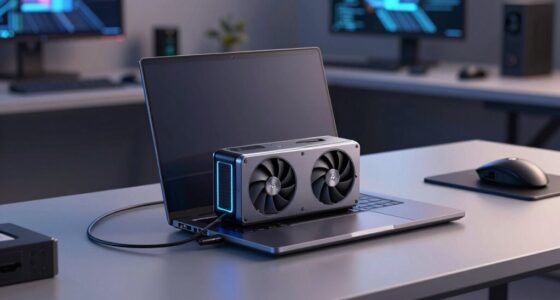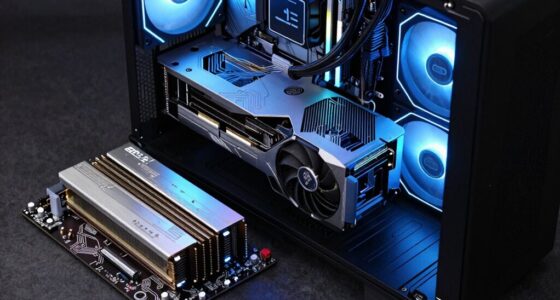
If you’re choosing between Jetson kits and AI PCs for edge AI, consider their size, power, and performance. Jetson kits are compact, energy-efficient modules made for local processing in remote or resource-limited environments, reducing latency and infrastructure needs. AI PCs are larger and more powerful, suitable for intensive tasks and cloud integration. Understanding these differences helps you pick the right hardware for your project — explore more to see which fits your needs best.

Get business pricing on tech for your team
- Business-only prices and quantity discounts
- Tax-exempt purchasing
- Multiple users, one account, clear invoices
Key Takeaways
- Jetson kits are compact, low-power modules optimized for edge deployment, while AI PCs are larger, high-performance systems for intensive tasks.
- Jetson kits excel in local decision-making with minimal latency, whereas AI PCs support complex processing and cloud integration.
- Jetson kits are suitable for remote, resource-constrained environments due to their energy efficiency; AI PCs require more power and infrastructure.
- Jetson kits operate effectively offline, reducing reliance on cloud connectivity; AI PCs are designed for seamless cloud data and model management.
- Both platforms serve diverse applications, with Jetson kits ideal for IoT and robotics, and AI PCs suited for large-scale data and training tasks.
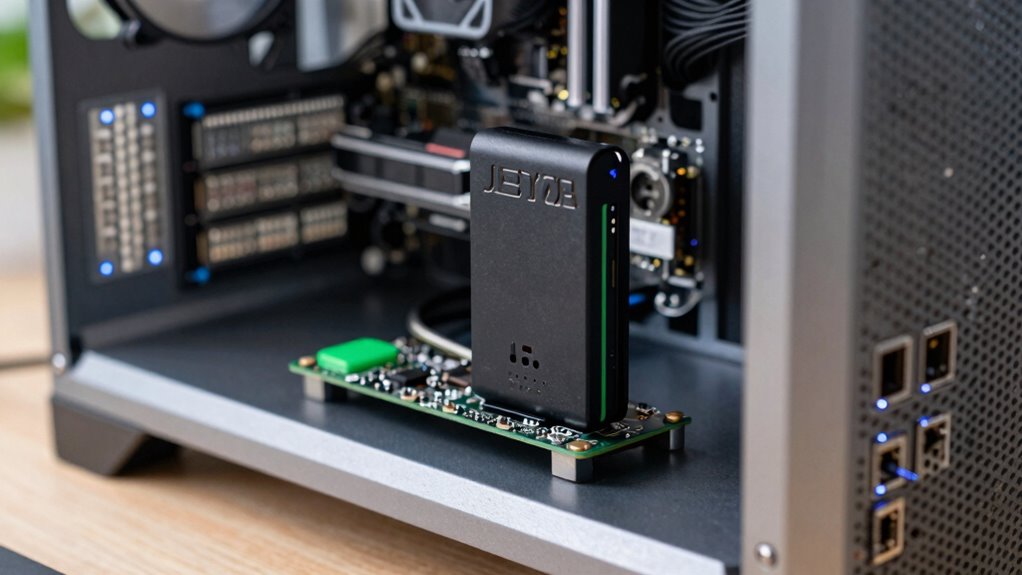
As the demand for real-time data processing grows, Edge AI hardware has become fundamental for bringing intelligence closer to where data is generated. When choosing between Jetson kits and AI PCs, you need to consider how each fits into your specific application, especially regarding cloud integration and power consumption. Jetson kits, designed by Nvidia, are compact, energy-efficient modules that excel at edge deployment. They’re built to run AI models locally, reducing reliance on cloud connectivity, which means they’re ideal if your project requires minimal latency and offline operation. Their low power consumption allows you to deploy multiple units in remote or resource-constrained environments without worrying about power supply constraints. This makes Jetson kits a practical choice for applications like robotics, autonomous vehicles, or IoT devices, where quick, local decision-making is essential. Additionally, their energy efficiency enables sustainable deployments in environmentally sensitive areas or long-term installations. The ability to operate in resource-limited environments is another key advantage of Jetson kits, especially in areas where power infrastructure is scarce.
On the other hand, AI PCs come with more processing power, often equipped with high-end GPUs, CPUs, and larger storage options. They’re better suited for tasks that demand intensive computation, such as training large models or running complex simulations. While AI PCs typically consume more power, they offer greater flexibility in cloud integration. You can connect them seamlessly to cloud services for data storage, model updates, or remote management, making them ideal for enterprise environments or research labs where high performance is indispensable. However, this increased power consumption means you need reliable power sources and proper cooling systems, which can add to the overall infrastructure costs. Additionally, Edge AI hardware is increasingly becoming more versatile, enabling a broader range of applications across various sectors, including smart home automation, where real-time processing is critical. The evolving AI hardware landscape continues to push the boundaries of what is possible in local AI deployment, offering more options tailored to specific needs.
Nvidia Jetson Nano Developer Kit
As an affiliate, we earn on qualifying purchases.
As an affiliate, we earn on qualifying purchases.
Frequently Asked Questions
How Do I Choose Between Jetson Kits and AI PCS?
You should choose based on your use case flexibility and hardware customization needs. Jetson kits are ideal if you want a compact, energy-efficient solution with straightforward setup, suitable for specific AI projects. AI PCs offer more hardware customization, better for complex tasks requiring high processing power and flexibility. Consider your project’s scope, power requirements, and future scalability to decide which option best fits your needs.
What Are the Power Consumption Differences?
Jetson kits are designed for power efficiency, consuming substantially less energy than AI PCs, which focus on high performance. This makes Jetson kits ideal for energy savings and applications needing low power consumption. AI PCs, while more power-hungry, deliver greater processing power. If you prioritize energy efficiency and low power use, Jetson kits are your best choice. For intensive tasks, AI PCs may be necessary despite higher energy demands.
Can Jetson Kits Be Upgraded Easily?
Yes, Jetson kits can be upgraded, but with some limitations. Their hardware scalability is generally limited compared to full AI PCs, making extensive upgrades more challenging. You might need to upgrade components like RAM or storage, but cooling requirements should be considered, as higher performance upgrades can generate more heat. Overall, while upgrades are possible, they’re not as flexible as with traditional AI PCs.
How Do Cost Considerations Affect Selection?
Did you know that AI hardware costs can range from a few hundred to several thousand dollars? Your budget constraints considerably influence your choice. If you’re working with limited funds, Jetson kits offer an affordable, scalable solution, but may face scalability challenges as your project grows. Conversely, AI PCs require a larger initial investment but can better handle future expansion. Consider your long-term needs and financial limits to make the best decision.
What Software Compatibility Issues Might Arise?
You might face compatibility challenges with software updates, especially if the Jetson kits and AI PCs run different operating systems or architectures. These issues can cause delays or require additional development work to guarantee seamless integration. To avoid this, check the software’s hardware requirements and support for your chosen platform beforehand. Regularly updating your software and testing compatibility helps maintain smooth operation across your edge AI hardware.
As an affiliate, we earn on qualifying purchases.
Conclusion
When choosing between Jetson kits and AI PCs, remember that Jetson devices offer compact, energy-efficient solutions perfect for real-time edge applications, while AI PCs provide more power for intensive tasks. Did you know that 80% of IoT data is processed at the edge? This highlights how vital selecting the right hardware is for maximum performance. So, whether you need speed, efficiency, or raw power, understanding these differences helps you make smarter, future-proof decisions for your AI projects.
As an affiliate, we earn on qualifying purchases.
compact AI edge computing device
As an affiliate, we earn on qualifying purchases.
As an affiliate, we earn on qualifying purchases.
Fall Picks
fall essentials
As an affiliate, we earn on qualifying purchases.