

Choosing between fine-tuning, RAG, and prompting depends on your goals, resources, and timeline. Fine-tuning is best if you need high accuracy in a specific domain and have the capacity for longer development. RAG works well for integrating current information and improving answer precision but involves managing external data. Prompting offers quick, flexible results with minimal setup. To make the right choice for your project, consider your needs—more details await as you explore further.
Key Takeaways
- Fine-tuning is ideal for domain-specific, high-accuracy tasks with ample data and focus on model interpretability.
- RAG suits dynamic knowledge updates and complex queries requiring external data integration but may raise privacy concerns.
- Prompting offers quick deployment and flexibility for simple or rapidly changing tasks with minimal resources.
- Consider resource availability, speed, and scalability: prompting is fastest, fine-tuning is resource-intensive, RAG balances update ease.
- Match your project’s complexity, privacy needs, and customization goals to choose the method that best aligns with your requirements.
What Are Fine-Tuning, RAG, and Prompting : and How Do They Differ?

Have you ever wondered how different AI systems are customized to perform specific tasks? Model adaptation is key here, and methods like fine-tuning, RAG, and prompting do it in unique ways. Fine-tuning involves adjusting a pre-trained model with additional data, which requires substantial data to teach the model new capabilities effectively. RAG, or retrieval-augmented generation, combines retrieval systems with generative models, allowing the AI to fetch relevant information dynamically without extensive training data. Prompting, on the other hand, uses carefully crafted inputs to guide the model’s responses without altering its underlying structure or requiring extra data. Each approach differs in how they adapt models to specific tasks, balancing data needs, flexibility, and complexity. Model adaptation techniques are essential for optimizing AI performance across various applications.
When Should You Use Fine-Tuning to Customize Your Language Model
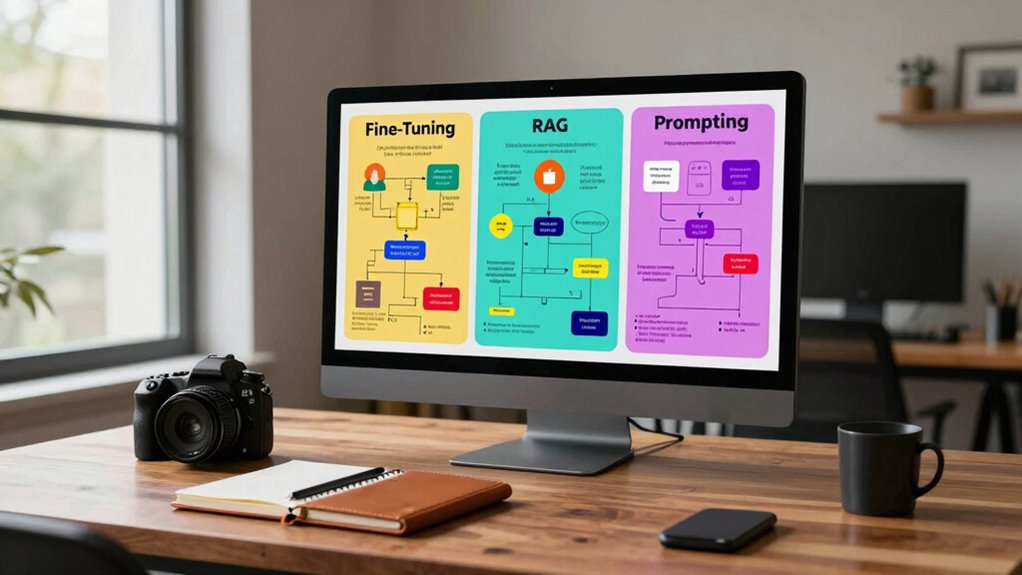
Fine-tuning is most effective when you need your language model to excel in a specific domain or perform specialized tasks that standard models might not handle well. It enhances model scalability for niche applications and guarantees better performance on targeted tasks. Use fine-tuning when data privacy is a concern, as you can keep sensitive data within your own environment during training. Consider this table for clarity:
| When to Use Fine-Tuning | Key Benefits |
|---|---|
| Domain-specific expertise | Improved accuracy in niche areas |
| Custom task performance | Better model scalability |
| Data privacy needs | Data remains controlled and private |
| Limited data for high accuracy | Efficient learning from small datasets |
Additionally, understanding the cultural nuances of Native communities can help tailor your models to better serve diverse user groups. When working with water-related content, incorporating aquatic environments can improve contextual understanding and relevance. Recognizing sound healing science principles can also enhance models designed for health and wellness applications, ensuring more accurate and effective responses.
How Retrieval-Augmented Generation Improves Context and Accuracy

Retrieval-Augmented Generation boosts your model’s understanding by providing relevant external information, enhancing its contextual awareness. This approach helps generate more precise responses by grounding answers in accurate data. Incorporating personalized care plans tailored to individual needs further ensures that responses are not only accurate but also aligned with the goal of promoting independence, dignity, and comfort for elderly individuals. Understanding the nutritional benefits of chia seeds can also support more comprehensive and health-conscious recommendations. Additionally, leveraging knowledge integration techniques enables AI systems to better synthesize diverse data sources, resulting in more reliable and contextually appropriate outputs. For instance, understanding how frictional unemployment can present new opportunities for growth allows the system to provide more nuanced and beneficial advice. For example, knowledge about Rhythm Failure and its related topics can assist in generating well-informed and relevant responses.
Enhanced Contextual Understanding
By integrating external data sources, Retrieval-Augmented Generation enhances your model’s ability to understand and respond with greater accuracy. This process improves semantic alignment by providing relevant, up-to-date information, which helps the model interpret context more effectively. This is especially important when dealing with breed-specific health concerns, as it enables the model to incorporate detailed, current knowledge about specific breeds and their needs. As a result, your model can grasp nuances and subtle distinctions within complex queries, leading to more meaningful responses. Additionally, RAG boosts model generalization by exposing it to diverse data, reducing overfitting to training sets. This broadens the model’s understanding of varied topics and contexts, making it more adaptable across different domains. Furthermore, incorporating detailed technical knowledge, such as high contrast ratios in projectors, enables the model to deliver more precise and specialized responses. The incorporation of external sources also helps mitigate issues related to outdated information. To maximize effectiveness, it’s important to understand how retrieval techniques can be tailored to specific applications. For example, utilizing domain-specific data can significantly enhance relevance and performance in targeted fields. Overall, RAG’s ability to incorporate external knowledge strengthens your model’s contextual awareness, ensuring it delivers responses that are not only accurate but also aligned with the user’s intent.
Increased Response Precision
How does Retrieval-Augmented Generation enhance the precision of your responses? By fetching relevant information from external sources, RAG boosts your model’s adaptability, allowing it to provide more accurate and detailed answers. This approach reduces the chances of hallucinations and errors, ensuring your responses align closely with current or specific data. This is especially important when discussing air purifier maintenance, as accurate guidance ensures optimal device performance and safety. Additionally, RAG can help address AI ethics by providing contextually appropriate responses that respect user privacy and safety standards. As a result, user engagement improves because your answers feel more reliable and tailored to their needs. RAG effectively combines generative capabilities with precise retrieval, fine-tuning the context and sharpening accuracy. This synergy helps your system adapt dynamically to complex queries, elevating response quality and giving users greater confidence in your outputs. Ultimately, RAG empowers you to deliver highly precise, contextually rich answers that resonate with users’ expectations.
Why Prompt Engineering Is a Fast and Flexible Solution

Have you ever needed to quickly adapt an AI model to new tasks without waiting for lengthy retraining? Prompt engineering offers a fast, flexible solution that leverages your existing models. It allows you to tailor responses through precise prompts, enabling seamless context adaptation and improved user engagement. This approach saves time and resources, making it ideal for dynamic environments. With prompt engineering, you can experiment with different instructions, refine outputs on the fly, and respond swiftly to changing needs. Its adaptability means you don’t have to overhaul your entire system for every new challenge. Plus, it empowers you to optimize performance without extensive technical overhaul, keeping your AI agile and responsive in real-time. This makes prompt engineering a smart choice for rapid, effective AI deployment. Additionally, understanding best practices for prompt design can further enhance your results and ensure more consistent outputs. Incorporating AI-powered data analytics can help you continually refine your prompts based on performance insights. Moreover, leveraging model interpretability techniques can provide clearer insights into how your prompts influence output quality. Utilizing conversion tools for large numbers can also assist in making numerical data more accessible and understandable in your prompts and outputs.
Cost, Speed, and Flexibility: Which Method Fits Your Budget and Timeline?

Choosing the right method depends on how quickly you need results and what your budget allows. Fine-tuning often takes more time and resources upfront but can save costs long-term, while prompting delivers immediate results with less investment. RAG offers a middle ground, balancing implementation speed and flexibility based on your specific needs.
Implementation Speed Differences
When evaluating implementation speed, it becomes clear that each method offers distinct advantages and challenges regarding cost, speed, and flexibility. Fine-tuning requires significant model deployment time and extensive training, slowing down deployment but allowing tailored performance. RAG enables rapid updates by integrating external data, reducing deployment time and facilitating quick responses to user feedback. Prompting is the fastest, needing minimal setup and allowing immediate use, ideal for quick prototyping. Additionally, the training process can greatly impact overall deployment timelines. – Fine-tuning involves lengthy training cycles and data preparation – RAG allows quick iteration by updating external knowledge sources – Prompting offers near-instant deployment with minimal adjustments – Model deployment speed varies based on the complexity of each method – User feedback integration influences the choice, affecting speed and flexibility
Budget and Resource Needs
Selecting the right method depends heavily on your budget, resources, and project timeline. Conducting a thorough cost analysis helps you understand the expenses involved in each approach. Fine-tuning requires significant resource allocation for data collection, training, and model adjustments, which can be costly and time-consuming. RAG systems often have lower initial costs but may incur ongoing costs for retrieval infrastructure and maintenance. Prompting typically offers the most flexible and budget-friendly option, as it relies on existing models without extensive retraining. Consider your resource capacity and speed needs to determine which method fits your constraints. If you have limited budget and need quick results, prompting might be ideal. For long-term, scalable solutions, investing in fine-tuning or RAG could be more appropriate. Additionally, understanding the digital revolution in entertainment can help you anticipate future technological shifts that impact these choices.
Choosing the Right Approach: Use Cases for Fine-Tuning, RAG, and Prompting

Deciding whether to use fine-tuning, Retrieval-Augmented Generation (RAG), or prompting depends on your specific needs and the complexity of the task. Fine-tuning is ideal when you need high model interpretability and tailored outputs, especially for specialized domains. RAG suits situations where access to large, up-to-date knowledge bases enhances responses, but it raises ethical considerations around data privacy. Prompting works well for quick, flexible tasks, though it may lack consistency for complex applications. To choose wisely, consider factors like:
Choose between fine-tuning, RAG, or prompting based on your task’s complexity and needs.
- Specificity of your use case
- Need for transparency and interpretability
- Data security and ethical implications
- Resource availability and scalability
- Task complexity and adaptability
Matching these elements ensures you select the most effective approach for your goals.
Key Factors to Consider When Picking Your AI Customization Strategy
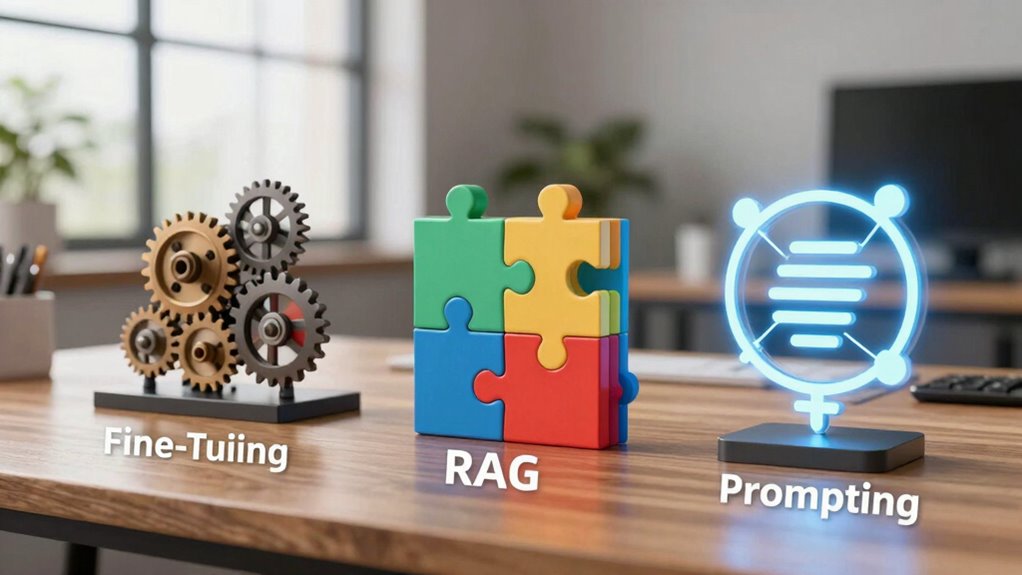
Choosing the right AI customization strategy hinges on understanding several key factors that directly impact your project’s success. First, consider the level of model customization you need; fine-tuning offers deep adjustments, while prompting relies on clever input design. Next, evaluate user personalization requirements—if tailoring responses to individual users is critical, methods supporting dynamic personalization are preferable. Also, assess your available resources and expertise: fine-tuning demands more data and technical skill, whereas prompting can be implemented quickly with less overhead. Additionally, understanding model reliability is essential to ensure consistent performance across different scenarios. It is also important to consider the degree of flexibility and scalability****, especially if your project requires ongoing updates or complex behaviors. Finally, think about the desired flexibility and scalability. If your project needs ongoing updates or complex behaviors, investing in model customization makes sense. Balancing these factors helps you select the most effective approach for your unique needs.
Final Tips: How to Implement and Combine These Methods Effectively

To implement and combine fine-tuning, RAG, and prompting effectively, start by clearly defining your project’s goals and constraints. This clarity guides your approach to model deployment and helps determine which method suits specific tasks. Incorporate user feedback early to identify strengths and weaknesses of each method, refining your strategy accordingly. Consider how these techniques can complement each other for ideal results.
- Evaluate which method aligns with your data and resources
- Test different combinations in controlled environments
- Monitor model performance continuously post-deployment
- Adjust prompts and fine-tuning based on real user input
- Balance automation with human oversight to improve accuracy
Frequently Asked Questions
Can Fine-Tuning Be Combined With RAG or Prompting Effectively?
Yes, you can combine fine-tuning with RAG or prompting effectively. Fine-tuning enhances domain adaptation by customizing models for specific tasks, while RAG and prompting help leverage external data and improve flexibility. Using data augmentation during fine-tuning boosts model robustness, making this combination powerful for tailored applications. Integrating these methods allows you to optimize performance, adapt to new domains, and generate more accurate, context-aware responses.
How Do Model Size and Complexity Influence Method Selection?
They say “bigger isn’t always better,” and that’s true with model size and complexity. Larger models offer more capacity for nuanced tasks, making fine-tuning or RAG more effective. But, complexity trade-offs include increased computational costs and slower deployment. Smaller models are faster and more efficient, often suitable for prompting. Choose based on your needs: bigger models excel at complex tasks, while smaller ones suit quick, resource-efficient applications.
What Are the Ethical Considerations for Each Approach?
You should consider ethical issues like bias mitigation and data privacy when choosing your approach. Fine-tuning might introduce biases if your training data isn’t diverse, so you must carefully curate data. RAG preserves privacy by using external sources, but verify these sources are secure. Prompting generally minimizes bias risks but can still leak sensitive info. Always evaluate how each method impacts fairness and confidentiality in your specific application.
How Do Updates and Maintenance Differ Across Methods?
You’ll find that updates and maintenance differ considerably across methods. Fine-tuning requires retraining the model regularly to guarantee stability, which can be time-consuming and resource-intensive. RAG systems need periodic updates to their knowledge base, maintaining model stability through careful integration. Prompting demands minimal updates, as you mainly tweak prompts for improved results, making it the most flexible with the highest update frequency, but potentially less stable over time.
Which Approach Offers the Best Scalability for Enterprise Deployment?
You’ll find prompting offers the best scalability for enterprise deployment, as it requires less model adaptation and handles large data volumes efficiently. With over 60% of companies prioritizing cost-effective solutions, prompting’s flexibility and minimal retraining make it ideal for rapid updates. Its ability to adapt quickly to new tasks without extensive fine-tuning guarantees you save on costs while maintaining high performance across diverse applications.
Conclusion
Choosing the right AI customization method is like finding the perfect tool for your craft—you need what fits your needs, budget, and timeline. Fine-tuning, RAG, and prompting each have their strengths, but none is one-size-fits-all. By understanding their differences and how they complement each other, you can build a powerful, tailored solution. Think of it as tuning a musical instrument—you’ll hit the right notes when you select the method that resonates best with your goals.