
🔍 Read the full analysis: Can Credits Become An Exhibition? AI In “After Action” on ThorstenMeyerAI.com

Get business pricing on tech for your team
- Business-only prices and quantity discounts
- Tax-exempt purchasing
- Multiple users, one account, clear invoices
TL;DR
After Action is an AI-built exhibition website that presents 24 fictional web experiences as productions in a continuous cinema-style credit roll, interrupted by small sand-table scenes. The source describes its design and accessibility features, but does not provide independent testing or evidence that all stated performance and responsive targets were verified.
After Action — Wing V Debrief Theater presents a collection of 24 fictional web experiences as a continuous film-credit sequence, interrupted by small, code-built sand-table scenes. The AI-built exhibition, described as live at the source’s cited web address, turns browsing into a staged finale rather than a conventional grid of project links, as detailed in the original analysis; its creator says it depicts no real company or military activity.
The exhibition’s central feature is a navigable credit roll listing the 24 sites as productions. Department-style headings frame the names as film credits, and chapter controls let visitors pause or jump between sections. The moving credits are accompanied by a separate, stationary linked register, which the source describes as an alternative way to reach the same material without following animated text.
After every eight productions, the sequence gives way to a miniature scene made with CSS-built terrain and markers. The described examples include a shield formation, a catapult’s arc and two keys moving toward a shared lock. These are presented as toy-scale visual motifs, not depictions of actual events. The site’s palette and typography are designed to evoke a cinema screening and a sand table, using black, projected white, amber and gold.
The source says JavaScript controls the timing and movement of the roll, synchronizing its time display, chapter label, locator and jump controls. Animation is intended to pause when the tab is hidden or the theater is not active; reduced-motion settings offer a manual-scroll alternative. The described build uses a local still image for its projected atmosphere because the intended ambient video was unavailable, while optional synthetic audio starts off and can be stopped.
A Different Way to Browse Digital Work
After Action makes the presentation format part of the exhibit. Rather than treating each website as a tile to click, it casts the collection as a sequence of productions, using pacing, chapter breaks and visual interludes to shape how visitors encounter it. That approach gives the collection a clear artistic frame while still supplying direct navigation.
The project also foregrounds a practical design question: how can a highly animated showcase remain usable? The stationary register, manual scrolling option and pause behavior are described as ways to provide alternatives to continuous motion. Those choices matter for visitors who use keyboard navigation or prefer reduced motion, although the source’s account alone does not establish how the site performs in independent accessibility testing.
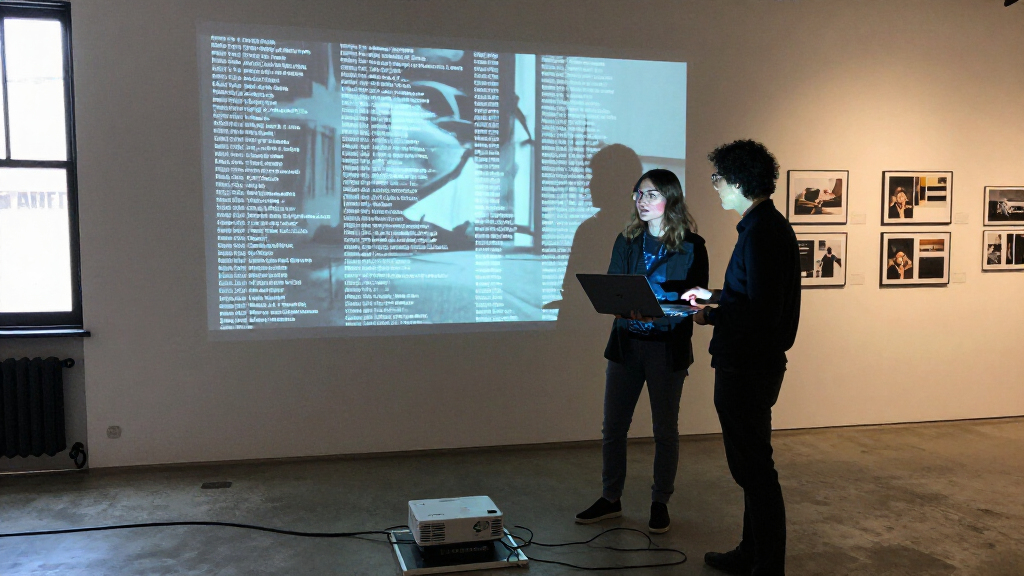
interactive web exhibition display
As an affiliate, we earn on qualifying purchases.
As an affiliate, we earn on qualifying purchases.
The Brief Behind the Theater
The source identifies After Action as room 125 of a planned 175 and says the piece was made from an art-direction brief for a single-page showcase. That brief called for a cinematic credit roll naming 24 sites, sand-table scenes between groups of credits, a final title card and a plain-text index. The fictional setting is explicitly described as a theater for imagined Wing V productions, not a record of military operations.
The brief also specified a lightweight implementation using HTML, CSS and JavaScript, with no frameworks, build step, content delivery networks or external requests. It set responsive, motion and accessibility goals, including layouts for three screen widths and keyboard-visible focus styles. The source describes some corresponding design choices, but does not include test results, screenshots from each width or independent verification that every target was met.
“War, staged. Craft, real. — WING V / FABLE 125”
— The exhibition’s art-direction brief
digital art installation equipment
As an affiliate, we earn on qualifying purchases.
As an affiliate, we earn on qualifying purchases.
What the Description Does Not Verify
The source describes the website as live and outlines how it is intended to work, but provides no independent audit or measured results for accessibility, frame rate, responsive behavior or browser compatibility. It is not clear whether every item in the original brief—including all three requested viewport checks and the documented critique passes—was completed or published.
The description also says the ambient video was unavailable in the build it discusses, with a local still image used instead. It does not establish whether that remains the current live behavior. The source does not give a launch date, visitor figures or details of the AI tools and human contributions involved beyond the wording in the brief.
As an affiliate, we earn on qualifying purchases.
Check the Live Exhibition
The next step for readers is to visit the live site cited by the source and compare its current behavior with the described design: the credit controls, stationary index, reduced-motion option and optional audio. No later release, update schedule or formal evaluation is announced in the material provided.
Any claims about performance or accessibility would need to be checked against the live page and tested with relevant devices and assistive settings. Until such evidence is available, the described features should be understood as the source’s account of the design, rather than independently verified results.
As an affiliate, we earn on qualifying purchases.
Key Questions
What is After Action?
It is an AI-built exhibition website that presents 24 fictional web experiences as productions in a cinema-style credit sequence.
Does the exhibition document real military activity?
No. The source explicitly describes Wing V as fictional and says the work is not an account of real military activity or a real company.
How can visitors navigate the moving credits?
The source describes pause and chapter-jump controls, plus a stationary linked register after the theater. It also says reduced-motion users can use manual scrolling.
Are the miniature scenes photographs or rendered military footage?
The described sand-table scenes are built with CSS, using tilted terrain, gradients and small markers. The source presents them as stylized visual miniatures.
Has the site’s accessibility or performance been independently tested?
The source lists design intentions such as pausing animation and supporting reduced motion, but provides no independent test results for accessibility, performance or responsive behavior.
Source: ThorstenMeyerAI.com
Fall Picks
fall essentials
As an affiliate, we earn on qualifying purchases.