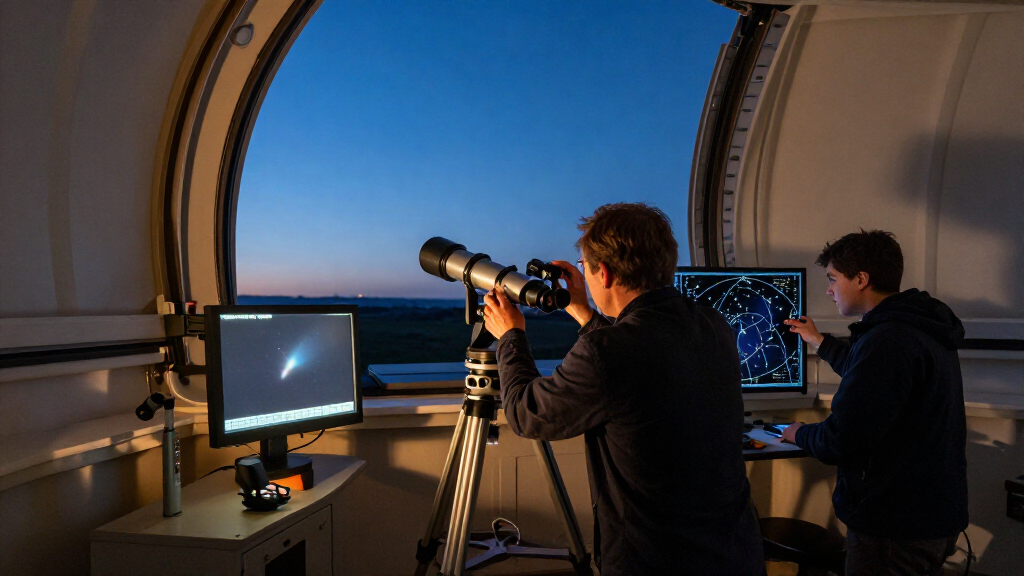

TL;DR
OORT is an AI-built artwork about a fictional observatory tracking the fictional comet P/2043 K1 Vesper. Its canvas gradually extends star trails as visitors stay, while saved local progress lets the scene resume on the same device. The comet, its orbit and its observing community are invented; the site presents no real astronomical discovery.
OORT, an AI-built artwork presented as an observatory for the fictional comet P/2043 K1 Vesper, turns time spent on its webpage into a visual record: star trails lengthen while visitors stay, then resume later on the same device, as described in the original analysis. The project’s central device, described as “held light,” makes waiting part of the experience rather than a pause before content.

Get business pricing on tech for your team
- Business-only prices and quantity discounts
- Tax-exempt purchasing
- Multiple users, one account, clear invoices
The site opens onto a dark, observatory-inspired scene. A canvas renders a seeded field of stars whose paths curve around a point below the visible frame. As elapsed time grows, the arcs extend along a logarithmic curve, making early changes apparent while allowing the image to keep developing during a longer visit. Because the field is seeded, the sky remains consistent on that device; local storage saves elapsed time so a return visit can continue the exposure.
Other elements also use time or interaction to change the scene. Scrolling moves a comet through an inline SVG: its ion tail points away from the sun, while its dust tail bends along the imagined orbit. Both respond to a shared progress value, which also keeps the displayed geometry, distance and year in step. A range control changes a defocused view and a related brightness estimate. The description says the animation pauses when the page is hidden and that visitors who prefer reduced motion receive a still version.
A visitor can hold a control briefly to open a simulated shutter. The site records a timestamp, but does not claim to reveal the comet: in the project’s fiction, it remains unseen and in transit. That choice makes the record one of attention, not an observation of a real celestial object. The source describes OORT as a single-page showcase made with HTML, CSS and JavaScript, with canvas and SVG providing its visuals.
Room 170 / Fictional Observatory
How Does “OORT — Comet Vigil For P/2043 K1 Vesper” Use Held Light?
OORT turns time spent on a page into the artwork. As visitors stay, star trails lengthen; saved progress lets the scene resume later on the same device. The comet and its observing history are fictional.
Time is the medium
A seeded star field gives the scene continuity. Its curved trails extend as the visit continues, with faster visible change early on and ongoing development over longer stays.
A consistent sky
The canvas renders stars from a seed, so the imagined field stays consistent on that device between visits.
Trails grow with time
Star paths curve around a point below the visible frame. A logarithmic progression makes early changes apparent while the trails keep developing.
Return to the vigil
Local storage preserves elapsed time, allowing the same device to continue the exposure when a visitor returns.
An illustrative progression
The description says trail length follows a logarithmic curve. These bars show the qualitative pattern, not measured values or a calibrated scale.
Conceptual illustration only; the source provides no numerical trail measurements.
A scene shaped by movement
Scrolling and controls connect the imagined comet’s passage with changing readings and views. Each interaction is part of the artwork’s fictional observatory.
Scroll through the passage
Scrolling advances an illustrated comet through inline SVG.
Follow the tails
The ion tail points away from the sun; the dust tail bends along the imagined orbit.
Adjust the view
A range control changes a defocused view and a related brightness estimate.
Mark attention
Holding the simulated shutter briefly records a timestamp, not a comet image.
What the vigil does—and does not—claim
OORT uses the language and atmosphere of astronomy to build a story. Its records describe attention inside the artwork, not verified observations of a celestial object.
A timestamp of attention
The simulated shutter records when someone chose to pay attention. The project description says the comet remains unseen and in transit; no image capture of it is described.
World-building details
“Last seen 1608,” observing notes, an ephemeris, coordinates, orbit, and brightness estimates belong to the fictional setting. The supplied material does not verify them against astronomical records.
P/2043 K1 Vesper is fictional. The supplied description reports no real astronomical discovery, observing campaign, or scientific milestone. This infographic summarizes that description and does not independently confirm the live website’s current behavior.
Instrument log meets long exposure
The art direction evokes a red-lit observing room and long-exposure photography. Its visual language helps make the fictional watch feel like an instrument record.
Night, cyan, ember
Deep black sets the scene; cyan marks the imagined ion tail and readings, while red-orange calls attention to instructions.
Display and coordinates
Dust-toned text, display lettering, and monospaced coordinates reinforce the feeling of a working observatory log.
Canvas and SVG
The supplied description identifies a single-page showcase built with HTML, CSS, and JavaScript, using canvas and SVG for its visuals.
From visitor to visible record
The experience links a personal visit to a persistent artwork, while keeping the fictional comet beyond the reach of the simulated shutter.
What visitors should know
Is P/2043 K1 Vesper a real comet?
No. The supplied project description identifies it as fictional and does not report a real astronomical discovery.
What does “held light” mean?
It describes star trails accumulating as time passes, with elapsed time saved locally so the scene can resume on that device.
Does the simulated shutter photograph the comet?
No capture is described. The control records a timestamp as a record of attention; the comet remains unseen in the artwork.
How does the comet move through the scene?
Scrolling advances an SVG illustration. The ion tail points away from the sun, and the dust tail curves along the imagined orbit.
What happens on a return visit?
The seeded star field stays consistent on the same device, and locally saved elapsed time lets the trails continue.
What about motion preferences?
The supplied description says animation pauses when the page is hidden and a still version is offered to visitors who prefer reduced motion.
How Waiting Becomes the Artwork
OORT makes duration visible. A visitor’s time on the page changes the artwork itself, with each longer stay extending the star trails. Saving progress on the device gives the image continuity across visits, so the experience is framed as an ongoing watch rather than a one-time reveal.
The distinction between a recorded visit and a real astronomical sighting matters. The shutter interaction logs when someone chose to pay attention, but the source says the comet remains unseen. The site’s claims about a comet, its orbital path, observers and historical provenance belong to its fictional setting; they are not evidence of an object under real-world observation.
Products Worth Considering

Apple Watch SE 3 GPS 44mm Smartwatch

DJI Osmo Mobile 8 Phone Gimbal with Mic Mini Transmitter, Infinity Black

Bose QuietComfort Ultra Earbuds (2nd Gen), Wireless Noise-Cancelling Earbuds with Immersive Audio and Wireless Charging Case, Black
As an affiliate, we earn on qualifying purchases.
Inside OORT’s Fictional Observatory
The project imagines an observatory and a community keeping watch over P/2043 K1 Vesper across decades. Its art direction invokes red-lit observing rooms and long-exposure photography: deep black sets the scene, cyan marks the imagined ion tail and readings, and red-orange highlights instructions. Dust-toned text, display lettering and monospaced coordinates give the interface the feel of an instrument log.
The supplied material also describes fictional observing notes, an ephemeris table, a brightness-estimation control and a “last seen 1608” provenance. These details help establish the setting; the source does not present them as verified records or astronomical data. It identifies the room as number 170 in a 175-room exhibition and says the live site exposes its original art-direction prompt through a footer link.
““The page makes duration part of the artwork instead of treating it as time spent before the content.””
— The OORT project description
What the Site Does Not Establish
The supplied description gives no publication date, authorship details beyond saying the room was AI-built, or independent assessment of how the site performs across devices. It also does not provide a way to verify the fictional comet’s coordinates, orbit, brightness estimates or “last seen 1608” provenance against real astronomical records. Those elements should be understood as part of the artwork’s premise.
The source points to a live site and describes its behavior, but this report is based on the supplied text; it does not independently confirm the current state of the webpage or its controls.
The Vigil Continues on Return
Within the artwork, the next change comes from the visitor: staying longer extends the trails, and returning on the same device resumes the saved scene. Scrolling advances the comet’s illustrated passage, while holding the shutter control creates a timestamped record. The source names no scheduled update, real-world observing campaign or scientific milestone for P/2043 K1 Vesper.
Key Questions
Is P/2043 K1 Vesper a real comet?
The supplied project description calls it a fictional comet. It does not report a real astronomical discovery.
What does “held light” mean in OORT?
It refers to the canvas accumulating star trails as time passes. The site also saves elapsed time locally so the same scene can resume on a return visit to that device.
Does the simulated shutter capture an image of the comet?
No such capture is described. The control records a timestamp as a record of attention; the project says the comet remains unseen and in transit.
How does the comet animation respond to scrolling?
Scrolling moves an illustrated comet through an inline SVG. The ion tail points away from the sun, while the dust tail follows a curved path along the imagined orbit.
What happens when a visitor returns to the site?
The description says the seeded star field stays consistent on the device and local storage preserves elapsed time, allowing the trails to continue from the earlier visit.
Source: Thorsten Meyer AI