🔍 Read the full analysis: A 2027 Guide To 9 External GPUs For AI on ThorstenMeyerAI.com

Get business pricing on tech for your team
- Business-only prices and quantity discounts
- Tax-exempt purchasing
- Multiple users, one account, clear invoices
TL;DR
ThorstenMeyerAI.com’s 2027 guide discusses nine external GPU solutions and says interface bandwidth, cooling, power, and upgradeability are key buying factors. Its supplied material names only five products or product lines, so a verified nine-item comparison cannot be reconstructed from the available information.
ThorstenMeyerAI.com’s 2027 guide, the original analysis, compares external GPUs for AI and other demanding workloads, highlighting bandwidth, cooling, power needs, and upgradeability. The supplied text names the Razer Core X V2, Plugable Thunderbolt 5 AI eGPU Enclosure, NIMO, and BOSGAME product lines, but it does not provide nine distinct, fully identified picks or enough test results to verify a definitive ranking.
The guide recommends the Razer Core X V2 for most users, describing it as reliable and broadly compatible, and singles out Plugable’s Thunderbolt 5 enclosure for users seeking higher throughput, topics also covered in this guide to choosing external GPUs for AI. These are the source’s assessments; the supplied material includes no independent benchmark results, test setup, prices, or named compatibility list to substantiate the recommendations.
Its main comparison is between Thunderbolt and USB4 V2 connections, which it says offer more bandwidth than older Thunderbolt 3 and 4, and OCuLink, which the source describes as a native PCIe connection with lower latency but limited device availability, considerations relevant to external GPUs for AI projects. The guide also contrasts empty enclosures, which let buyers install a separate graphics card, with integrated eGPU units that are easier to set up but cannot be upgraded by swapping the GPU.
The source says power supply requirements and thermal design affect everyday use. Larger power supplies can add weight and bulk, while compact metal enclosures may have less airflow and could throttle under sustained load. It does not provide measured temperatures, noise levels, power figures, or product-by-product results.
The 9 picks
- 1
 BOSGAME eGPU Graphic Card Dock Expansion Card with Radeon RX 7600M XT 8GB GDD…View on Amazon →
 - 2
 NIMO External GPU Docking Station with AMD Radeon RX 7600M XT 8GB GDDR6View on Amazon →
 - 3
 Plugable Thunderbolt 5 AI eGPU Enclosure & Dock: 80Gbps, TAA CompliantView on Amazon →
 - 4
 Razer Core X V2 External Graphics Enclosure (eGPU)View on Amazon →
 - 5
 MINISFORUM DEG2 USB4 V2 (TBT5 Compatible) & OCuLink eGPU Dock, 80Gbps Dual-Li…View on Amazon →
 - 6
 MINISFORUM DEG1 eGPU Dock – External GPU Docking Station for RTX 4090 & AMD R…View on Amazon →
 - 7
 OwlTree Graphics Card eGPU Dock for Thunderbolt 3/4 USB 4, with 60cm CableView on Amazon →
 - 8
 OCuLink eGPU Dock – PCIe 4.0 x4 (64 Gbps) ATX External GPU EnclosureView on Amazon →
 - 9
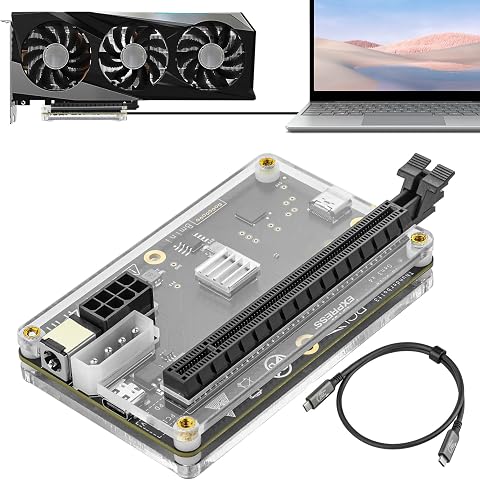 PCIe 3.0 x16 22Gbps eGPU Dock with Thunderbolt 4 Cable (compatible NVIDIA/AMD…View on Amazon →
Bandwidth, Cooling and Upgrade Trade-offs
External GPUs can let a compatible laptop use a desktop or mobile graphics processor without replacing the computer. For AI workloads, the connection matters because data must move between the host system and the GPU; a faster advertised link may reduce one bottleneck, but it does not by itself establish real-world model performance or value.
The choice also affects the system’s useful life and portability. An empty enclosure can preserve the option to replace the GPU later, but requires buyers to account for the card, power supply, and space. An integrated unit may be simpler to carry and connect, while fixing the user to its included GPU. The guide’s practical message is that interface speed should be weighed alongside cooling, compatibility, and total cost.
How External GPU Connections Differ
The guide frames its recommendations around three factors: bandwidth potential, compatibility, and thermal efficiency. It gives Thunderbolt 3 and 4 a 40Gbps link rate and says Thunderbolt 5 and USB4 V2 offer up to 80Gbps. It describes OCuLink as PCIe 4.0 x4, or 64Gbps. These are interface figures stated in the source, not measurements of usable GPU performance; actual results can vary with hardware and workload.
Compatibility depends on the computer as well as the enclosure. The source notes that OCuLink requires a matching port, while Thunderbolt and USB4 support is not universal across all laptops and operating systems. It also says an external GPU may require driver or firmware configuration. The text refers to integrated NIMO and BOSGAME units and gives an RX 7600M XT as an example, but does not state which exact models include that GPU.
“The primary tradeoff remains between the convenience of Thunderbolt connections and the higher performance ceiling of OCuLink or USB4 V2 solutions.”
— ThorstenMeyerAI.com guide
Missing Picks and Test Evidence
The available source text does not list all nine promised options. It names two enclosures and two integrated-product lines, but does not identify enough distinct models to produce nine accurate product sections. It also does not include the full comparison table, current prices, test methods, benchmark results, or dated compatibility checks.
Claims about reliability, broad compatibility, performance loss, and thermal throttling are not accompanied by cited tests in the supplied material. The listed bandwidth figures describe connection standards; they should not be read as guaranteed data rates or as proof that a particular eGPU will accelerate a given AI task. Readers should verify exact model specifications and host-device support before buying.
Verify Models Before Buying
A complete nine-product comparison would need the missing model names and product-specific details, including GPU configuration, power delivery, supported host ports, dimensions, pricing, and test results. Until those details are available, the source supports a comparison of buying factors and a few named products, not a substantiated ranking of nine distinct eGPUs.
Buyers considering an enclosure should check the laptop’s ports and operating-system support, the graphics card’s physical fit and power draw, and whether the enclosure can charge the laptop. For AI use, they should also look for workload-specific benchmarks rather than relying only on interface bandwidth. The guide’s publication date and the prices or availability of its named products are not specified in the supplied text.
Key Questions
Which external GPU does the guide recommend for most users?
The source recommends the Razer Core X V2, citing reliability and broad compatibility. It provides no benchmark data or detailed compatibility list to independently verify that assessment.
What does the guide say about Thunderbolt 5 and USB4 V2?
It says both offer up to 80Gbps, compared with 40Gbps for Thunderbolt 3 and 4. Those figures describe interface bandwidth in the source and do not guarantee a particular eGPU’s real-world performance.
Why might someone choose OCuLink?
The guide describes OCuLink as a direct PCIe connection with a high theoretical bandwidth and lower latency than Thunderbolt. It also says the option is limited to computers with a compatible port.
Are all nine products identified in the available guide text?
No. The supplied material names the Razer Core X V2, Plugable Thunderbolt 5 AI eGPU Enclosure, and NIMO and BOSGAME product lines, but does not identify nine distinct models.
What should buyers check before choosing an eGPU?
Check host-port compatibility, the enclosure’s supported GPU size and power, laptop charging support, cooling, and whether the GPU is replaceable. For AI workloads, seek benchmarks for the relevant software and tasks.
Source: ThorstenMeyerAI.com
Fall Picks
fall essentials
As an affiliate, we earn on qualifying purchases.