
TL;DR
Anthropic announced Claude Meetings on November 12, 2026, a beta that joins Google Meet calls to transcribe, answer questions and create documents during the meeting. Team and Enterprise settings differ, and Anthropic’s published material does not specify how long meeting records are retained or what artifact creation will cost after February 10, 2027.
Anthropic announced Claude Meetings on November 12, a beta feature that joins Google Meet calls as a visible participant to transcribe discussion, answer questions and create documents, whiteboards or slides. The feature is available to Team and Enterprise customers, but its defaults differ by plan: Team has it on by default, while Enterprise owners must enable it, making a review of organization settings relevant before teams use it.

Get business pricing on tech for your team
- Business-only prices and quantity discounts
- Tax-exempt purchasing
- Multiple users, one account, clear invoices
Anthropic’s Help Center says Claude keeps a transcript, summary and screen descriptions, but not the meeting’s audio. It joins after someone adds it from a connected Google Calendar or enables personal auto-join. A notice is posted in the call chat, and answers Claude provides there are visible to everyone in the meeting. Anthropic says a session can last up to eight hours.
During a call, participants can ask Claude to create an artifact, such as a document or whiteboard, on the meeting page. It can also use connected tools, such as Slack, with the relevant person’s permission. Anthropic says it asks the first time and that approval applies going forward. After the call, colleagues on the invitation receive a recap email; guests do not.
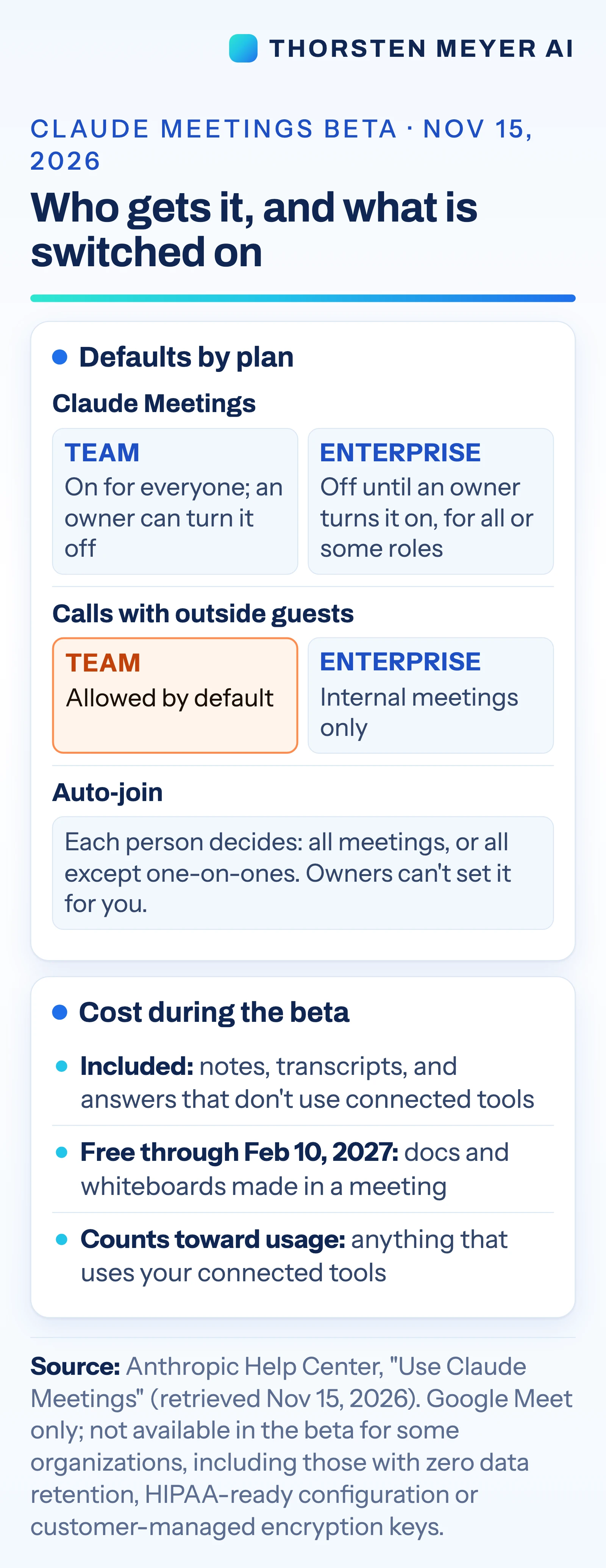
On Team plans, Claude Meetings is on by default and outside guests are allowed by default. On Enterprise, it is off until an owner enables it and is limited to internal meetings by default. If outside guests are disallowed and one joins, Claude leaves. If guests are allowed, Claude takes notes but does not reply in chat. Anthropic says users should make sure everyone on the call agrees to being transcribed.
Meeting Settings Shape Who Is Included
The feature combines live transcription, meeting artifacts and connected tools in a single call. That can make meeting work easier to carry forward, but it also means administrators and users need to understand which meetings Claude can join, what gets recorded and who can see its chat responses.
The different defaults matter for organizations with mixed internal and external calls. A Team user may encounter a broader default guest setting than an Enterprise user. Individual auto-join is a personal setting, Anthropic says, and organization owners cannot set it for each user. The company also says it is the user’s responsibility to confirm participants are comfortable with transcription. These details place practical responsibility on teams to review settings and meeting expectations before using the beta.
Products Worth Considering

Bose TV Speaker Compact Soundbar with Bluetooth and HDMI-ARC, Black

Samsung 37-inch Odyssey G7 4K UHD Curved Gaming Monitor

Anker SOLIX C1000 Gen 2 Portable Power Station with 100W Solar Panel
As an affiliate, we earn on qualifying purchases.
Google Meet Beta and Plan Access
Anthropic describes the feature as a beta for Team and Enterprise plans, available in Claude and Claude Desktop. Google Meet is the supported platform at launch; the company says support for other platforms is coming soon, without giving a date in the material reviewed on November 15.
Some organizations cannot use the beta, including those with zero data retention, HIPAA-ready configuration or customer-managed encryption keys. Notes, transcripts and answers are included in Team and Enterprise plans. Documents and whiteboards made during meetings are free through February 10, 2027; use of connected tools counts toward usage.
Anthropic’s example describes a team planning a customer event: Claude drafts a document during the call and can look up a prior event cost after asking for permission. The example illustrates the company’s intended workflow; it does not establish how the beta performs across organizations or meeting types.
““takes the notes, answers questions, and builds artifacts, such as docs, whiteboards, and slides, live during the call””
— Anthropic Help Center, “Use Claude Meetings”
Retention and Pricing Details Remain Open
Anthropic’s announcement and Help Center material reviewed on November 15 do not state how long meeting records are retained. They also do not give a price for documents and whiteboards after February 10, 2027, or a launch date for platforms beyond Google Meet. The available information does not specify when those points will be clarified.
The company describes which records are saved and how guest settings work, but the material does not resolve every organization’s policy or compliance questions. Customers will need to check their own configuration and applicable internal rules before deciding whether to use the beta for particular meetings.
Watch for Platform and Pricing Updates
Anthropic says support for other meeting platforms is coming soon, but has not published a schedule. Organizations considering the beta can review the Team or Enterprise defaults, calendar connection, guest access and individual auto-join settings before adding Claude to calls.
Customers will also need to look for Anthropic’s guidance on record retention and any pricing after February 10, 2027. Until those details are published, the beta’s long-term costs and the period meeting records remain available are unresolved.
Key Questions
What is Claude Meetings?
It is an Anthropic beta that joins Google Meet as a visible participant to transcribe calls, answer questions and create documents, whiteboards or slides.
Which plans can use the beta?
Anthropic says Claude Meetings is available to Team and Enterprise customers in Claude and Claude Desktop. Some organizations, including those with zero data retention or HIPAA-ready configuration, are excluded during the beta.
Does Claude save meeting audio?
No. Anthropic says it saves a transcript, summary and screen descriptions, not audio.
What should an organization review before using it?
Check the plan’s defaults for enabling Claude Meetings and allowing outside guests, along with calendar access and personal auto-join settings. Anthropic says users should confirm that everyone on the call agrees to transcription.
What details has Anthropic not published?
The material reviewed does not give a retention period for meeting records, the price for documents and whiteboards after February 10, 2027, or a date for support beyond Google Meet.
Source: Thorsten Meyer AI