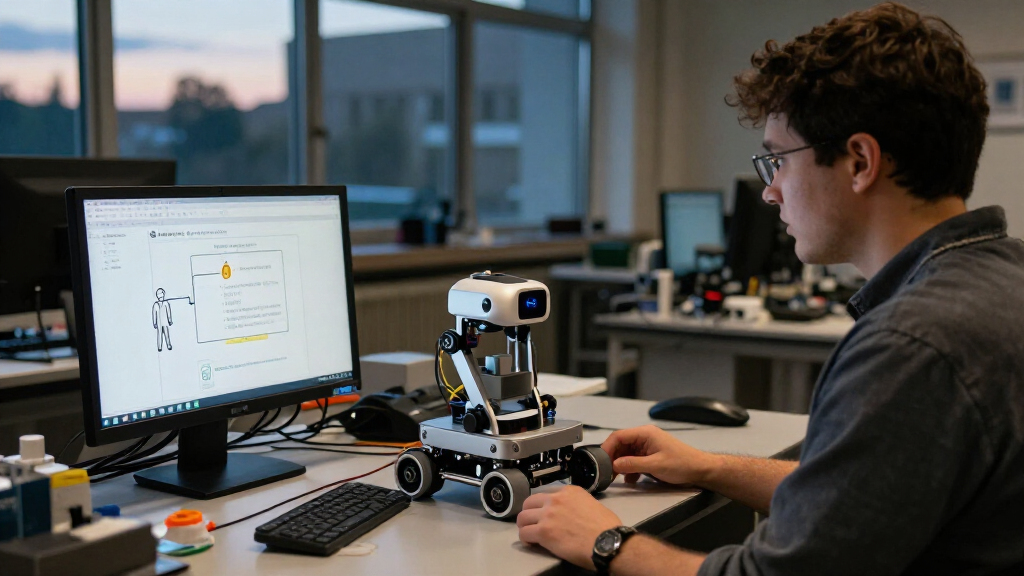
🔍 Read the full analysis: Where Do Scientists Draw The Line On AI Agents? on ThorstenMeyerAI.com

Get business pricing on tech for your team
- Business-only prices and quantity discounts
- Tax-exempt purchasing
- Multiple users, one account, clear invoices
TL;DR
A Hugging Face report drawing on interviews with 17 scientists says AI agents used in research should be judged on more than task completion. Researchers identified five conditions—validation, privacy, objectivity, accountability and transparency—while proposed evaluations are still under development.
A Hugging Face report based on interviews with 17 scientists says research AI agents should be evaluated not only on whether they finish tasks, but also on whether their work can be checked and responsibly used. Interviewees identified validation, privacy, objectivity, accountability and transparency as conditions for responsible use; the report’s proposed tests are not yet validated safeguards or established standards.
The interviewees worked across the natural, applied and social sciences. They described possible uses for agents in processing large datasets, writing code, documenting experiments and handling repetitive administrative work. Participants said automation could give researchers more time for fieldwork, mentoring and developing ideas, and could help analyze data that is too large for manual review.
Those potential benefits come with a need to inspect an agent’s process. The report says scientists raised concerns that an agent could make subtle errors confidently, omit studies that contradict a claim or select evidence that favors a preferred hypothesis. Researchers may also need to establish whether the system followed the requested method and which sources, files or other information it accessed.
The authors outline possible evaluations rather than completed benchmarks. A literature-review test could check for unsupported claims or missing contradictory evidence; a coding test could examine whether an agent accesses files outside its authorized scope. Data-processing tests could compare an agent’s methods and results with established human workflows. The report does not say these tests have been built, adopted or shown to prevent mistakes.
Where Scientists Draw The Line On AI Agents
Scientists say research agents should be judged by how they work, not just whether they finish a task. Researchers need ways to verify results and remain responsible for them.
Five conditions for responsible use
The report says these conditions matter when researchers rely on agents in scientific work.
Validation
Check claims against sources and look for missing or conflicting evidence.
Privacy
Know what information an agent accesses, especially in work involving people.
Objectivity
Watch for evidence selected to support a favored hypothesis.
Accountability
Researchers remain responsible for how studies are conducted and reported.
Transparency
Inspect the methods, sources and files used to produce a result.
Where agents could help
Participants saw potential for delegating time-consuming research work.
What proposed evaluations could check
The report suggests tests tailored to research tasks.
Check for unsupported claims and overlooked contradictory studies.
See whether an agent accesses files outside its authorized scope.
Compare processing methods and results with established human workflows.
Potential gains and duties
- More time for fieldwork, mentoring and developing ideas
- Examine datasets too large for manual review
- Verify evidence and methods
- Protect sensitive data and manage access
- Stand behind findings presented
Why Research Needs More Than Task Scores
The report focuses attention on a distinction that matters when AI systems contribute to scientific work: a plausible output is not necessarily a reliable research result. Scientists may need to reproduce an analysis, confirm that evidence supports a claim and document how data was handled. If an agent’s steps cannot be inspected, a task-completion score alone may not show whether the work is fit for use.
There are also responsibilities that do not disappear when work is delegated to software. The report connects agent use with privacy and access protections for research involving people, as well as physical limits and hazardous materials in laboratory settings. Researchers remain accountable for how a study is conducted and for the findings they present. For developers and institutions, the five dimensions offer questions to address when designing, testing and reviewing research tools, but the interviews do not show that any framework will prevent errors.
Products Worth Considering

DJI Osmo Action 4 Essential Combo Waterproof 4K Action Camera

Bose QuietComfort Wireless Noise Cancelling Headphones, Sandstone

LG UltraGear 32-inch QHD Curved Gaming Monitor, 180Hz, 1ms, AMD FreeSync
As an affiliate, we earn on qualifying purchases.
From Model Safety to Research Practice
The report’s authors say their interest grew from work evaluating the safety of models developed at Ai2. They describe existing safety work on scientific applications as often emphasizing catastrophic risks in areas such as biology and nuclear physics. Their interviews turn toward a practical question: whether agents follow the standards of responsible research in the specific fields where they are used.
The scientists were recruited through a researcher network established in earlier survey work. The authors asked where participants would welcome agent assistance, what could go wrong and what protections would make them comfortable using agents. They present the interviews as a way to inform AI development, not as a representative survey of the scientific community. Participants also expressed mixed views about AI’s longer-term effects: some anticipated faster scientific progress, while others worried about the future role of human scientists. Training and the creation and enforcement of guidelines were identified as timely needs.
““Responsible science is about more than accuracy.””
— Hugging Face report authors
What the Interviews Cannot Establish
The report does not provide evidence that the 17 interviewees represent scientists across disciplines or institutions, and it does not establish how common each concern is. The source material also does not include interview transcripts or detailed participant demographics. The findings should therefore be read as themes from a small interview group, rather than a measurement of scientific consensus.
Practical questions remain open: how evaluations should be designed, who should run them and whether results would affect deployment. The report does not set a single policy for documenting AI-assisted work, reviewing it institutionally or managing access to sensitive data. Its suggested tests are proposals for development, not proof that agents currently meet the five conditions.
Developing Tests With Scientists
The authors describe a participatory benchmark, shaped with scientists who can define field-specific practices and safety requirements, as a longer-term goal. They say the next direction is to make scientific tools’ behavior and limitations easier to inspect and to evaluate whether systems follow standards relevant to their fields.
Those evaluations will need to be developed with researchers before their usefulness can be judged. Institutions and research teams will also need guidance on checking and disclosing AI-assisted work, alongside training and enforceable guidelines. The report does not give a release date for benchmarks or a timeline for adopting policies, so it remains unclear when these proposals might become operational.
Key Questions
What did the scientists say AI agents need for research use?
The 17 interviewees identified validation, privacy, objectivity, accountability and transparency as conditions to address. The report does not claim that all scientists share these priorities.
What research work might agents perform?
Participants saw potential for agents to process large datasets, write code, document experiments and handle repetitive administrative tasks. These were described as possible uses, not proof that agents perform them reliably.
Have the proposed safety tests been adopted?
No. The report describes possible evaluations, including tests for unsupported literature-review claims and unauthorized file access. It does not say the benchmarks have been built, validated or adopted by institutions.
Does the report represent scientists generally?
The report is based on interviews with 17 scientists recruited through a researcher network. The authors present it as input to AI development, not as a representative survey of the scientific community.
Primary source: Hugging Face · via ThorstenMeyerAI.com