To build a KPI tree executives understand, start by clearly aligning metrics with strategic goals, keeping the structure simple and hierarchical. Focus on the most impactful KPIs, visualize them with clear charts and color coding, and use familiar business language to explain each element. Avoid clutter by limiting metrics to what truly matters, and validate your data regularly. If you follow these steps, you’ll create an intuitive KPI tree that drives quick decision-making—more tips await as you explore further.
Key Takeaways
- Use clear, business-focused language to translate technical KPIs into familiar strategic terms.
- Prioritize and visually highlight critical metrics to draw executive attention.
- Organize KPIs hierarchically, linking high-level goals to supporting metrics for logical flow.
- Simplify visuals with dashboards, color coding, and minimal clutter for quick comprehension.
- Validate data accuracy regularly and incorporate stakeholder feedback to refine the KPI structure.
Why a Simple KPI Tree Helps Executives Make Faster Decisions

A simple KPI tree streamlines complex data, allowing you to quickly identify key performance areas. Effective data visualization makes it easier to interpret performance metrics at a glance, reducing confusion and saving time. When your KPI tree is straightforward, stakeholders stay engaged because they can see how their efforts impact overall goals. Clear visuals help communicate progress and identify issues promptly, enabling faster decision-making. Engaged stakeholders are more likely to trust and act on the data, fostering collaboration. This simplicity prevents information overload, so you won’t waste time sifting through irrelevant details. Additionally, leveraging cloud infrastructure ensures your KPI data remains accessible and scalable as your organization grows. Incorporating relevant metrics aligned with your strategic objectives further enhances clarity and focus. Furthermore, understanding the astrological influences on decision-making can add an insightful dimension to strategic planning. Recognizing the importance of data accuracy helps maintain trust in your metrics, ensuring that decisions are based on reliable information. Implementing visualization best practices can also enhance comprehension and engagement across teams. Ultimately, a clean, visual KPI tree empowers you to respond swiftly to changes, aligning your team’s actions with strategic objectives and driving better results.
What Are the Main Parts of Your KPI Tree?

Ever wonder what makes a KPI tree effective for tracking performance? The main parts include clear KPI categories, specific metrics, and visual elements like data visualization tools. Your KPI categories should align with your strategic goals, ensuring KPI alignment across departments. Each metric needs to be measurable and relevant, providing insights into performance. Data visualization plays a vital role by translating complex data into understandable visuals, helping executives quickly grasp progress. The structure of your KPI tree should clearly show how high-level goals connect to specific metrics, making it easier to spot areas needing improvement. Additionally, understanding how to care for it and live with your KPIs can enhance their usefulness and sustainability over time. Incorporating visualization tools can further simplify complex data, making insights more accessible. Recognizing the importance of performance measurement ensures your KPI tree remains aligned with evolving organizational priorities. By focusing on these core parts, your KPI tree becomes a powerful tool for monitoring progress and making informed decisions, especially when these elements are supported by a comprehensive data strategy.
How to Identify the Key Elements of Your KPI Tree

To identify the key elements of your KPI tree, start by defining your core business goals. Then, pinpoint the critical metrics that directly measure progress toward those goals. Finally, map out the relationships clearly to guarantee each metric aligns and contributes to your overall strategy. Incorporating visual tools like field‑of‑view and imaging‑scale examples can help clarify complex relationships and make your KPI tree more intuitive.
Define Core Business Goals
How do you pinpoint the core business goals that will shape your KPI tree? Start by ensuring your goals align with your overall business strategy, creating strong business alignment. Clarify what success looks like, focusing on specific outcomes rather than vague ambitions. Engage stakeholders to gain diverse perspectives and validate priorities. Focus on high-impact areas that directly influence growth, efficiency, or customer satisfaction. Keep goals concise and measurable, providing clear goal clarity for everyone involved. Avoid overloading your team with too many objectives; instead, prioritize the most critical. This focused approach helps you build a KPI tree rooted in essential business goals, making it easier to track progress and communicate priorities effectively across your organization.
Identify Critical Metrics
Identifying the critical metrics that comprise your KPI tree is essential for measuring progress effectively. Start by analyzing your core business goals and determine which metrics directly influence them. Use data segmentation to break down large datasets into meaningful groups, revealing specific areas needing attention. This helps you focus on metrics that truly matter. Additionally, leverage metric benchmarking to compare your performance against industry standards or competitors, ensuring your KPIs are relevant and attainable. Prioritize metrics that are actionable and can be influenced by your team’s efforts. Avoid tracking too many metrics; instead, select those that provide clear insights into performance and progress toward your goals. This focused approach ensures your KPI tree remains practical, aligned, and easy for executives to understand and act upon.
Map Relationships Clearly
Mapping relationships clearly is crucial for understanding how your key metrics interconnect and influence one another within your KPI tree. To do this effectively, focus on establishing a clear data hierarchy that reflects the cause-and-effect relationships between metrics. This ensures each KPI’s role is transparent and logical. Consider these steps:
- Identify primary metrics that drive overall performance and position them at the top.
- Break down these metrics into supporting sub-metrics, creating a logical flow.
- Use visual clarity techniques, like color coding or connectors, to illustrate relationships and dependencies.
- Incorporate performance metrics to track how each element impacts overall success and make adjustments accordingly. Recognizing causal relationships within your data helps highlight which metrics truly influence outcomes and guides strategic decision-making.
Transform Complex Data Into Clear KPI Visuals
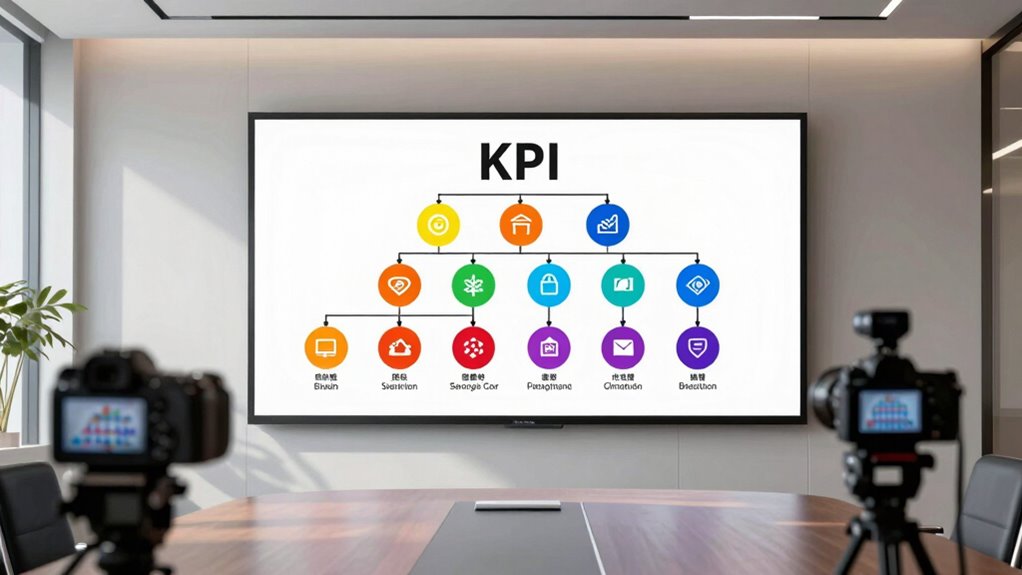
You can make complex data more accessible by simplifying your visuals and avoiding clutter. Use clear color coding to distinguish key metrics quickly and guarantee your audience understands the most important insights at a glance. Highlighting key metrics helps focus attention where it matters most, making your KPI visuals more effective. Incorporating visual hierarchy principles ensures that your most critical data stands out clearly.
Simplify Data Visuals
Transforming complex data into clear KPI visuals is essential for effective decision-making. To achieve this, focus on visual simplification to enhance data clarity. First, eliminate unnecessary details that distract from key insights, ensuring visuals are streamlined. Second, use simplified charts like bar graphs or line charts instead of complex diagrams, making trends easier to spot. Third, prioritize clarity over aesthetics by choosing straightforward layouts and avoiding clutter. This approach helps your audience quickly grasp critical metrics without confusion. Remember, the goal is to present data in a way that’s immediately understandable, enabling faster decisions. Clear visuals cut through noise, making your KPI reports more impactful and actionable for executives.
Use Clear Color Coding
Have you ever noticed how confusing it can be to interpret data visuals with inconsistent or poorly chosen colors? Clear color coding enhances visual clarity, making KPIs easier to understand at a glance. Use distinct, meaningful colors to represent different statuses or categories, such as green for good, red for issues, and yellow for caution. Here’s a simple example:
| KPI Status | Color |
|---|---|
| On track | Green |
| At risk | Yellow |
| Off track | Red |
| Pending | Gray |
| Achieved | Blue |
This consistent approach helps your audience quickly grasp performance levels without confusion, ensuring your KPI visuals communicate effectively and support swift decision-making. Incorporating visual storytelling techniques can further enhance comprehension by making complex data more engaging and memorable. Additionally, using visual hierarchy principles ensures that the most important information stands out, guiding viewers’ attention naturally. Applying consistent color schemes is essential for maintaining clarity and avoiding misinterpretation across different reports and dashboards. Moreover, understanding the significance of color contrast can improve accessibility for viewers with visual impairments, ensuring everyone can interpret the data accurately. Being aware of color-blind friendly palettes can also help design visuals that are inclusive for all viewers.
Highlight Key Metrics
Ever wonder how to make complex data instantly understandable? Highlighting key metrics simplifies your KPI visuals, making them accessible for everyone. Focus on data accuracy to guarantee stakeholders trust the information and make informed decisions. To effectively highlight these metrics:
- Select the most impactful KPIs aligned with strategic goals.
- Use clear visuals like charts or dashboards that emphasize these metrics visually.
- Regularly update your visuals to reflect the latest data, maintaining stakeholder engagement and trust.
This approach ensures your KPI tree isn’t cluttered with irrelevant data and clearly communicates priorities. When key metrics stand out, your team can quickly grasp performance insights and act accordingly. Prioritizing data accuracy and engagement guarantees your visuals remain meaningful, fostering confidence among stakeholders.
Prioritize KPIs to Highlight What Matters Most to Executives

To effectively communicate what matters most to executives, you need to prioritize KPIs that align with strategic goals and provide clear insights. Focus on data granularity to guarantee each KPI offers actionable information without overwhelming detail. Too much granularity can obscure the bigger picture, so select KPIs that reflect key performance areas. Utilize KPI automation to streamline data collection and reporting, freeing up time for analysis and decision-making. Automating KPIs also helps maintain consistency and accuracy, making it easier for executives to trust the numbers. Prioritization means highlighting the metrics that directly impact strategic objectives, rather than overwhelming your dashboard with every available data point. This targeted approach ensures executives see what truly matters, enabling faster, more informed decisions. Incorporating practical methods from kitchen fundamentals can help clarify complex data concepts for better understanding and facilitate effective decision-making processes. Additionally, applying visualization techniques can enhance data clarity, making KPI insights more accessible and impactful for executive review. Incorporating data simplification strategies can further improve comprehension and support quicker, more confident decisions. Employing standardized terminology also ensures everyone interprets the KPIs consistently, reducing confusion and aligning focus across teams.
How to Speak Your Executives’ Language in Your KPIs

Aligning your KPIs with the language your executives use makes your reporting more impactful. To do this, you must translate technical terminology into familiar business jargon. Start by: 1. Identifying key terms your leaders use, such as “bottom-line growth” instead of “net profit margin.” 2. Framing KPIs around strategic goals, like replacing “customer retention rate” with “client loyalty.” 3. Simplifying complex data into clear, actionable insights that resonate with business priorities. Additionally, incorporating concepts like water-based activities can help illustrate how operational metrics relate to overall business health.
Create an Intuitive, Easy-to-Follow KPI Tree

To make your KPI tree effective, you need to guarantee metrics clearly with your goals. Simplify complex data and use visual tools to help your team grasp insights quickly. An intuitive design ensures everyone can follow the story your KPIs tell.
Align Metrics With Goals
Creating an intuitive KPI tree starts by guaranteeing your metrics directly reflect your strategic goals. To do this, focus on three key steps.
- Confirm data accuracy: Reliable data ensures your metrics truly represent performance, preventing misguided decisions.
- Benchmark against standards: Use benchmarking standards to compare your metrics with industry leaders, setting realistic targets.
- Align metrics with goals: Each KPI should directly connect to specific objectives, ensuring clarity and focus. This alignment helps you prioritize efforts and avoid tracking irrelevant data. When metrics mirror your strategic aims and adhere to accurate, standardized data, your KPI tree becomes a powerful tool for decision-making. Clear alignment simplifies communication, keeps everyone focused, and promotes accountability across your organization.
Simplify and Visualize Data
Once your metrics are aligned with your strategic goals, the next step is to simplify and visualize the data to make it easily understandable. Use data dashboards that display key KPIs at a glance, reducing complexity and highlighting critical insights. Visual elements like charts, graphs, and color coding help convey information swiftly, making it easier for executives to grasp performance trends. Incorporate KPI benchmarks to set clear performance standards and identify areas needing attention. An intuitive KPI tree should be organized hierarchically, with high-level metrics leading to more detailed data, creating a logical flow. This approach ensures that your data remains accessible, enabling quick decision-making without wading through unnecessary details. Keep your visualizations focused, clear, and aligned with your strategic priorities.
Use Visual Tools to Build and Present Your KPI Tree Effectively

Using visual tools to build and present your KPI tree makes complex data more accessible and easier to understand. These tools enhance your data storytelling by translating metrics into clear, compelling visuals. When designing dashboards, focus on clarity and simplicity to guarantee your audience grasps key insights quickly. To maximize effectiveness, consider these steps:
Visual tools simplify complex data, making KPIs clearer and more engaging for your audience.
- Choose intuitive visualization formats like flowcharts or heatmaps to highlight relationships.
- Use consistent color schemes and labels to reinforce understanding and reduce confusion.
- Incorporate interactive elements, enabling viewers to explore data layers and drill down for details.
How to Test and Improve Your KPI Tree for Better Clarity
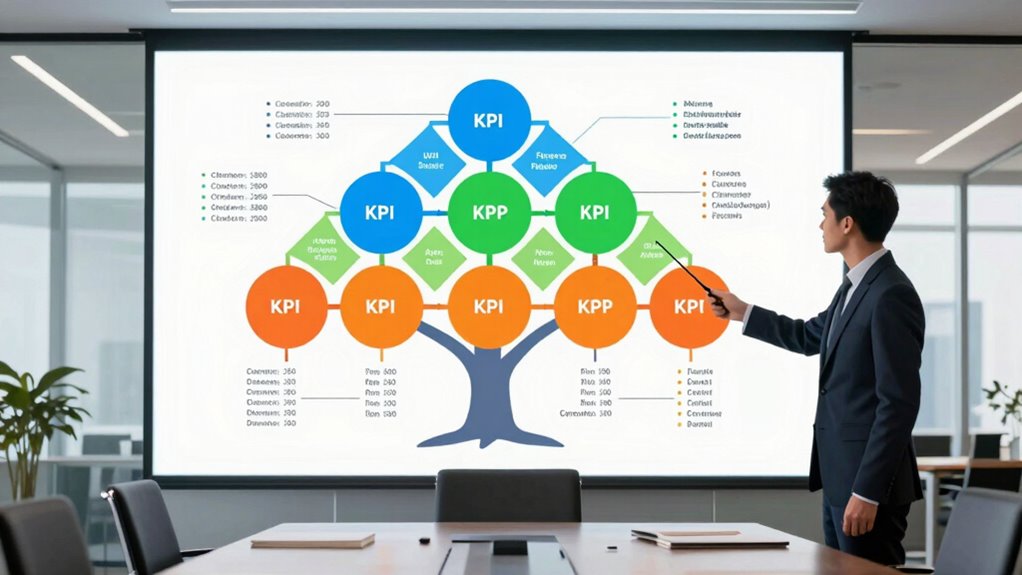
To guarantee your KPI tree communicates clearly, testing and refining it based on real feedback is essential. Start with data validation to ensure your metrics are accurate and relevant. Gather stakeholder feedback by sharing your KPI tree with key decision-makers; their insights reveal whether the structure makes sense and highlights areas needing clarity. Use this feedback to adjust the hierarchy or definitions for better understanding. Here’s a simple way to visualize this process:
| Step | Focus |
|---|---|
| Data validation | Confirm KPI accuracy |
| Stakeholder feedback | Gather insights |
| Analyze discrepancies | Identify confusion points |
| Refine KPI structure | Improve clarity |
| Repeat testing | Ensure continuous improvement |
This cycle helps you craft a KPI tree that’s both precise and easily understood.
Common Mistakes to Avoid When Building Your KPI Tree
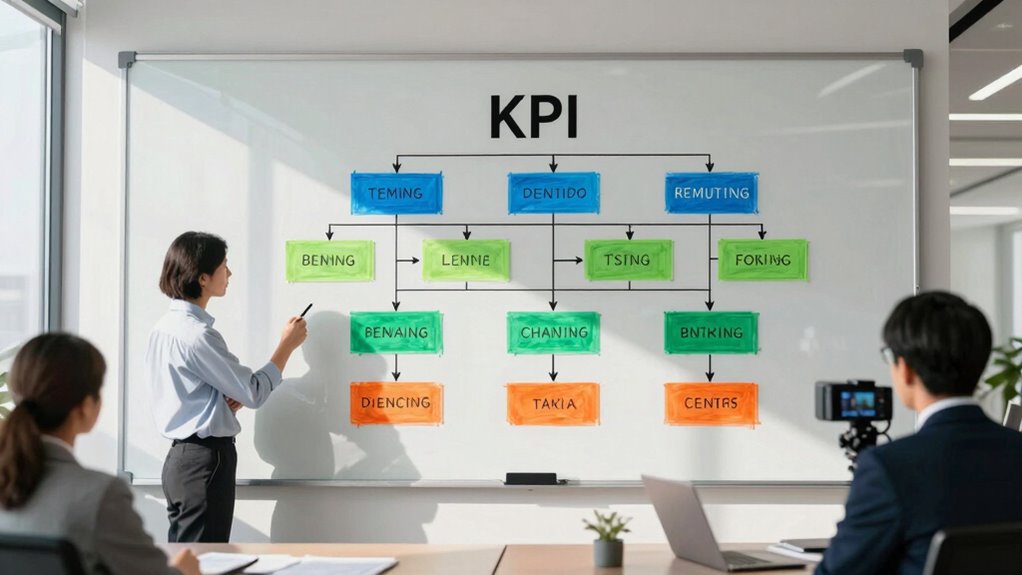
Building your KPI tree without careful planning can lead to confusion and misaligned objectives. One common mistake is creating data overload, where too many metrics distract from what truly matters. To avoid this, focus on a manageable number of KPIs that directly support your strategic goals. Second, watch out for misaligned metrics—ensure each KPI accurately reflects team or department performance and contributes to overall success. Third, neglecting to review and update your KPI tree regularly can cause outdated or irrelevant indicators to persist. By steering clear of these pitfalls, you’ll develop a clear, focused KPI structure that aligns with your objectives and facilitates effective decision-making. Keep your metrics purposeful, streamlined, and relevant for maximum impact.
Frequently Asked Questions
How Often Should I Update My KPI Tree for Maximum Effectiveness?
You should update your KPI tree regularly to keep it effective, ideally with real-time updates whenever significant changes occur. Incorporate stakeholder feedback consistently to guarantee it aligns with evolving business priorities. While daily updates may be unnecessary, revisiting monthly or quarterly helps maintain relevance. This approach ensures your KPI tree remains a dynamic tool, reflecting current performance, and supporting informed decision-making across your organization.
Can KPI Trees Be Customized for Different Departments or Teams?
Yes, KPI trees can definitely be adapted for different departments or teams. You should focus on department customization to align KPIs with each team’s specific goals and functions. Incorporate team specific KPIs that reflect their unique responsibilities and targets. This approach ensures relevance, improves focus, and helps team members understand how their performance impacts overall organizational success. Tailoring your KPI tree makes it more effective and actionable across various units.
What Tools or Software Are Best for Creating KPI Trees?
You should consider tools like Tableau, Power BI, or Lucidchart, as they excel at creating clear data visualizations and integrate smoothly with your existing software systems. These platforms allow you to customize KPI trees for different departments, making complex data easy to interpret. They also support real-time updates and collaborative features, ensuring your KPI dashboards stay accurate and aligned with your organizational goals.
How Do I Align KPIS With Overall Company Strategy?
To align KPIs with your company strategy, start by understanding your strategic goals and translating them into clear performance metrics. You then select KPIs that directly measure progress toward these goals, ensuring they reflect key business drivers. Regularly review and adjust your KPIs to maintain strategic alignment, and communicate their importance across teams. This approach keeps everyone focused on the right priorities and drives overall success.
What Are the Signs of an Ineffective or Confusing KPI Tree?
You’ll notice an ineffective KPI tree when it’s filled with misaligned metrics that don’t reflect your company’s goals, causing confusion. Overly complex structures make it hard to interpret, leading to frustration and miscommunication. If team members struggle to identify key drivers or if the KPIs don’t clearly connect to strategic objectives, it’s a sign your KPI tree needs simplification. Keep it straightforward and aligned for better understanding and decision-making.
Conclusion
Building a clear KPI tree is like planting a sturdy tree that supports your entire decision-making landscape. When you focus on simplicity, prioritize what truly matters, and use visual tools, you’ll create a map that guides you swiftly through complex data. Keep testing and refining it, so it remains a reliable compass. With this approach, your KPIs will become a clear stream, flowing smoothly toward smarter, faster executive decisions.