To manage delegation without chaos, understand the 5-Level Ownership Model, which guides how responsibility and accountability evolve. Assess your team’s current ownership by observing initiative, accountability, and problem-solving behaviors, then use clear expectations and feedback to foster growth. Overcoming challenges like mistrust or miscommunication involves setting expectations, providing support, and tracking progress. Focusing on clarity and accountability ensures everyone knows their roles. Keep exploring these concepts to reveal more effective delegation strategies and foster shared ownership.
Key Takeaways
- Recognize and develop five ownership levels to tailor delegation and promote proactive responsibility.
- Assess current ownership and clarity through observations, feedback, and performance metrics.
- Foster ownership growth with empowerment, accountability frameworks, coaching, and milestone recognition.
- Address delegation challenges by establishing clear expectations, building trust, and maintaining open communication.
- Use ongoing feedback and performance evaluation to ensure clarity, accountability, and continuous improvement.
What Are the 5 Levels of Ownership in Delegation?
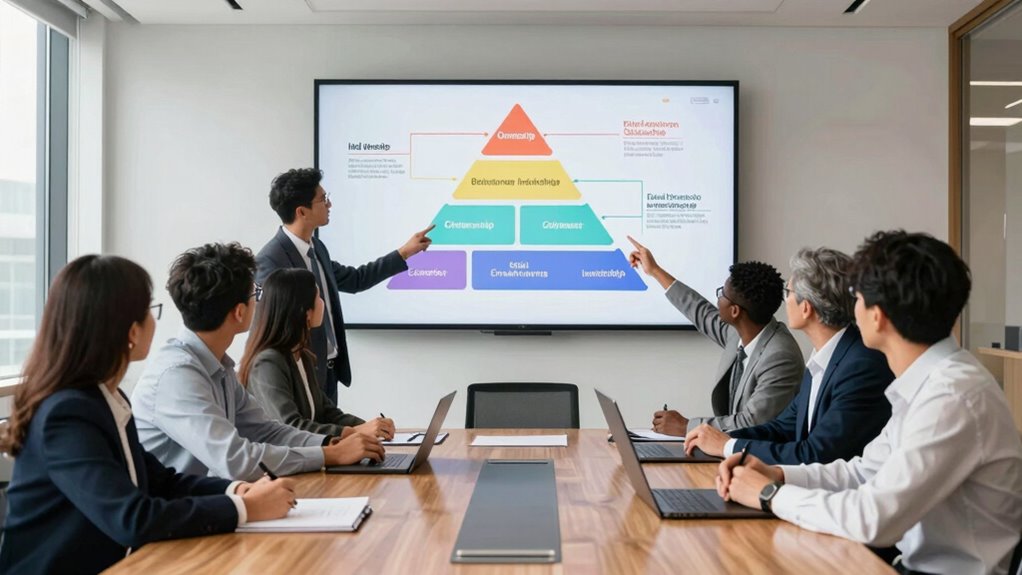
There are five distinct levels of ownership in delegation, each representing how much responsibility and accountability a team member assumes. These levels form a responsibility hierarchy, guiding how ownership mindset develops within your team. At the lowest level, team members follow instructions without question, showing minimal ownership. As they grow, they take responsibility for tasks, demonstrating a proactive ownership mindset. Moving up, they anticipate issues and seek solutions, reflecting higher accountability. The highest level involves full ownership, where team members act as if they own the project, making decisions confidently. Recognizing these levels helps you tailor your delegation approach, encouraging your team to advance through the hierarchy. This structured model clarifies expectations, fosters accountability, and promotes a culture of shared ownership. Additionally, understanding the importance of performance quality in project outcomes can motivate team members to develop greater ownership. Developing a sense of accountability is essential for encouraging team members to move upward in the ownership hierarchy, leading to more autonomous and effective project management. Incorporating personality traits identified through assessments can further enhance how you assign responsibilities and support development within your team, especially when considering motivation factors that drive individual ownership behaviors.
How Can You Assess Your Team’s Current Ownership Level?
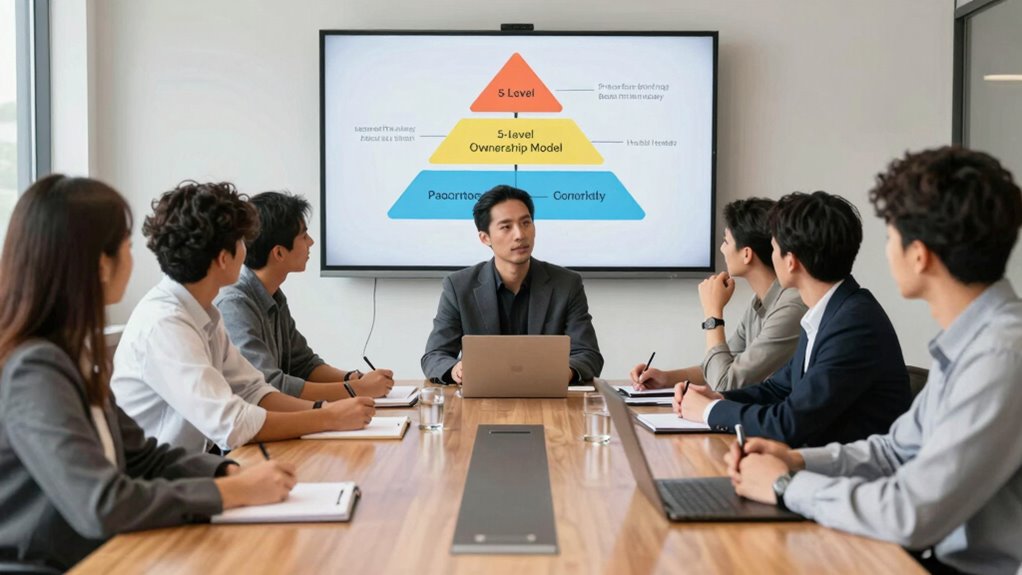
To accurately assess your team’s current ownership level, start by observing how they approach their tasks and responsibilities. Pay attention to their initiative, accountability, and problem-solving behaviors. During team evaluation, notice if members proactively seek solutions or wait for instructions, which indicates their level of ownership. Are they committed to quality work and owning mistakes? Do they take responsibility without needing constant supervision? These signs reveal where they stand on the ownership spectrum. Conduct one-on-one conversations to gather insights into their mindset and confidence. Combining these observations with direct feedback helps you perform an effective ownership assessment. Recognizing types of ownership can further clarify each team member’s engagement level. Additionally, understanding team dynamics can help you identify how different ownership styles influence overall team performance. Being aware of ownership levels can also guide you in tailoring your leadership approach to foster higher responsibility and commitment within your team. This understanding allows you to identify strengths and gaps, guiding your next steps to foster higher ownership within your team.
How to Help Your Team Move Through Ownership Levels

Ever wondered how to guide your team toward higher ownership levels? Start by implementing empowerment strategies that foster independence. Use clear accountability frameworks to set expectations and track progress. Focus on:
- Providing targeted coaching to build confidence
- Encouraging autonomy with defined boundaries
- Offering constructive feedback to reinforce ownership
- Recognizing milestones to motivate continued growth
These steps help team members understand their responsibilities and develop a sense of ownership. Incorporate accountability frameworks to ensure everyone knows what’s expected and feels responsible. Consistently reinforce accountability frameworks so everyone knows what’s expected and feels responsible. As trust builds, they’ll take on more complex tasks with confidence. Remember, guiding your team through ownership levels isn’t a one-time effort — it’s a continuous process of support, feedback, and empowerment. Building trust through consistent support and clear expectations is essential for sustainable growth. This approach accelerates growth and cultivates a high-performance culture. Effective team development plays a crucial role in fostering a sense of ownership and engagement. Additionally, fostering clarity of roles helps team members understand their specific responsibilities within the ownership model. Recognizing the importance of ongoing communication ensures that expectations remain clear and adaptable as teams evolve.
What Common Delegation Challenges Might You Face: and How to Overcome Them?
Delegation often presents challenges because it requires balancing trust, clarity, and control. One common obstacle is trust issues, where you might hesitate to delegate because you doubt your team’s capabilities or fear losing oversight. This can lead to micromanagement or reluctance to assign important tasks. Communication gaps also frequently cause problems, resulting in misunderstandings or incomplete work. To overcome these hurdles, establish clear expectations upfront and foster open dialogue. Build trust gradually by delegating smaller tasks initially and providing constructive feedback. Regular check-ins help clarify any uncertainties and reinforce accountability. Remember, effective delegation isn’t about relinquishing control; it’s about setting your team up for success while maintaining the right level of oversight. Additionally, understanding the ownership model can help you determine the appropriate level of involvement for each task, ensuring smoother delegation processes. Developing a clear framework for accountability can further streamline this process, making delegation more effective and less chaotic. Incorporating trust-building strategies, such as transparent communication and consistent follow-through, can greatly enhance the overall delegation experience. Recognizing the importance of creative storytelling for branding can also motivate your team by aligning tasks with a compelling vision.
How to Measure Clarity and Accountability at Each Ownership Level?

Understanding how to measure clarity and accountability at each ownership level is essential for effective delegation. To do this, focus on specific indicators that reflect performance metrics and communication clarity. First, assess how well expectations are articulated—are instructions clear and concise? Second, review progress updates—are they detailed enough to gauge accountability? Third, analyze results—do outcomes align with targets? Fourth, solicit feedback—are team members confident in their roles and responsibilities? By tracking these areas, you create a tangible way to evaluate whether ownership levels are sufficiently clear and answerable. Additionally, monitoring communication protocols can help ensure that expectations remain transparent and consistent across all levels. Incorporating performance metrics provides a measurable way to assess progress and identify areas for improvement. Moreover, establishing clear benchmarks allows for easier comparison of performance across teams and time periods. Regularly reviewing feedback mechanisms can also highlight potential gaps in understanding or execution, enabling proactive management. This focused approach ensures everyone understands their role, reduces confusion, and keeps performance metrics aligned with organizational goals.
Frequently Asked Questions
How Does the 5-Level Ownership Model Compare to Traditional Delegation Methods?
Compared to traditional delegation, the 5-level ownership model emphasizes trust building and accountability strategies, making delegation more effective. You take greater responsibility at each level, fostering clearer communication and shared ownership. This approach reduces chaos by encouraging proactive problem-solving and continuous engagement, ensuring tasks are completed with high standards. You’ll find that this model promotes stronger team cohesion and better results than conventional methods that often lack accountability focus.
What Are Common Signs Indicating a Team Member Is Ready to Advance Ownership Levels?
You’ll notice a team member is ready to advance ownership levels when performance indicators show consistent quality and deadlines are met without reminders. Motivation cues like increased initiative, proactive problem-solving, and taking ownership of challenges also signal readiness. Don’t overlook subtle signs—such as enthusiasm for new tasks or a desire to improve—indicating they’re enthusiastic to handle more responsibility and grow into higher ownership levels confidently.
How Can Leadership Foster Ownership in Remote or Hybrid Teams?
You can foster ownership in remote or hybrid teams by trust-building and implementing accountability measures. Encourage open communication, set clear expectations, and empower team members to make decisions. Recognize their contributions publicly and provide regular feedback. Use tools that track progress transparently, and guarantee everyone understands their roles. This approach creates a sense of responsibility, motivating your team to take full ownership of their tasks and outcomes.
What Role Does Feedback Play in Progressing Through Ownership Levels?
Did you know that 69% of employees say feedback helps improve their performance? Feedback plays a vital role in progressing through ownership levels by guiding your skill development and fostering accountability. When you receive specific, constructive input, you can identify areas for growth, boost your confidence, and take greater ownership of your work. Regular feedback accelerates performance improvement and helps you move confidently through each ownership stage.
Are There Industry-Specific Adaptations of the 5-Level Ownership Model?
Yes, there are industry-specific adaptations of the 5-level ownership model. You can customize it for your sector by aligning each level with industry standards, challenges, and workflows. This sector adaptation helps you better understand responsibilities, enhance accountability, and tailor delegation strategies. By incorporating industry customization, you guarantee the model fits your unique environment, making ownership development more practical and effective across different sectors.
Conclusion
By understanding and applying the 5-level ownership model, you can delegate effectively and prevent chaos. Imagine assigning a project to a team member who confidently owns each step, from understanding the task to final execution. For example, when Sarah moved from just following instructions to fully owning her tasks, her productivity soared. Embrace the model, guide your team through each level, and watch collaboration and accountability thrive, creating a smoother, more efficient workflow.