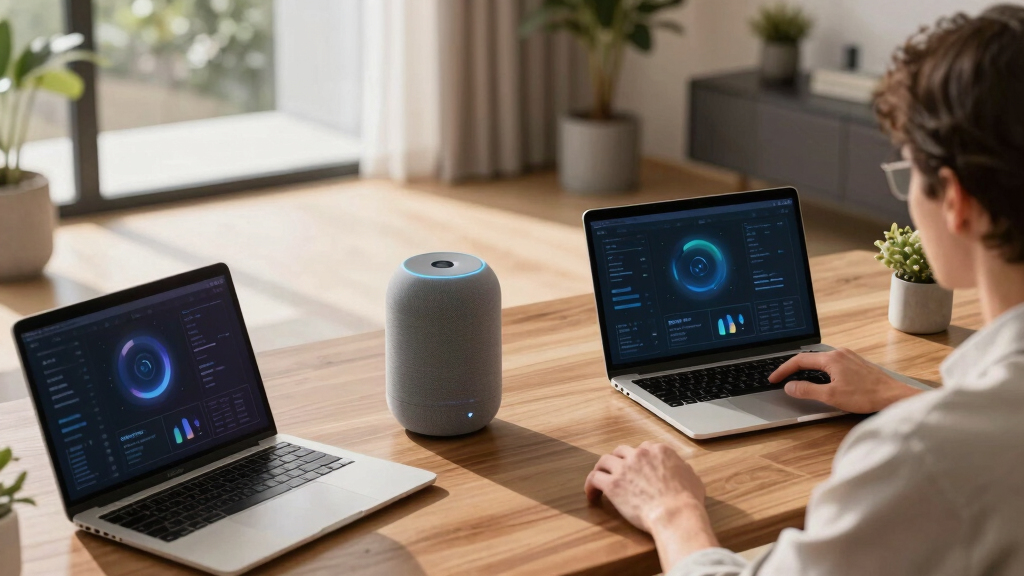

📊 Full opportunity report: 2026 And Beyond: 10 AI Advancements You’ll See on ThorstenMeyerAI.com — validation score, market gap, and execution plan.

Get business pricing on tech for your team
- Business-only prices and quantity discounts
- Tax-exempt purchasing
- Multiple users, one account, clear invoices
TL;DR
By 2026, AI is expected to deliver significant advancements in natural language understanding, automation, and ethical frameworks. This article outlines the top 10 anticipated developments and their potential impact.
Artificial intelligence is poised to make substantial progress by 2026, with key breakthroughs expected across multiple domains, including natural language processing, automation, and ethical AI. These advancements will shape industries, influence policy, and redefine human-AI interaction, making this a pivotal period for AI development.
Industry experts and researchers project that by 2026, AI systems will achieve more sophisticated natural language understanding, enabling more seamless human-computer communication. Automation will expand into complex tasks previously thought to require human judgment, such as legal analysis and medical diagnosis, driven by improved machine learning models and data processing capabilities.
Significant progress is also anticipated in AI ethics and governance, with new frameworks and tools designed to ensure responsible AI deployment. Additionally, advancements in AI hardware, including specialized chips, will facilitate faster and more energy-efficient processing, supporting real-time applications at scale.
While these developments promise transformative benefits, some aspects remain uncertain, including the pace of regulatory adaptation and the ethical implications of autonomous AI systems. Experts caution that the timeline for these breakthroughs may shift depending on technological, regulatory, and societal factors.
The 10 picks
- 1
 Samsung 34" ViewFinity S50GC Series Ultra-WQHD Monitor, 100Hz, 5ms, HDR10, AM…View on Amazon →
 - 2
 Sceptre 34-Inch Curved Ultrawide WQHD Monitor (3440 × 1440), 165Hz, 1ms, Disp…View on Amazon →
 - 3
 LG 34WR55QK-B 34-inch UltraWide WQHD Curved Computer MonitorView on Amazon →
 - 4
 INNOCN 34-Inch Ultrawide WQHD Monitor with 180Hz Refresh Rate, HDR400, G-SYNC…View on Amazon →
 - 5
 Samsung 49” Business Curved Ultrawide Dual QHD Computer Monitor, USB-C, Displ…View on Amazon →
 - 6
 MSI PRO MP341CQW E12 34-inch VA UWQHD Computer Monitor, 120Hz, Adaptive-Sync,…View on Amazon →
 - 7
 Dell 34 Plus USB-C Curved Monitor – S3425DW – 34-inch 3440×1440, 120Hz, VA Pa…View on Amazon →
 - 8
 Deco Gear 49 Inch Curved Ultrawide Monitor, 5120×1440 Dual QHD, 32:9, HDR400,…View on Amazon →
 - 9
 Samsung 34′ Odyssey G5 Ultra-Wide Gaming Monitor with 1000R Curved Screen, 16…View on Amazon →
 - 10
 LG 34U640B-B 34-Inch UltraWide Curved QHD Monitor with 144Hz, FreeSync Premiu…View on Amazon →
Why 2026 Will Be a Turning Point for AI
The projected advancements in AI by 2026 will fundamentally alter industries such as healthcare, finance, and transportation, enabling more efficient, accurate, and personalized services. They also raise critical questions about ethics, employment, and privacy, emphasizing the need for responsible development and regulation.
This era could see AI systems becoming more integrated into daily life, influencing decision-making processes and automating complex tasks. Understanding these changes is essential for policymakers, businesses, and consumers to prepare for a future shaped by increasingly intelligent machines.
Key Trends and Predictions Shaping AI’s Future
Over the past decade, AI has evolved rapidly, with breakthroughs in deep learning, natural language processing, and robotics. Leading companies and research institutions have invested heavily in developing more capable AI models, with some predicting a new wave of ‘general AI’ capabilities by 2026. Industry forecasts rely on current research trajectories, funding levels, and technological innovations, though actual progress may vary due to unforeseen challenges.
Recent advancements include large language models like GPT-4, improvements in autonomous vehicle technology, and increased focus on AI ethics and safety. These trends suggest that by 2026, AI will be more capable, more integrated into daily life, and subject to more sophisticated governance frameworks.
“We expect AI to reach new levels of understanding and autonomy by 2026, fundamentally changing how we work and live.”
— Dr. Emily Carter, AI Researcher
Unconfirmed Aspects and Potential Challenges
While projections are optimistic, the timeline for achieving these AI milestones remains uncertain. Factors such as regulatory hurdles, ethical debates, and technical challenges could slow progress. Additionally, the development of truly general AI—capable of human-like reasoning—may take longer than anticipated or prove more difficult than current models suggest.
There is also ongoing debate about how AI advancements will impact employment and privacy, with some experts warning of unintended consequences that could arise if safeguards are not properly implemented.
Next Steps for AI Development and Regulation
Researchers and industry leaders will continue refining AI models, focusing on safety, transparency, and ethical considerations. Governments and regulatory bodies are expected to develop frameworks to manage AI deployment responsibly, balancing innovation with societal risks.
Public engagement and international cooperation will likely increase as AI becomes more embedded in critical infrastructure and daily life, aiming to mitigate risks and maximize benefits.
Key Questions
What are the most significant AI advancements expected by 2026?
Major anticipated advancements include more sophisticated natural language understanding, increased automation of complex tasks, and improved AI ethics and governance frameworks.
Will AI become capable of human-like reasoning by 2026?
Experts believe progress toward human-like reasoning is possible but uncertain; it may require longer timelines and breakthroughs beyond current capabilities.
How will AI advancements impact employment?
AI is expected to automate many tasks, potentially displacing some jobs while creating new opportunities in AI development, maintenance, and oversight. The exact impact will depend on regulatory and societal responses.
What ethical concerns are associated with future AI growth?
Concerns include privacy, bias, autonomy, and decision-making transparency. Developing robust ethical frameworks is critical to ensuring responsible AI deployment.
What role will regulation play in AI’s future?
Regulatory bodies are expected to establish guidelines and standards to ensure AI safety, fairness, and accountability, influencing the pace and direction of AI innovation.
Source: ThorstenMeyerAI.com
Fall Picks
fall essentials
As an affiliate, we earn on qualifying purchases.





![Claude Code Reads AGENTS.md Only When Telemetry Is On [Fixed]](https://goodsidekick.com/wp-content/uploads/2026/09/claude-code-reads-agents-md-only-when-telemetry-is-on-fixed-featured-260x140.jpg)