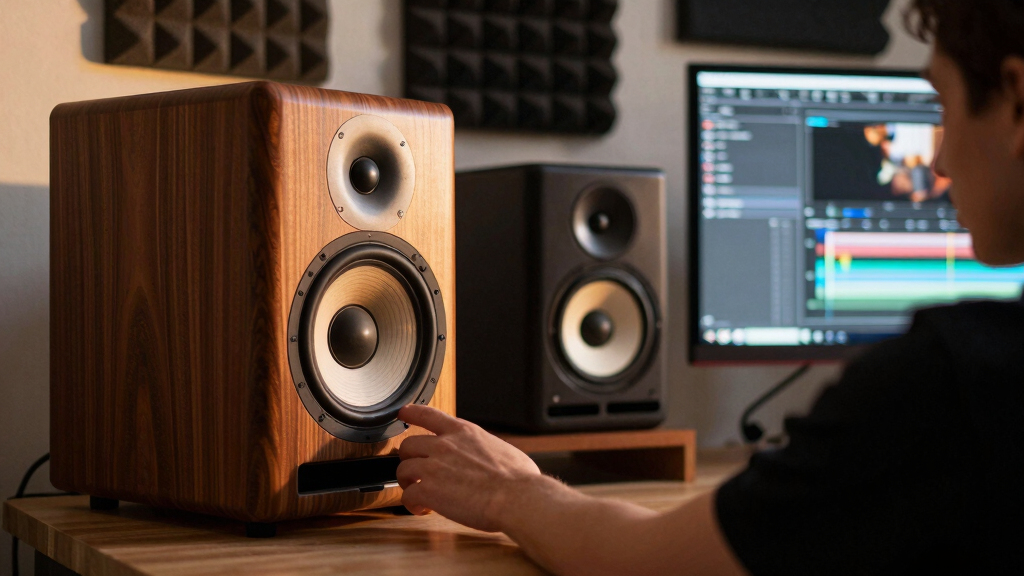

Choosing the best studio monitor speakers for video editing means balancing accuracy, clarity, and affordability. The Edifier MR3 stands out as the overall top choice thanks to its balanced sound profile and Bluetooth convenience. For a more budget-friendly option, the Edifier R1280T offers decent performance at a lower price point, while the JBL 305P MkII provides excellent accuracy for professional work. Each of these options reflects different priorities: sound fidelity, ease of use, or value. The main tradeoffs involve balancing price with sound precision and connectivity features. Continue reading for a detailed breakdown of each model and what makes them suitable for video editing.
Key Takeaways
- The most accurate sound reproduction comes from models with flat frequency response, like the JBL 305P MkII.
- Connectivity options such as Bluetooth or RCA can influence ease of use but may impact sound neutrality.
- Size and power ratings vary; larger speakers tend to deliver better bass but require more space and power management.
- Budget-friendly options can perform well but often sacrifice some fidelity and build quality compared to premium choices.
- User-specific needs, like Bluetooth compatibility or compact design, heavily influence the best fit for individual workflows.


More Details on Our Top Picks
Edifier MR3 Powered Studio Monitor Speakers, Hi-Res Audio Certified Bluetooth V5.4 Active Bookshelf Loudspeakers, 2.0 Computer Speaker with Headphone Output RCA AUX Balanced TRS Input – Black (Pair)
This model stands out for delivering exceptional sound clarity across a wide frequency range, in particular when compared to the Edifier R1280T, which has a more traditional bookshelf design but less control at high volumes. The Hi-Res Audio certification ensures detailed monitoring, making it ideal for video editing where precision matters. Its rich connectivity options—Bluetooth V5.4, RCA, AUX, and balanced TRS—allow seamless integration with multiple devices, surpassing many competitors like the Mackie CR3.5, which lacks Bluetooth. While these speakers are a bit larger and less compact than some, the volume control remains controlled and distortion-free even at high levels. The MDF cabinet helps reduce distortion, but the tradeoff is slightly heavier weight. The detachable wires facilitate flexible placement, though recommended for closer positioning. Overall, this pick makes the most sense for professionals needing high-fidelity audio with versatile connectivity, especially in a home studio environment.
Pros:- Exceptional frequency response for accurate monitoring
- Rich connectivity including Bluetooth and multiple inputs
- Controlled volume output with minimal distortion
Cons:- Bulkier size may be less suitable for tight spaces
- Higher weight compared to smaller monitors
Best for: Video editors who prioritize detailed sound reproduction and multiple device connectivity in a multi-purpose setup.
Not ideal for: Users with very limited space who need ultra-compact monitors or those seeking minimal setup complexity.
- Frequency Response:52Hz – 40kHz
- Power Output:18W x 2 RMS
- Connectivity:Bluetooth V5.4, RCA, AUX, TRS
- Speaker Size:4 inches
- Enclosure Material:MDF
- Signal-to-Noise Ratio:85 dB
Bottom line: This monitor is ideal for those who need precise audio and flexible device connections in a versatile home studio.
JBL 305P MkII 5″ 2-Way Active Powered Studio Reference Monitors Speakers
Compared to the Edifier MR3, the JBL 305P MkII excels in imaging accuracy thanks to its patented Image Control Waveguide, which provides a wide sweet spot suitable for critical listening during video editing. Its dual 41-watt Class-D amplifiers deliver deep bass and crisp highs, outperforming smaller monitors like the Mackie CR3.5, which have less power and room calibration options. The Boundary EQ and HF Trim controls allow room-specific tuning, making it adaptable to various environments, unlike less adjustable models. While these monitors are relatively compact, they are not as feature-rich in connectivity as the Edifier MR3, relying mainly on XLR/TRS. They are built for professionals who need consistent, accurate sound across a broad range, especially for mixing and detailed editing tasks.
Pros:- Excellent imaging with a wide sweet spot
- Room tuning via Boundary EQ and HF Trim
- Powerful and detailed sound with deep bass
Cons:- Limited connectivity options compared to competitors like Edifier MR3
- Slightly larger footprint than smaller monitors
Best for: Video editors who require highly accurate stereo imaging and room calibration options.
Not ideal for: Beginners or casual users who need simple plug-and-play monitors without calibration controls.
- Frequency Response:43Hz – 24kHz
- Power Output:41W x 2
- Connectivity:XLR, TRS
- Speaker Size:5 inches
- Built-In Features:Room EQ, HF Trim
- Signal-to-Noise Ratio:75 dB
Bottom line: This monitor system is perfect for professionals needing room-specific tuning and precise sound imaging in a dedicated editing space.
Edifier R1280T Powered Bookshelf Speakers – 2.0 Active Near Field Studio Monitor Speaker – Wooden Enclosure – 42 Watts RMS Power
Compared with more advanced monitors like the Edifier MR3, the R1280T offers reliable sound quality with a natural tone, suitable for budget-conscious video editors. Its full-range 4-inch driver and silk dome tweeter produce a warm, balanced sound, though lacking the high-frequency detail of premium models. The wooden enclosure adds a touch of acoustic warmth, but it isn’t designed for critical studio use. Its remote control and side panel EQ controls provide basic adjustability, but with less precision than dedicated studio monitors. The power output of 42W RMS makes it adequate for small rooms, but may not fill larger spaces with clear sound. This makes it an excellent choice for those starting out or editing in a casual setting, where cost is a major factor.
Pros:- Affordable price with decent sound quality
- Wide volume range with good control
- Easy to connect via AUX or RCA
Cons:- Limited high-frequency detail and punch
- Not suitable for critical mixing or large spaces
Best for: Beginner video editors or hobbyists needing decent sound without high-end calibration or connectivity features.
Not ideal for: Professional environments requiring flat response and precise monitoring in a large or acoustically treated room.
- Frequency Response:80Hz – 20kHz
- Power Output:42W RMS
- Connectivity:AUX, RCA
- Speaker Size:4 inches
- Enclosure Material:Wood
- Signal-to-Noise Ratio:85 dB
Bottom line: This speaker set is a solid entry-level choice for casual editing and focused work in small environments.
Mackie CR3.5 3.5″ Creative Reference Powered Studio Monitors with Tone Knob and Location Switch — Active Speakers for Music Production, Desktop Computer, Gaming, HiFi Listening
While the Mackie CR3.5 may not match the flat response of the Edifier MR3 or JBL 305P MkII, it excels in providing adjustable tone controls and multiple connection options that make it highly versatile for various uses, including gaming, casual listening, and video editing. Its 3.5-inch woven woofer delivers decent low-end, but lacks the punch of larger monitors like the JBL 305P. The built-in tone knob allows users to boost bass or highs, which can be helpful for casual audio but may compromise accuracy for critical editing. The location switch offers flexibility to optimize sound for desktop or bookshelf placement, a feature absent in simpler monitors. Overall, this is a good multi-purpose monitor with a focus on user customization, making it suitable for those who want adaptable sound in a compact package.
Pros:- Adjustable tone knob for bass and treble
- Multiple input options including TRS, RCA, 3.5mm
- Flexible placement with location switch
Cons:- Less flat response, not ideal for critical editing
- Smaller driver size limits low-end punch
Best for: Content creators and casual video editors who need flexible tone control and multiple device connections for varied tasks.
Not ideal for: Professional mixing or detailed sound editing where flat response and calibration are essential.
- Frequency Response:Not specified
- Power Output:Not specified
- Connectivity:TRS, RCA, 3.5mm
- Speaker Size:3.5 inches
- Built-In Features:Tone knob, Location switch
- Signal-to-Noise Ratio:Not specified
Bottom line: This monitor is perfect for users seeking adaptable sound with tone control in a compact, versatile setup.
Edifier MR3 Powered Studio Monitor Speakers, Hi-Res Audio Certified Bluetooth V5.4 Active Bookshelf Loudspeakers, 2.0 Computer Speaker with Headphone Output RCA AUX Balanced TRS Input (White)
Compared to the Edifier R1280T, the MR3 offers Hi-Res Audio certification and Bluetooth V5.4 for wireless convenience, making it a strong choice for video editors who want detailed sound and easy device pairing. Its full-range drivers produce a rich, controlled sound with minimal distortion at high volumes, surpassing the R1280T’s more casual profile. The detachable wires and Bluetooth support simplify placement and connectivity for flexible setups. However, the size is less compact than some desktop monitors, and for absolute flat response, more specialized studio monitors would be preferable. Nonetheless, the combination of clarity and wireless ease makes this a top pick for versatile use.
Pros:- Hi-Res Audio certification for detailed sound
- Bluetooth V5.4 for wireless streaming
- Rich, controlled sound at high volumes
Cons:- Larger size may limit desktop placement
- Less suited for critical mixing compared to dedicated studio monitors
Best for: Video editors who need precise sound with wireless capabilities and flexible device connections in a home setup.
Not ideal for: Those requiring ultra-flat response for critical mixing, or very space-constrained environments.
- Frequency Response:52Hz – 40kHz
- Power Output:18W x 2
- Connectivity:Bluetooth V5.4, RCA, AUX, TRS
- Speaker Size:4 inches
- Enclosure Material:Wood
- Signal-to-Noise Ratio:85 dB
Bottom line: Ideal for editors needing detailed sound with wireless convenience and flexible device connections in a versatile environment.
M-AUDIO BX3 Pair 3.5″ Studio Monitors, HD PC Speakers for Recording and Multimedia with Music Production Software
This pick stands out for offering a surprising amount of power and flexibility at an accessible price point, making it ideal for small setups such as home offices or secondary editing stations. Compared to larger studio monitors like the PreSonus Eris 3.5, the BX3 delivers more raw volume and bass response, though it sacrifices some accuracy in favor of a punchier sound. Its versatile inputs—RCA, 1/4″, and 1/8″—allow easy connection to a wide range of devices, and the 120W output is impressive for its size. However, the design leans toward multimedia and gaming rather than precise mixing, and the passive speaker component can introduce some connectivity complexity. This makes it a solid budget option for casual creators or those needing dependable desktop sound without professional-grade accuracy.
Pros:- High 120W power output delivers ample volume for small rooms
- Multiple connection options for flexible device pairing
- Bass reflex design provides extended low-end response
- Includes a complete bundle with cables and software
Cons:- Sound profile favors punchy bass over flat accuracy
- Passive speaker adds setup complexity and potential signal loss
Best for: Budget-conscious users who want powerful desktop speakers for multimedia, gaming, or light editing.
Not ideal for: Professional audio engineers or video editors requiring highly accurate sound for critical mix decisions.
- Power Output:120 Watts
- Speaker Size:3.5 Inches
- Frequency Response:22 KHz
- Connectivity:RCA, 1/4″, 1/8″ inputs
- Enclosure Material:Acoustically-inert MDF
- Cabinet Design:Bass reflex
Bottom line: Ideal for casual media consumption and light editing on a budget, but not suited for critical audio work.
Edifier MR4 Powered Studio Monitor Speakers, 4″ Active Near-Field Reference Speaker – Black (Pair)
This model makes the most sense for creators who need a balanced, flat response for accurate monitoring, especially in small spaces. Compared to the M-AUDIO BX3, the MR4 offers a more refined sound profile with true studio transparency, aided by its 1″ silk dome tweeter and 4″ woofer. The MDF cabinet helps reduce resonance, enhancing clarity, while the multiple inputs—including balanced TRS and RCA—support professional and semi-pro setups. Its front headphone jack adds convenience for quick-mix checks. The main tradeoff is a slightly higher price and a somewhat larger footprint, which might be less ideal for ultra-compact desktops. This makes it a solid choice for serious hobbyists or semi-professional video editors seeking reliable, studio-quality sound.
Pros:- Flat frequency response for precise monitoring
- Multiple balanced and unbalanced inputs for professional connectivity
- High-quality MDF enclosure reduces resonance
- Front headphone output for quick reference
Cons:- Higher cost compared to entry-level speakers
- Size may be less suitable for very tight desktop spaces
Best for: Video editors and music producers seeking flat, accurate sound in a compact, near-field setup.
Not ideal for: Casual listeners or those prioritizing bass-heavy sound for casual media consumption.
- Speaker Size:4 Inches
- Frequency Response:20 KHz
- Power Output:50 Watts
- Inputs:TRS, RCA, AUX
- Cabinet Material:MDF
- Additional Features:Headphone output, flat response
Bottom line: Perfect for critical listening and near-field mixing, with a focus on transparency over bass emphasis.
PreSonus Eris 3.5 Studio Monitors, Pair — Powered, Active Monitor Speakers for Near Field Music Production, Desktop Computer, Hi-Fi Audio
This choice stands out for combining studio accuracy with user-friendly features, making it a go-to for small home studios or multimedia enthusiasts. Compared to the Edifier MR4, the Eris 3.5 offers a slightly more compact form factor and a straightforward volume control, although it doesn’t have the same level of flatness, leaning toward a more balanced but lively sound profile. Its 50W power and versatile inputs—including RCA, ¼”, and front headphone jack—support a range of devices from computers to musical instruments. The slightly less refined resonance control is a tradeoff for affordability and ease of use. This makes it an excellent pick for beginner to intermediate users who want reliable accuracy without a steep learning curve or high cost.
Pros:- Accurate yet lively sound suitable for multiple media types
- Multiple input options including ¼”, RCA, and headphone jack
- Compact, space-efficient design
- Good build quality with a two-year warranty
Cons:- Not as flat or transparent as high-end studio monitors
- Limited bass extension compared to larger speakers
Best for: Beginner and hobbyist video editors or musicians needing accurate sound with simple controls.
Not ideal for: Professional mixing engineers or those needing ultra-flat response for mastering purposes.
- Power:50 Watts
- Speaker Size:3.5 Inches
- Frequency Response:20 KHz
- Inputs:RCA, ¼”, Headphone
- Built-In Media:Active
- Warranty:2 Years
Bottom line: Great for small studios and multimedia use where a balance of accuracy and user-friendliness is desired.
M-AUDIO BX5BT Pair 5″ Desktop Studio Monitor Speakers with DSP and Bluetooth with App Control, for Music Production, Video Edits, Content Creation, Podcasting
This model excels for creators who want studio-quality sound combined with modern connectivity features, especially Bluetooth streaming and app-based tuning. Compared with the PreSonus Eris 3.5, the BX5BT offers a larger 5″ woofer and DSP tuning, allowing precise customization of sound profiles via the M-Audio Studio Control app. Its Bluetooth 5.0 ensures cable-free playback from any device within a 100-foot range, making it ideal for multi-purpose setups or streaming. The 240W power output guarantees ample volume and punch, though some may find the slightly complex app controls a learning curve. This makes it an attractive option for content creators and video editors who need flexibility in their workflow and sound tuning.
Pros:- Large 5″ Kevlar woofer with DSP tuning
- App-controlled 5-band EQ for personalized sound
- Wireless Bluetooth streaming with 100 ft range
- High 240W output for loud, punchy sound
Cons:- More complex setup due to app controls
- Larger footprint may be less suitable for very small desks
Best for: Content creators and video editors who want wireless control and customizable sound profiles.
Not ideal for: Purists who prefer analog-only setups or do not need Bluetooth connectivity.
- Power:240 Watts
- Speaker Size:5 Inches
- Frequency Response:49 Hz
- Connectivity:Bluetooth, TRS
- DSP Tuning:Yes
- App Control:Yes
Bottom line: Excellent for those needing flexible, customizable studio sound with modern wireless features.
Ortizan C7 Dual-Mode 2.0 Studio Monitors, Active Monitor Speakers for Near Field Music Production, Bluetooth 5.3 Wireless Computer PC Monitor Gaming Bookshelf Speakers(Pair, Black)
This option is best suited for users who want versatile, all-in-one speakers capable of both studio monitoring and casual media playback, including gaming. Compared to the smaller PreSonus Eris 3.5, the Ortizan C7 offers a larger 3.5-inch driver with a 60W power output and Bluetooth 5.3, allowing quick wireless pairing and a more robust sound for entertainment. Its dual-mode setup supports both Bluetooth and wired inputs, including RCA and AUX, making it adaptable to a variety of devices. The sound quality emphasizes a balanced midrange and decent bass, though it’s not suitable for critical mixing. Its sizable design and multi-functionality make it perfect for multimedia and gaming enthusiasts who want decent sound without the need for dedicated studio monitors.
Pros:- Bluetooth 5.3 for quick wireless pairing
- Dual-mode with wired RCA and AUX inputs
- 60W power output with clear, balanced sound
- Large 3.5-inch driver enhances midrange
Cons:- Not designed for critical monitoring or mixing
- Larger size may occupy more desk space
Best for: Casual video editors, gamers, and multimedia users who value wireless convenience and all-in-one functionality.
Not ideal for: Professional audio engineers or editors needing ultra-flat, accurate sound for mixing.
- Power Output:60 Watts
- Speaker Size:3.5 Inches
- Connectivity:Bluetooth 5.3, RCA, AUX
- Frequency Response:20-20 KHz
- Wireless Range:18 Meters
- Additional Features:Dual-mode, auto setup
Bottom line: Best for casual multimedia use and gaming, with decent sound and strong wireless features but limited accuracy for professional editing.
Edifier MR5 2.0 Studio Monitor Bookshelf Speakers, 110W(RMS), Hi-Res Audio, Bluetooth 6.0, 3-Way Active Design, Room Compensation, XLR/TRS/RCA Inputs, Compact Size for Home Studio & Music – Black
This pick stands out for its balanced combination of professional-grade features and user-friendly controls. The 3-way active crossover system with a 5″ long-throw woofer, 3.75″ mid driver, and 1″ silk dome tweeter delivers detailed sound across a wide frequency range (46Hz–40kHz), making it well-suited for critical video editing tasks. Compared with the JBL 305P MkII, the MR5 offers more precise room tuning via physical rear knobs and the EDIFIER ConneX App, giving it an edge in adaptable studio environments. However, this added complexity could be overwhelming for beginners. The 110W RMS Class D amplifier produces a peak SPL of 101dB, capable of filling mid-sized rooms with clear audio. Its multi-connectivity options—XLR, TRS, RCA, Bluetooth 6.0—offer flexibility for various studio setups, while its compact MDF cabinet minimizes resonance. A tradeoff is the slightly higher price point and larger size compared to smaller desktop models like the OHAYO 60W speakers. Overall, this monitor makes the most sense for serious video editors who need precise, room-tuning capabilities without sacrificing connectivity or audio fidelity.
Pros:- Exceptional frequency response up to 40kHz for accurate audio reproduction
- Advanced room compensation controls via physical knobs and app
- Multiple input options including XLR, TRS, RCA, and Bluetooth 6.0
- Powerful 110W RMS Class D amp for high SPL and clear sound
Cons:- Higher price compared to simpler consumer-level speakers
- Larger and heavier, less ideal for minimal desktop setups
Best for: Video editors requiring versatile, room-tunable studio monitors with professional connectivity options.
Not ideal for: Beginners or casual users who prefer plug-and-play simplicity over detailed room calibration.
- Power Output:110W RMS
- Frequency Response:46Hz–40kHz
- Connectivity:XLR, TRS, RCA, Bluetooth 6.0
- Speaker Size:5-inch woofer, 3.75-inch mid, 1-inch tweeter
- Peak SPL:101dB
- Design:3-Way Active Bookshelf
Bottom line: This model suits video editors who value comprehensive room calibration and connectivity for a professional editing environment.
OHAYO 60W Computer Speakers for Music and Gaming, Active Bluetooth 5.3, Stereo 2.0 Speakers for Desktop PC or Laptop, 3.5mm Aux RCA USB Input, 1 Pair, Black
This choice excels for its compact size and ease of use, making it ideal for casual video editing or multimedia tasks on limited desk space. The 3-inch full-range driver and rear bass port produce powerful 30Wx2 distortion-free sound, suitable for small rooms or personal workstations. Compared with the Edifier MR3, the OHAYO offers more bass depth thanks to its rear port, but it lacks the detailed room calibration controls found in the MR5. Its Bluetooth 5.3 connectivity ensures quick pairing with modern devices, while the multiple inputs—RCA, AUX, USB—provide versatile connection options. The MDF enclosure reduces resonance, but the smaller drivers mean less precise audio reproduction at higher frequencies, which could be a drawback for critical video editing. The simple push-button volume control offers quick adjustments but lacks fine-tuning capabilities. Overall, this speaker makes the most sense for users who need affordable, space-efficient monitors for casual editing or multimedia enhancement.
Pros:- Compact, space-saving design fits small desks
- Powerful 30Wx2 output for clear, distortion-free sound
- Multiple input options including Bluetooth 5.3, RCA, AUX, and USB
- Durable MDF enclosure reduces resonance
Cons:- Lacks advanced room tuning controls like the MR5
- Limited high-frequency detail due to smaller drivers
Best for: Video editors working in small or shared spaces who prioritize simplicity and affordability.
Not ideal for: Professional editors needing detailed room calibration and high-frequency accuracy for critical work.
- Power Output:60W
- Frequency Response:20 KHz
- Connectivity:Bluetooth 5.3, RCA, AUX, USB
- Speaker Size:3-inch driver
- Design:Stereo 2.0 Bookshelf
- Power Source:Corded Electric
Bottom line: This model is best suited for casual video editing in limited spaces, where ease of use and affordability take priority.
How We Picked
The selection process focused on performance, sound accuracy, build quality, and usability. We prioritized models that offer a flat frequency response tailored for audio editing, ensuring faithful reproduction of audio tracks. Connectivity versatility, durability, and user-friendly controls were also key factors. Price was considered to balance value versus quality, with special attention to models that serve both beginners and professionals. The ranking reflects a combination of sound fidelity, features, and overall reliability in a typical video editing environment.Factors to Consider When Choosing Best Studio Monitor Speakers For Video Editing
When choosing studio monitor speakers for video editing, it’s vital to consider several factors that directly impact your workflow and output quality. A well-balanced set ensures your audio mixes translate accurately across different playback systems. It’s also important to weigh connectivity options, size, and power requirements to match your workspace. Understanding these core considerations helps avoid common pitfalls like overspending on features you don’t need or selecting speakers that don’t deliver the necessary accuracy.Sound Accuracy and Frequency Response
For video editing, sound accuracy is paramount. Look for monitors with a flat frequency response that don’t artificially boost bass or treble, ensuring your mixes are true to life. This helps prevent surprises when your audio is played on other systems. Cheaper models often color the sound, which can mislead your editing decisions. Investing in monitors with proven accuracy ultimately saves time and prevents costly re-edits.
Connectivity and Compatibility
Consider what inputs your workflow requires—RCA, XLR, TRS, or Bluetooth. Wired connections like XLR and TRS generally provide cleaner, more reliable audio with less interference, which is critical for precise editing. Bluetooth models offer convenience but may introduce latency or compression artifacts. Think about your existing equipment and future expansion plans to choose a monitor with suitable connectivity options.
Size, Power, and Room Space
Monitor size correlates with sound dispersion and bass response; larger speakers (5 inches or more) typically deliver fuller sound but require more space. Power output influences how loud and clear your audio remains at higher volumes. Smaller, lower-powered monitors can work in tight spaces but might lack depth for critical listening. Match the speaker size and power to your room size and typical volume needs to avoid compromised sound quality.
Build Quality and Durability
Reliable construction ensures longevity and consistent performance, especially in busy editing environments. Look for sturdy enclosures and quality drivers that won’t distort or degrade over time. Budget options might save money initially but could suffer from lower durability or increased noise interference. A sturdy build is an investment in maintaining accurate sound over years of use.
Budget and Value
While premium monitors deliver unmatched accuracy, many mid-range options provide excellent value for most video editors. Balance your budget with the features that matter most—like accuracy, connectivity, and size. Avoid overspending on unnecessary features if your primary goal is precise editing; however, skipping quality could lead to poor audio translation and rework later. Set a realistic budget aligned with your professional needs.
Frequently Asked Questions
Do I need studio monitors for video editing or can I use regular speakers?
Studio monitors are designed to deliver a flat and neutral sound profile, which is essential for accurate audio mixing. Regular speakers often boost certain frequencies, making it harder to judge true sound balance. Using monitors ensures your edits translate well across different playback systems, preventing surprises when your project is played elsewhere. While regular speakers can work temporarily, investing in proper monitors improves your editing precision and final quality.
Is Bluetooth connectivity a good option for studio monitors used in video editing?
Bluetooth offers convenience and quick pairing, but it generally compromises sound fidelity and introduces latency, which can be problematic during detailed editing. Most professional monitors rely on wired connections like XLR or TRS for the best signal clarity and minimal delay. If your workflow requires Bluetooth, choose models that maintain high audio quality, but for critical editing tasks, wired options remain superior.
How important is the size of the monitor speakers for editing?
The size of the monitors impacts both sound quality and space requirements. Larger speakers (around 5 inches or more) tend to produce richer bass and a broader soundstage, which helps in detailed editing. Smaller monitors are more space-efficient but might lack low-end depth, making them less ideal for comprehensive audio work. Match the monitor size to your room size and editing needs to avoid compromising accuracy.
Should I prioritize active or passive monitors for video editing?
Active monitors come with built-in amplification, simplifying setup and reducing the need for external equipment, which is ideal for most video editing setups. Passive monitors require a separate amplifier, adding complexity and cost. For ease of use, reliability, and consistent performance, active monitors are generally the better choice for editing workflows, especially in home studios or small setups.
How much should I expect to spend on good studio monitors for professional video editing?
Entry-level professional-grade monitors typically start around $200 to $300 per pair, with mid-range options ranging from $400 to $800 offering a noticeable boost in accuracy and build quality. Premium models can exceed $1000, providing the best fidelity and durability. Your budget should reflect your editing needs—if you’re serious about precise audio work, investing in higher-quality monitors will pay dividends in the final output quality.
Conclusion
For most users, the Edifier MR3 offers an excellent balance of sound quality, connectivity, and affordability, making it ideal for those who want reliable accuracy without breaking the bank. The JBL 305P MkII remains the best overall choice for professionals who need flat response and precise audio. Beginners or casual editors might prefer the Edifier R1280T for its simplicity and value. For those seeking premium performance, investing in higher-end models like those with XLR support or larger drivers ensures top-tier fidelity. Ultimately, selecting the right monitor depends on your workspace, budget, and specific editing needs.