
AI social media automation tools can help with ideation, drafting, platform planning, and repeatable publishing workflows, but these eight options are guides rather than standalone scheduling software. I rank AI for Scaling Content and Social Media for Small Business Owners as the best overall starting point because it centers on the needs of small teams, while AI-Powered Social Media Marketing 2026 stands out for multi-platform strategy and ChatGPT for Content Creation for creator-focused workflows. The main tradeoff is whether you need a practical system for a specific audience or broader coverage across channels and AI tools. Readers should also distinguish workflow guidance from software that directly schedules posts or connects accounts. Continue reading for the full comparison and advice on choosing the right resource for your goals.

Get business pricing on tech for your team
- Business-only prices and quantity discounts
- Tax-exempt purchasing
- Multiple users, one account, clear invoices
Key Takeaways
- Audience fit separates the strongest options: the small-business-focused guide has a clearer use case than titles aimed broadly at creators or marketers.
- Platform breadth comes with a tradeoff: the multi-platform marketing guides cover more channels, while ChatGPT and creator-focused guides offer a narrower workflow focus.
- Beginner resources prioritize foundations over automation depth: the two beginner guides are better suited to learning systems and channel basics than to selecting hands-off publishing software.
- Prompt and workflow emphasis is most useful for repeatable work: the step-by-step prompts guide is a distinct choice for readers who want to reduce planning friction and avoid starting from scratch.
- None of these titles replaces a connected scheduling platform: buyers seeking account integrations, publishing queues, or analytics should pair a guide with software that provides those functions.



| AI social media automation tool | Format | Platforms | Topic |
|---|---|---|---|
| AI for Scaling Content and Soc | Book | — | — |
| Best AI Tools for Content Crea | Book | — | — |
| AI Tools for Content Creators: | Book | Not specified in available product information | — |
| AI-Powered Social Media Market | Book | Facebook, YouTube, Instagram, X, TikTok | — |
| The Ultimate Social Media Mark | Book | Facebook, Instagram, TikTok, YouTube | Social media marketing |
| Social Media Marketing for Beg | Book | Instagram, TikTok, Facebook, YouTube Shorts | Social media marketing |
| AI-Powered Social Media Market | — | Instagram, TikTok, Facebook | AI-powered social media marketing |
| ChatGPT for Content Creation: | — | YouTube, Instagram, TikTok | AI-assisted content creation |
More Details on Our Top Picks
AI for Scaling Content and Social Media for Small Business Owners
Small-business focus gives this guide a clearer audience than Best AI Tools for Content Creators (2026 Edition), which points toward creator growth across YouTube and Instagram. Its stated coverage of AI-assisted planning, content creation, and social scheduling connects automation to a practical business routine: deciding what to publish, preparing it, and getting it onto social channels. That makes it the most directly relevant pick here for owners who need an approachable content process rather than a broad creator toolkit. The tradeoff is limited detail in the available product information: platforms, named tools, and specific workflow examples are not listed. Compared with the wider platform scope of AI-Powered Social Media Marketing 2026, this book appears more tailored to small-business needs than to cross-platform growth or monetization.
Pros:- Targets small-business owners rather than a general creator audience.
- Covers AI-assisted content planning and creation.
- Includes social media scheduling as part of the workflow.
- Part of a series focused on AI productivity for small businesses.
Cons:- The available product information does not identify supported platforms.
- Named AI tools and detailed workflow examples are not specified.
Best for: Small-business owners who want a guide to using AI for planning, creating, and scheduling social content as part of their day-to-day marketing.
Not ideal for: Creators seeking a detailed comparison of specific AI tools or platform-by-platform instructions, since the available description does not name tools or social networks.
- Format:Book
- Series:AI Productivity for Small Business Owners
- Book number:6
- Primary audience:Small-business owners
- Main focus:AI-assisted content planning and creation
- Social media topic:Content scheduling
Our verdict“Choose this guide if you run a small business and want AI content planning, creation, and scheduling framed around your needs.”
Best AI Tools for Content Creators (2026 Edition): Grow Faster on YouTube, Instagram, and Social Media Using ChatGPT and AI Tools
This guide is the clearest fit for creators who want to connect AI-assisted content creation with audience growth on YouTube and Instagram. Its title specifically names ChatGPT and other AI tools, giving it a more creator-oriented angle than AI for Scaling Content and Social Media for Small Business Owners, which focuses on small-business planning and scheduling. That distinction matters: the appeal here is growth across creator channels, not a stated small-business publishing routine. The available description does not identify particular tools beyond ChatGPT, explain scheduling features, or spell out platform-specific workflows, so I would not treat it as a verified automation manual. Compared with AI Tools for Content Creators: A Practical Blueprint to Automate Your Workflow and Scale Your Digital Brand, this title makes audience growth its more visible promise, while its actual workflow depth remains unclear.
Pros:- Explicitly focuses on content creators and online audience growth.
- Names YouTube and Instagram as target platforms.
- Highlights ChatGPT alongside other AI tools.
- Connects AI-assisted creation with social media growth.
Cons:- The available description does not specify scheduling or publishing automation.
- Specific tools beyond ChatGPT and detailed workflows are not identified.
Best for: YouTube and Instagram creators who want a guide centered on using ChatGPT and AI tools to support content creation and audience growth.
Not ideal for: Small-business owners who primarily need a defined scheduling process or readers who want confirmed platform-by-platform automation instructions.
- Edition:2026 Edition
- Format:Book
- Named AI tool:ChatGPT
- Other tools:AI tools; specific tools not listed
- Platforms named:YouTube, Instagram, and social media
- Primary focus:AI-assisted content creation and audience growth
Our verdict“Pick this guide if your priority is using ChatGPT and AI to grow a creator audience on YouTube and Instagram.”
AI Tools for Content Creators: A Practical Blueprint to Automate Your Workflow and Scale Your Digital Brand
Workflow automation is the strongest stated reason to choose this guide: it is framed around organizing AI-assisted content work and scaling a digital brand. That gives it a different emphasis from Best AI Tools for Content Creators (2026 Edition), whose title stresses growth on YouTube and Instagram. It may suit creators who want to think about repeatable production processes rather than audience growth alone. Still, the product information offers no named platforms, tools, or examples, so the word “automate” should not be taken as proof of specific scheduling or publishing integrations. Compared with AI for Scaling Content and Social Media for Small Business Owners, this guide sounds more focused on creator workflows and brand expansion, while the small-business title more clearly includes social content scheduling. The limited detail makes this a narrower recommendation for readers comfortable with a general blueprint.
Pros:- Places workflow automation at the center of its stated focus.
- Connects content production with scaling a digital brand.
- Aims specifically at content creators.
- Offers a distinct process-oriented angle among the creator-focused titles.
Cons:- The available product information does not name any AI tools.
- Platforms and specific automation steps are not provided.
- Social scheduling or publishing features are not confirmed.
Best for: Independent creators and digital-brand owners who want a general framework for using AI to automate content workflows.
Not ideal for: Readers who need confirmed platform support, named software recommendations, or step-by-step social scheduling instructions.
- Format:Book
- Primary audience:Content creators
- Main focus:AI tools for content creation
- Workflow focus:Automating content workflows
- Brand focus:Scaling a digital brand
- Platforms:Not specified in available product information
Our verdict“Choose this if you want a broad AI workflow framework for a digital brand, not a confirmed platform-specific automation guide.”
AI-Powered Social Media Marketing 2026: Strategies for Facebook, YouTube, Instagram, X, and TikTok
Among these titles, this is the most explicit about cross-platform coverage, naming Facebook, YouTube, Instagram, X, and TikTok. That breadth makes it a stronger fit for marketers coordinating a presence across several networks than The Ultimate Social Media Marketing Guide for Beginners 2027, which names four platforms and is explicitly beginner-focused. The description also promises step-by-step strategies and discusses making money online, so the scope extends beyond publishing automation into growth and monetization. The tradeoff is that the available details do not name specific AI tools or explain how much of the guidance concerns scheduling and workflow automation. Compared with the small-business-focused AI for Scaling Content and Social Media for Small Business Owners, this guide offers a wider platform map, but less clear evidence of a practical scheduling routine.
Pros:- Names five major social platforms, including X.
- Promises step-by-step social media strategies.
- Covers AI-powered growth alongside online monetization.
- Offers broader stated platform coverage than the beginner guide in this batch.
Cons:- The available product data does not name specific AI tools.
- The extent of scheduling and automation instruction is unclear.
- The wide growth and monetization scope may be less focused on daily publishing workflows.
Best for: Social media marketers or creators managing accounts across Facebook, YouTube, Instagram, X, and TikTok who want broad AI-powered growth guidance.
Not ideal for: Readers seeking a narrowly focused scheduling tool manual or a guide with named AI products and verified workflow details.
- Edition:2026
- Format:Book
- Platforms:Facebook, YouTube, Instagram, X, TikTok
- Primary focus:AI-powered social media growth
- Strategy format:Step-by-step strategies
- Additional topic:Online monetization
Our verdict“Choose this guide if you need broad AI-powered marketing guidance spanning five named social platforms and monetization.”
The Ultimate Social Media Marketing Guide for Beginners 2027
This guide makes the most sense for new marketers who want a beginner-oriented starting point across Facebook, Instagram, TikTok, and YouTube. Its stated coverage of AI tools, brand growth, and making money online gives it a broader marketing foundation than a title centered only on content workflows. Compared with AI-Powered Social Media Marketing 2026, it names one fewer platform and emphasizes beginners rather than five-network breadth. The 2027 publication year may appeal to readers seeking a newer edition, but it does not by itself confirm current tool instructions or platform changes. The available description also does not specify particular AI products or scheduling steps, so this is better framed as an introductory marketing guide than a hands-on social media automation manual.
Pros:- Explicitly targets beginners.
- Covers Facebook, Instagram, TikTok, and YouTube.
- Includes AI tools and brand growth topics.
- Addresses making money online as part of social media marketing.
Cons:- The available description does not identify specific AI tools.
- Scheduling and publishing automation steps are not detailed.
- Names fewer platforms than AI-Powered Social Media Marketing 2026.
Best for: New social media marketers who want introductory guidance on four major platforms, AI tools, brand growth, and online income.
Not ideal for: Experienced social media managers who need detailed automation workflows, named tools, or broader platform coverage such as X.
- Publication year:2027
- Format:Book
- Audience:Beginners
- Topic:Social media marketing
- Platforms:Facebook, Instagram, TikTok, YouTube
- Additional topics:AI tools, brand growth, and making money online
Our verdict“Choose this as an introductory social media marketing guide if you want beginner-level coverage of four platforms and AI-related topics.”
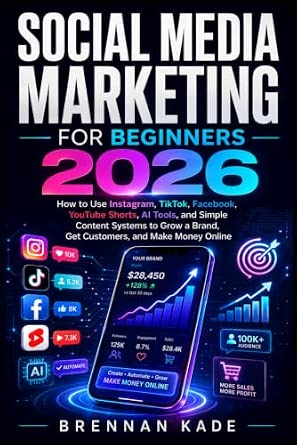
Social Media Marketing for Beginners 2026: A Guide to Instagram, TikTok, Facebook, YouTube Shorts, AI Tools, and Content Systems
This beginner-focused book earns its place by pairing AI tools with simple content systems across Instagram, TikTok, Facebook, and YouTube Shorts. That broad platform mix makes it a better starting point for someone choosing where to build an audience than ChatGPT for Content Creation, which centers on writing captions and video scripts for three platforms. The tradeoff is less clarity about the book’s specific methods: the supplied description does not detail its workflows or explain how it handles scheduling and other automation tasks. I’d treat it as an introduction to social media marketing with AI in the mix, not as a documented automation manual. Its beginner focus may help readers organize a first content routine, but experienced marketers may want more operational detail.
Pros:- Covers Instagram, TikTok, Facebook, and YouTube Shorts
- Connects AI tools with simple content systems
- Beginner audience makes its intended level clear
- Includes audience growth and online monetization as goals
Cons:- The supplied description does not explain the specific methods or workflows
- No scheduling, publishing, or other automation capabilities are specified
- Book length and additional format details are not provided
Best for: New creators who want an introductory overview of marketing across several major social platforms and basic AI-supported content systems.
Not ideal for: Experienced social media managers seeking detailed automation procedures, platform-specific tactics, or clearly described workflows.
- Format:Book
- Topic:Social media marketing
- Platforms:Instagram, TikTok, Facebook, YouTube Shorts
- Tools covered:AI tools
- Intended audience:Beginners
- Content approach:Simple content systems
- Stated goals:Audience growth and making money online
Our verdict“Choose this as a broad starting guide if you are new to social media marketing, but look elsewhere for detailed automation workflows.”
AI-Powered Social Media Marketing: Step-by-Step Prompts and Workflows to Grow on Instagram, TikTok, and Facebook Without Burning Out
This guide is the clearest fit here for readers who want step-by-step prompts and workflows, rather than a general introduction to social media. Its focus on Instagram, TikTok, and Facebook gives it a more defined scope than Social Media Marketing for Beginners 2026, which also covers YouTube Shorts but supplies little detail about its methods. The promise of sustainable marketing also speaks to creators who need a repeatable process instead of more posting demands. Still, the available description does not specify how the workflows handle scheduling, approvals, analytics, or platform changes, so I wouldn’t assume it functions like automation software. It is best approached as a practical guide to AI-assisted work, with less breadth than a multi-platform survey.
Pros:- Explicitly focuses on step-by-step prompts and workflows
- Covers Instagram, TikTok, and Facebook
- Addresses sustainable marketing and burnout avoidance
- More workflow-focused in its stated scope than a general beginner overview
Cons:- The supplied description does not specify scheduling or automated publishing
- No details are provided about analytics, approvals, or workflow tools
- Does not list YouTube among its covered platforms
Best for: Solo creators and small marketing teams who want prompt-led processes for Instagram, TikTok, and Facebook without building an overly demanding content routine.
Not ideal for: Readers who need confirmed publishing, scheduling, analytics, or YouTube-specific workflows rather than guidance on prompts and marketing processes.
- Topic:AI-powered social media marketing
- Platforms:Instagram, TikTok, Facebook
- Methods:Step-by-step prompts and workflows
- Stated focus:Growing an online presence
- Workload emphasis:Marketing without burning out
- AI approach:Prompt-led workflows
Our verdict“Pick this guide if you want structured AI prompts and sustainable routines for three social platforms, not a full publishing automation system.”
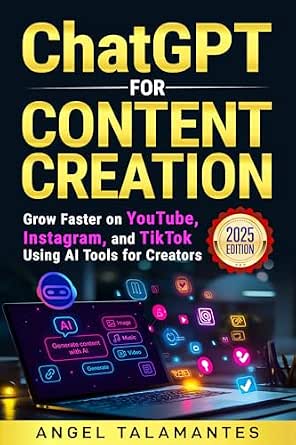
ChatGPT for Content Creation: A Practical Guide to Using AI Tools for YouTube, Instagram, and TikTok
For creators whose main bottleneck is producing words for social posts and videos, this guide has the most focused promise in the group: ChatGPT and other AI tools for captions and video scripts on YouTube, Instagram, and TikTok. That makes it a closer match for hands-on content creation than AI-Powered Social Media Marketing, whose stated emphasis is broader prompts and workflows for marketing on Instagram, TikTok, and Facebook. The narrower writing focus can help a creator turn ideas into usable copy, but it does not establish that the book covers scheduling, publishing, or end-to-end account management. Buyers looking for a full automation playbook may find the scope limited. It is also presented as part of the AI Business Blueprint series, rather than as a platform-wide marketing guide.
Pros:- Directly addresses captions and video scripts
- Covers YouTube, Instagram, and TikTok
- Includes ChatGPT and other AI tools
- Content-creation scope is clearly defined
Cons:- Scheduling and publishing automation are not specified
- The described platform list does not include Facebook
- The supplied description gives no detail on its workflows or methods
Best for: Video creators and social media freelancers who want AI-assisted captions and scripts for YouTube, Instagram, and TikTok.
Not ideal for: Businesses seeking a full social media automation process, including scheduling, publishing, analytics, or Facebook-specific guidance.
- Topic:AI-assisted content creation
- AI tools:ChatGPT and other AI tools
- Platforms:YouTube, Instagram, TikTok
- Content types:Captions and video scripts
- Series:AI Business Blueprint
- Guide style:Practical guide
Our verdict“Choose this for AI-assisted captions and video scripts across three creator platforms, but not as a complete social media automation guide.”

How We Picked
I compared the eight titles as educational resources for AI-assisted social media work, not as direct substitutes for scheduling platforms. The criteria were audience clarity, practical workflow guidance, relevance to social channels, usefulness of AI or prompt instruction, and how well each title appears suited to a reader’s starting level. I gave more weight to a clear, actionable fit than to broad claims about growth or automation.
The ranking favors resources with a defined audience and a practical link between AI assistance and social publishing. That puts the small-business title first for its focused use case, followed by guides with wider platform strategy or specific creator workflows. General beginner guides remain valuable for foundational learning, but rank lower for buyers seeking advanced automation direction. Since titles alone do not confirm software integrations, scheduling features, or the depth of each method, readers should check the book description and sample pages before buying.
| AI social media automation tool | Platforms | Topic |
|---|---|---|
| AI for Scaling Content and Soc | — | — |
| Best AI Tools for Content Crea | — | — |
| AI Tools for Content Creators: | Not specified in available product information | — |
| AI-Powered Social Media Market | Facebook, YouTube, Instagram, X, TikTok | — |
| The Ultimate Social Media Mark | Facebook, Instagram, TikTok, YouTube | Social media marketing |
| Social Media Marketing for Beg | Instagram, TikTok, Facebook, YouTube Shorts | Social media marketing |
| AI-Powered Social Media Market | Instagram, TikTok, Facebook | AI-powered social media marketing |
| ChatGPT for Content Creation: | YouTube, Instagram, TikTok | AI-assisted content creation |
Factors to Consider When Choosing AI Social Media Automation Tools
Choose a guide by the work you want to improve, not by the word “AI” in its title. These resources can teach planning and content workflows, but a book or guide will not automatically connect your accounts or publish posts for you. The factors below help separate learning material from the software and operating system your social channels may need.
Match the resource to your role and workload
A solo business owner needs a different system from a video creator or a social media manager handling several brands. A focused guide can make advice easier to apply because it starts with a recognizable workload and audience. Broad creator resources may offer more ideas, but you may need to adapt examples to your own business. Before choosing, list the tasks you want to improve, such as generating post ideas, repurposing video, or planning a weekly calendar. A common mistake is selecting the broadest title and assuming it will be the most useful. When your team has distinct responsibilities, prioritize material that reflects those roles rather than a single generic workflow.
Separate workflow education from publishing automation
AI guidance can help draft captions or organize a content pipeline, while automation software handles account connections, queues, approvals, and scheduled publishing. Those are related needs, but they are not interchangeable. If you need posts to go live without manual copying, verify that the software you plan to use supports your platforms and the publishing actions you want. A guide can still be valuable, especially for deciding what to publish and how to review generated material. Avoid buying educational content expecting it to provide integrations or an automated posting dashboard. For an end-to-end setup, consider whether you need both a learning resource and a separate tool.
Check whether platform coverage matches your channels
Multi-platform guides may help when your audience is spread across channels, but broad coverage can mean less room for platform-specific detail. If most of your effort goes into one network, look for instructions that address its formats, content cadence, and audience behavior. Consider how often you need to adapt one idea into different formats, since a video script may not translate cleanly into a short caption or a community post. A frequent mistake is treating cross-posting as simple duplication. Stronger workflows adapt the hook, length, and call to action for each channel. Choose breadth when managing several channels is the problem; choose depth when one platform drives most of your results.
Look for reusable processes, not prompt volume
A long list of prompts can appear useful but may not solve the harder problem: making AI outputs consistent with your brand and goals. Look for a process that explains how to provide context, refine drafts, check accuracy, and turn approved content into repeatable work. Reusable templates are most helpful when they leave room for audience details and campaign objectives. If a workflow skips editing and review, it can increase output while making content less distinctive. Before committing, check sample material for examples that show the steps from idea to publishable post. The best fit is a method you can repeat without making every post sound alike.
Set expectations for human review and brand control
AI can speed up first drafts, but a person still needs to check facts, tone, rights, and sensitive topics. This matters especially when posts make product claims, discuss current events, or speak for a business. Decide who owns final approval before adding automation to a team workflow. Small teams may prefer a simple review checklist, while larger teams may need documented approvals and clear account permissions. A common mistake is automating publication before defining who can correct an error or pause a queue. Favor guidance that treats review as part of the workflow rather than an optional final step.
Decide when broader guidance is worth the extra effort
A wide-ranging marketing guide can help readers who are still choosing channels and building a strategy, while a narrowly focused resource may be easier to put into practice immediately. The tradeoff is flexibility versus specificity: broader coverage can support future needs but may require more filtering today. If you already know your audience, platforms, and posting goals, spend more attention on practical examples and workflow detail than on general overviews. If your strategy is still unsettled, foundational material may prevent you from automating an unsuitable plan. Compare the table of contents and sample pages against the decisions you need to make this month. Choose scope based on the next real task, not on the number of topics promised.
Frequently Asked Questions
Are these AI social media automation tools software that publish posts for me?
No. The eight entries in this roundup are guide titles, so they offer instruction rather than verified account connections or automatic publishing. They may explain ways to use AI in content planning and creation, but that is different from scheduling posts through a connected platform. If publishing automation is your main goal, check software documentation for supported networks, approval steps, and scheduling functions. You can use a guide alongside that software to develop a more consistent content process.
Which type of guide should I choose if I run a small business?
Start with a resource aimed directly at small-business owners, since its intended audience is closer to the staffing and planning limits many small teams face. Then check whether its examples address your channels and the kinds of posts you need to produce. If you mainly need broad channel strategy, a multi-platform marketing guide may be a better companion. Avoid assuming that a business-focused title will include a full software setup; confirm the actual topics in the description or sample pages. Choose the option that maps to a task you can put into practice soon.
Should I pick a broad multi-platform guide or one focused on ChatGPT?
Choose a multi-platform guide if your challenge is coordinating strategy across several channels. A ChatGPT-focused resource may suit you better if you want help applying one AI assistant to creator workflows and social content. Neither choice automatically covers every platform or guarantees current feature instructions, so review the scope before buying. If your work spans multiple channels but relies heavily on one drafting assistant, the two approaches may complement each other. Make the first purchase based on the task causing the most friction now.
How can I tell whether a guide will help me automate a real workflow?
Look for examples that connect inputs, drafting, editing, approval, and publishing rather than presenting isolated prompts. Check whether the material explains how to supply audience and brand context, adapt content for different platforms, and review AI outputs. Also confirm whether “automation” means a repeatable process or direct software actions such as scheduling and account integration. A sample chapter or detailed contents page can reveal whether the guidance is practical enough for your needs. If integration instructions are missing, plan to pair the resource with separate publishing software.
Do beginner social media guides make sense if I already post regularly?
They can help if your current posting is inconsistent or lacks a clear system, even if you know the basics of using social platforms. Their value is lower when you already have a stable calendar and need advanced automation, team approvals, or detailed channel tactics. Compare the guide’s scope with the problem you are trying to solve, rather than choosing based only on its beginner label. A foundational resource may be useful for rebuilding your process, but it could repeat material you already know. In that case, a workflow- or prompt-focused title is likely a closer match.
Conclusion
Best overall: choose AI for Scaling Content and Social Media for Small Business Owners if you want a resource with a defined small-business audience. Best value: the beginner-focused guides make the most sense when you need foundational direction before adding more tools. Best premium-style choice: select the multi-platform AI marketing guide if you need broader strategic coverage, while checking its contents for the depth you expect. Best for beginners: pick one of the dedicated beginner guides to build a steadier approach before automating more of your process. Best for specific needs: turn to the step-by-step prompts guide for repeatable content workflows or the ChatGPT creator guide for AI-assisted video and social content. None of these titles alone replaces publishing software, so pair your choice with a connected scheduler if automatic posting is the goal.