
Using temperature and top-p isn’t complicated once you get the hang of it. Temperature controls how random or focused the responses are—lower for predictable replies, higher for creative ones. Top-p dynamically picks from words based on their cumulative probability, balancing coherence and variety. By adjusting these settings, you can shape AI responses to match your needs. Keep exploring, and you’ll discover how mastering these parameters can make your interactions more effective and engaging.

Get business pricing on tech for your team
- Business-only prices and quantity discounts
- Tax-exempt purchasing
- Multiple users, one account, clear invoices
Key Takeaways
- Both parameters are adjustable tools that help control AI response diversity and predictability.
- Lower values produce more conservative, focused outputs; higher values increase creativity and variability.
- Understanding their roles simplifies tuning responses without confusion.
- Experimenting with different settings reveals their impact on output style and coherence.
- Mastering these controls allows for customizing responses to meet specific needs effectively.
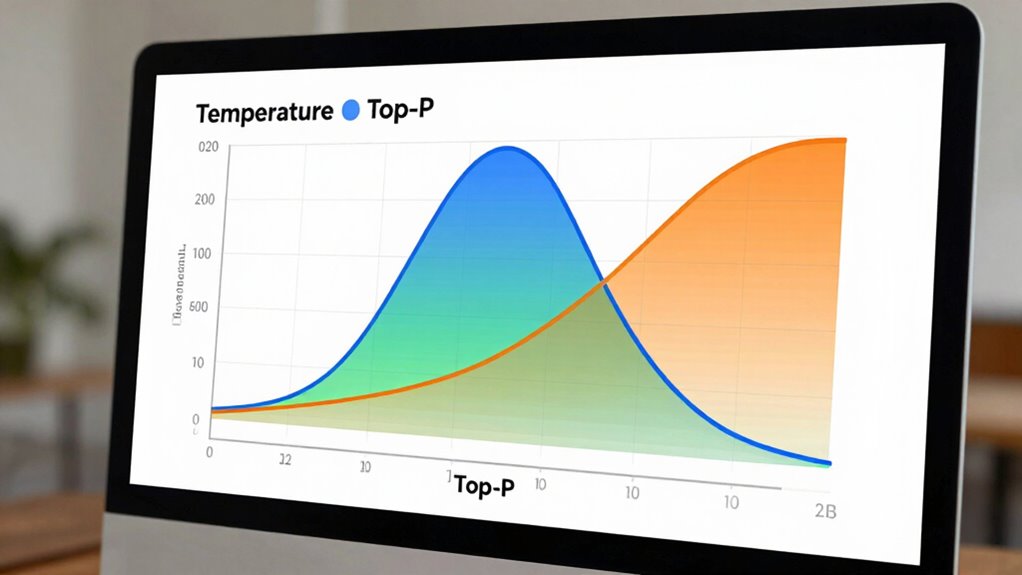
Have you ever wondered how AI models generate diverse or focused responses? The secret lies in a few key parameters, primarily temperature and top-p, which might seem confusing at first but are actually straightforward once you understand their roles. These parameters are essential tools for model tuning, allowing you to control the randomness of the output and shape the responses to suit your needs.
Temperature is like a dial for randomness control. When you set a low temperature, say 0.2, the AI tends to produce more conservative, predictable responses. It sticks closely to common patterns and the most probable words or phrases. On the other hand, cranking up the temperature to 0.8 or higher introduces more variability, encouraging the model to explore less obvious options. This can lead to more creative or diverse outputs, but it also increases the chance of generating responses that are less coherent or relevant. Adjusting temperature gives you a way to fine-tune how focused or exploratory your AI’s responses are, making it a vital component of model tuning. Understanding sampling methods can help you better grasp how these parameters influence AI output, especially since they are part of broader model tuning techniques.
Top-p, often called nucleus sampling, offers a different approach to randomness control. Instead of relying solely on the most probable words, it considers a subset of words whose cumulative probability adds up to a specified threshold, such as 0.9. This means the model dynamically chooses from the top portion of the probability distribution, balancing predictability with variety. Top-p is especially useful when you want to maintain coherence while still allowing for some creativity. It’s a flexible way to manage randomness because it adapts to the context, including less likely words if they contribute to a richer, more interesting response. Recognizing the parameters involved can demystify the process and make it easier to experiment effectively. Additionally, understanding probability distributions can deepen your comprehension of how these sampling techniques work together to generate nuanced outputs.
You don’t need to see these parameters as intimidating obstacles. Instead, think of them as tools that empower you to craft responses that match your intent. Whether you want precise, reliable answers or more inventive, surprising outputs, adjusting temperature and top-p helps you achieve that. The key is experimenting with different settings to understand how they influence the model’s behavior. Over time, you’ll find the right balance that makes your interactions with AI both effective and engaging. By understanding and applying these controls, you turn what might seem like complex options into straightforward ways to shape your AI’s responses to your liking.
Products Worth Considering

Bose QuietComfort Wireless Noise Cancelling Headphones, Sandstone

Sonos Era 100 SL Compact Microphone-Free Speaker – Black

DJI Osmo Mobile 8 3-Axis Phone Gimbal Stabilizer
As an affiliate, we earn on qualifying purchases.
Frequently Asked Questions
How Do Temperature and Top-P Affect Response Creativity?
You can influence your neural network’s response creativity by adjusting temperature and top-p. Higher temperature makes the language more diverse, encouraging unexpected or creative outputs, while lower temperature results in more focused, predictable responses. Top-p controls the probability threshold for word selection, balancing coherence and diversity. By tweaking these settings, you guide your AI to generate responses that suit your desired level of language diversity and creativity.
Can I Use Temperature and Top-P Together?
Ever wondered if you can combine parameter tuning techniques? Yes, you can use temperature and top-p together to enhance response variability. Adjusting both allows you to fine-tune creativity and diversity in outputs, giving you more control over responses. By balancing these parameters, you create a more nuanced, dynamic output tailored to your needs. Don’t think of it as conflicting; think of it as a powerful way to craft better, more engaging responses.
What Are Common Mistakes When Setting Temperature and Top-P?
A common mistake in parameter calibration is setting temperature and top-p without understanding their combined effect on model tuning. You might choose values that either make responses too random or too conservative, reducing output quality. Always test different settings to find a balance that aligns with your goals. Avoid assuming they work independently; their interplay influences creativity and coherence, so fine-tune them carefully for best results.
How Do I Choose the Best Temperature for My Task?
You can choose the best temperature by considering your model training goals and data preprocessing needs. Start with a moderate setting, around 0.7, and adjust based on your results. Lower temps produce more focused, conservative responses, ideal for factual info, while higher temps foster creativity. Experiment and observe how your data preprocessing impacts output, refining the temperature to balance creativity and accuracy for your specific task.
Are There Scenarios Where Only One Parameter Is Sufficient?
Sometimes, only one parameter suffices, especially when you need clear, consistent responses. If your task demands high contextual appropriateness, adjusting the temperature might be enough to control creativity. Conversely, when you want diverse outputs, prioritizing Top-P can be more effective. Focus on parameter prioritization based on your specific needs. In simple scenarios, using just one parameter streamlines the process and guarantees your results stay aligned with your goals.
Conclusion
Now that you understand how temperature and top-p shape your AI’s responses, you’re better equipped to steer conversations and creativity. Think of these settings as the keys to revealing endless possibilities—each turn a new melody, each tweak a fresh harmony. Don’t let confusion hold you back; embrace the rhythm of these tools, and let your imagination dance freely. After all, mastering these controls is like conducting your own symphony of ideas.