
AI PCs and NPUs are hardware components built to speed up AI tasks directly on your devices, making processes faster and more efficient. They use specialized architectures, like dedicated cores and parallel processing, to handle neural network calculations with less power, heat, and latency. This means longer battery life and smoother performance. If you want to understand how these innovations improve your devices without hype, there’s more to discover below.

Get tech for your team delivered free — and shop member deals
- Fast, free delivery on millions of items
- Access to Prime Big Deal Days deals on October 6–7
- Prime Video, Amazon Music and more included
Key Takeaways
- AI PCs and NPUs are hardware components designed to accelerate AI tasks directly on devices, improving speed and efficiency.
- They use specialized architectures with dedicated cores to perform neural network operations more effectively than general-purpose CPUs.
- These chips are optimized for low power consumption, extending battery life and reducing heat in mobile and embedded devices.
- Industry adoption is driven by the need for efficient, high-performance AI hardware that balances speed with energy use.
- They enable everyday devices to handle complex AI workloads quickly, making AI more practical and accessible in real-world applications.
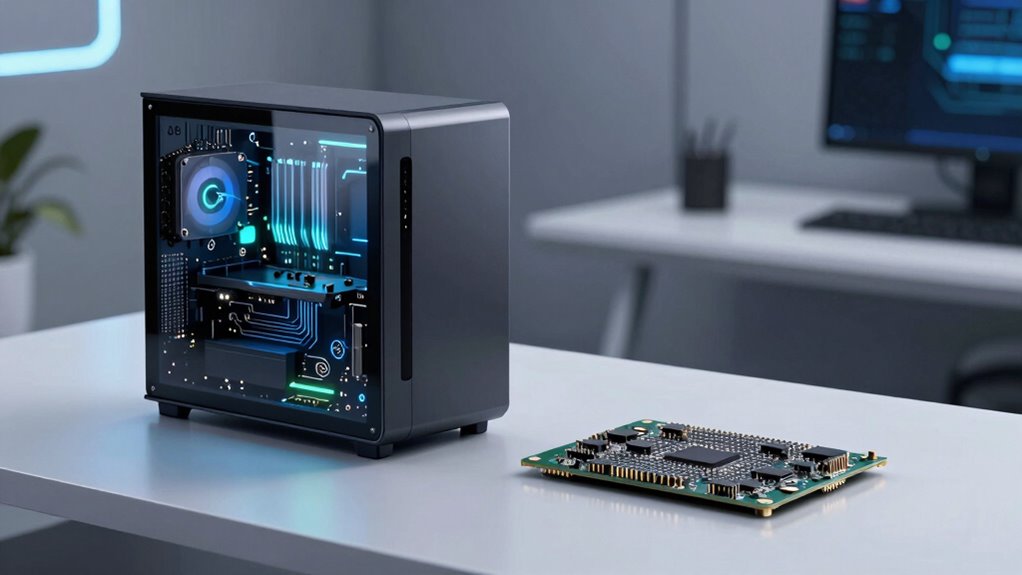
Artificial intelligence personal computers (AI PCs) and neural processing units (NPUs) are transforming how we handle complex data and machine learning tasks. These technologies are designed to accelerate AI workloads directly on your device, allowing for faster processing and more efficient performance. Unlike traditional CPUs, which are general-purpose and may struggle with intensive AI operations, AI PCs and NPUs are optimized specifically for these tasks, making them powerful tools for AI development and deployment.
One of the key advantages of AI PCs and NPUs is hardware optimization. These units are built with specialized architectures that streamline AI computations. They typically incorporate parallel processing capabilities and dedicated cores that handle neural network operations more efficiently than standard hardware. This specialization results in quicker data processing, reduced latency, and lower power consumption, which is vital for devices that need to operate continuously or in energy-constrained environments. By optimizing hardware for machine learning workloads, AI PCs and NPUs free up system resources, allowing your device to perform multiple tasks seamlessly without sacrificing speed or accuracy. Additionally, advancements in AI hardware are continuously driving innovation, making these components even more efficient and capable. As AI hardware becomes more widely adopted, the integration of these specialized units is fostering a shift toward smarter hardware design****, making AI hardware more adaptable to various device types and industries.
Power efficiency is another essential benefit. Traditional computing hardware often consumes significant energy when running AI algorithms, leading to faster battery drain and higher operational costs. NPUs, however, are designed to perform AI tasks with minimal power usage. They achieve this by reducing unnecessary data movements and focusing on core computations, which conserves energy and extends battery life. For mobile devices and edge computing applications, this power efficiency means you can run complex AI models longer without needing frequent recharges or external power sources. It also reduces heat generation, keeping devices cooler and more reliable over time. This energy-conscious design is a crucial factor in making AI hardware suitable for a broad range of practical, real-world applications.
Furthermore, the integration of AI hardware like NPUs has been driven by the increasing demand for specialized AI hardware, which emphasizes hardware optimization and power efficiency. By integrating AI PCs with NPUs, you’re effectively enabling smarter, more responsive systems that are also energy-conscious. These units aren’t just about raw speed—they’re about smarter hardware design that balances performance with power consumption. This balance makes AI hardware more accessible and practical for everyday use, from smartphones to personal computers and embedded systems. As a result, you benefit from faster AI processing without the trade-offs of increased energy costs or reduced device lifespan.
In essence, AI PCs and NPUs are reshaping how we think about machine learning hardware. They emphasize hardware optimization and power efficiency, ensuring that AI tasks are handled swiftly and sustainably. This shift not only improves performance but also makes AI more practical for widespread, real-world applications, giving you smarter, more efficient devices that keep up with your needs.
As an affiliate, we earn on qualifying purchases.
Frequently Asked Questions
How Do NPUS Differ From Traditional CPUS and GPUS?
NPUs differ from traditional CPUs and GPUs by focusing on specialized hardware integration for AI tasks. They process neural networks more efficiently, boosting processing efficiency. Unlike CPUs and GPUs, which handle a broad range of computations, NPUs optimize AI workloads directly, making your devices faster and more power-efficient in AI applications. This specialization allows NPUs to deliver better performance for AI tasks without unnecessary energy consumption.
Are AI PCS Suitable for All Types of AI Workloads?
AI PCs are like Swiss Army knives—adaptable, but not always perfect for every task. They can handle diverse AI workloads, but their effectiveness depends on hardware compatibility. For complex, specialized AI tasks, dedicated hardware like NPUs might be better suited. If your AI workload is varied, an AI PC can be versatile, but for maximum efficiency, matching hardware to specific needs is key.
What Are the Energy Consumption Implications of AI PCS?
AI PCs often consume more power than traditional computers due to their high-performance components, but many are designed for better power efficiency. By optimizing hardware and software, you can achieve significant energy savings, reducing overall power consumption. This not only benefits your electricity bill but also lessens environmental impact. So, while AI PCs may use more energy initially, focusing on energy-efficient designs can help you balance performance with energy savings.
Can Existing Software Seamlessly Utilize NPUS?
You wonder if your existing software can seamlessly utilize NPUs? It’s not straightforward. Compatibility depends on whether developers have optimized software to leverage NPU capabilities. Performance optimization often requires updates, specialized drivers, or APIs designed for these processors. Without these, your software might run but won’t fully harness the NPU’s power. So, to uncover true potential, expect some adaptation or future updates for smooth integration.
How Secure Are AI PCS With Integrated NPUS?
AI PCs with integrated NPUs are generally secure, but hardware integration can introduce security vulnerabilities if not properly managed. You should stay vigilant about firmware updates and manufacturer security patches, as these help address potential flaws. While NPUs enhance performance, they can become targets for attacks if exploited. Regularly reviewing security protocols and ensuring robust access controls will help protect your system against threats.
As an affiliate, we earn on qualifying purchases.
Conclusion
Just like the quiet strength of a well-trained knight, AI PCs and NPUs silently power your devices, ready to defend your data and enhance performance. As you navigate a world filled with digital dragons and cyber castles, understanding these components lets you wield technology with confidence. Remember, behind every smooth interaction is a hidden hero working tirelessly—much like the unseen hand that guides the legendary sword in the stone, ensuring your tech remains swift and secure.
As an affiliate, we earn on qualifying purchases.
As an affiliate, we earn on qualifying purchases.
Fall Picks
fall essentials
As an affiliate, we earn on qualifying purchases.