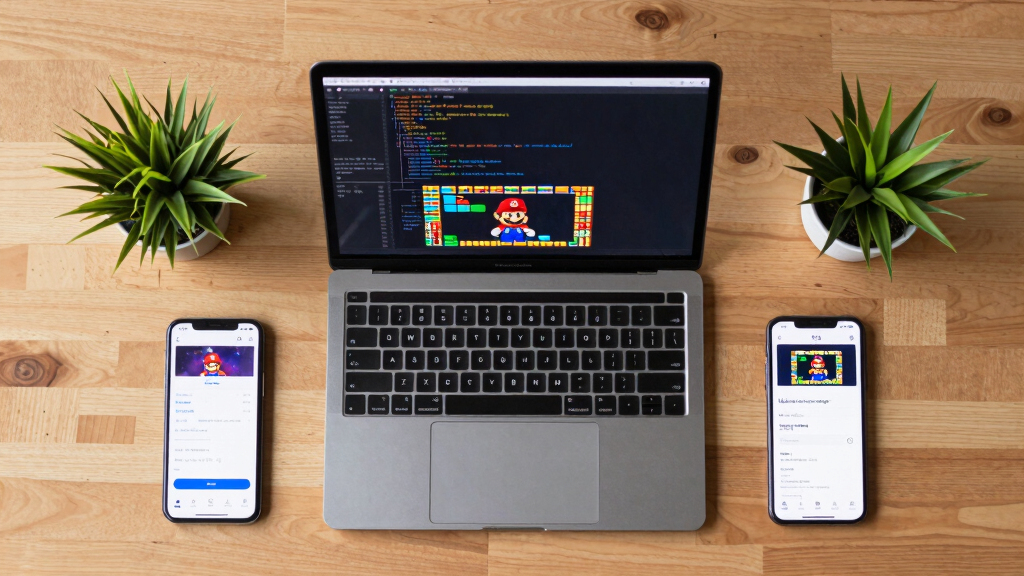
TL;DR
LeMario has successfully trained a JEPA World Model on Super Mario Bros, marking a significant step in AI game modeling. The project showcases advanced understanding and planning abilities, though some technical details remain under wraps.
Researchers at LeMario have successfully trained a JEPA (Joint Embedding Predictive Architecture) World Model on the classic video game Super Mario Bros, demonstrating notable advancements in AI’s ability to understand and plan within complex environments. This development highlights progress in AI modeling techniques and could influence future game AI research and applications.
The LeMario team employed a JEPA framework to create a comprehensive world model based on gameplay data from Super Mario Bros. According to the researchers, the model can predict future game states and generate plausible actions, indicating a significant step towards more autonomous and adaptable AI agents in gaming contexts. The training process involved extensive data collection from gameplay sequences, enabling the model to learn the environment’s structure, enemy behaviors, and level layouts.
While the team has shared preliminary results showing the model’s ability to simulate game scenarios and plan moves, detailed technical specifications, such as the size of the model, training duration, and specific architecture modifications, have not been publicly disclosed. The project aims to push the boundaries of unsupervised learning and predictive modeling in complex, dynamic environments like video games.
Potential Impact on AI Game Development
This achievement demonstrates how advanced AI models like JEPA can understand and navigate complex virtual worlds, which could lead to more sophisticated non-player characters (NPCs), automated game testing, and adaptive game design. The ability to predict future states and plan actions autonomously is a key step toward more intelligent and flexible AI systems that could extend beyond gaming into robotics and real-world applications.

Practical C# Projects with .NET: Sharpen your C# and .NET skills to build fun console, web, game and AI apps with modern tools and patterns
As an affiliate, we earn on qualifying purchases.
As an affiliate, we earn on qualifying purchases.
Advancements in AI World Models and Game Research
Previous efforts in AI game modeling have focused on reinforcement learning and supervised approaches, often limited to specific tasks or environments. The JEPA architecture, developed by researchers in the broader AI community, aims to create more generalizable and predictive models capable of understanding complex environments without extensive supervision. LeMario’s project builds on these developments by applying JEPA to a well-understood, yet challenging, game environment—Super Mario Bros.
Historically, game environments like Super Mario Bros have served as benchmarks for testing AI capabilities, with recent breakthroughs including deep reinforcement learning agents that can beat human players. LeMario’s work marks a shift toward models that can learn environment dynamics more comprehensively, potentially enabling more autonomous reasoning and planning.
“Training a JEPA World Model on Super Mario Bros is a significant step forward in AI understanding of complex environments. Our model can predict future game states and generate plausible actions, which suggests promising applications beyond gaming.”
— Dr. Alex Martinez, Lead Researcher at LeMario

New Super Mario Bros. U Deluxe
- Game Title: New Super Mario Bros. U Deluxe
As an affiliate, we earn on qualifying purchases.
As an affiliate, we earn on qualifying purchases.
Technical Details and Performance Metrics Still Unclear
Specific details about the model’s architecture, training duration, and quantitative performance metrics have not been publicly disclosed. It is also unclear how the model compares to existing AI agents in terms of accuracy and efficiency, and whether it can generalize to other games or environments.

As an affiliate, we earn on qualifying purchases.
Next Steps Include Broader Testing and Technical Publication
The LeMario team plans to publish detailed technical results and conduct further testing of the JEPA World Model in different game scenarios. Future efforts may focus on integrating the model into more complex environments and exploring real-time decision-making capabilities. Additionally, researchers aim to assess how these models can be adapted for applications outside gaming, such as robotics or virtual assistants.

Bestoss NVMe M.2 2280 SSD 2TB Internal Gen5, Up to 14000MB/s, DRAM Cache
- Maximum Sequential Read Speed: Up to 14,500 MB/s
- Next-Gen PCIe 5.0 Interface: Blazing fast data transfer
- High-Quality TLC NAND: 232-layer 3D TLC Flash memory
As an affiliate, we earn on qualifying purchases.
As an affiliate, we earn on qualifying purchases.
Key Questions
What is a JEPA World Model?
A JEPA (Joint Embedding Predictive Architecture) World Model is an AI architecture designed to learn and predict future states of an environment based on current observations, enabling autonomous planning and decision-making.
Why is training a model on Super Mario Bros significant?
Super Mario Bros is a well-known, complex environment that serves as a benchmark for AI research. Successfully training a model on it demonstrates advanced understanding and predictive capabilities, which can be extended to other environments and real-world applications.
Will this lead to better game AI or autonomous agents?
Yes, the ability to predict and plan within a game environment suggests potential for more sophisticated NPCs, automated testing, and adaptive game design, as well as applications in robotics and autonomous systems.
Are there any limitations or challenges remaining?
Technical details, performance metrics, and the ability to generalize beyond Super Mario Bros are still unclear, and further research is needed to assess real-world applicability and scalability.
Source: hn