
📊 Full opportunity report: How To Track Your Symptoms Between TRT Lab Tests on IdeaNavigator AI — validation score, market gap, and execution plan.

Get business pricing on tech for your team
- Business-only prices and quantity discounts
- Tax-exempt purchasing
- Multiple users, one account, clear invoices
TL;DR
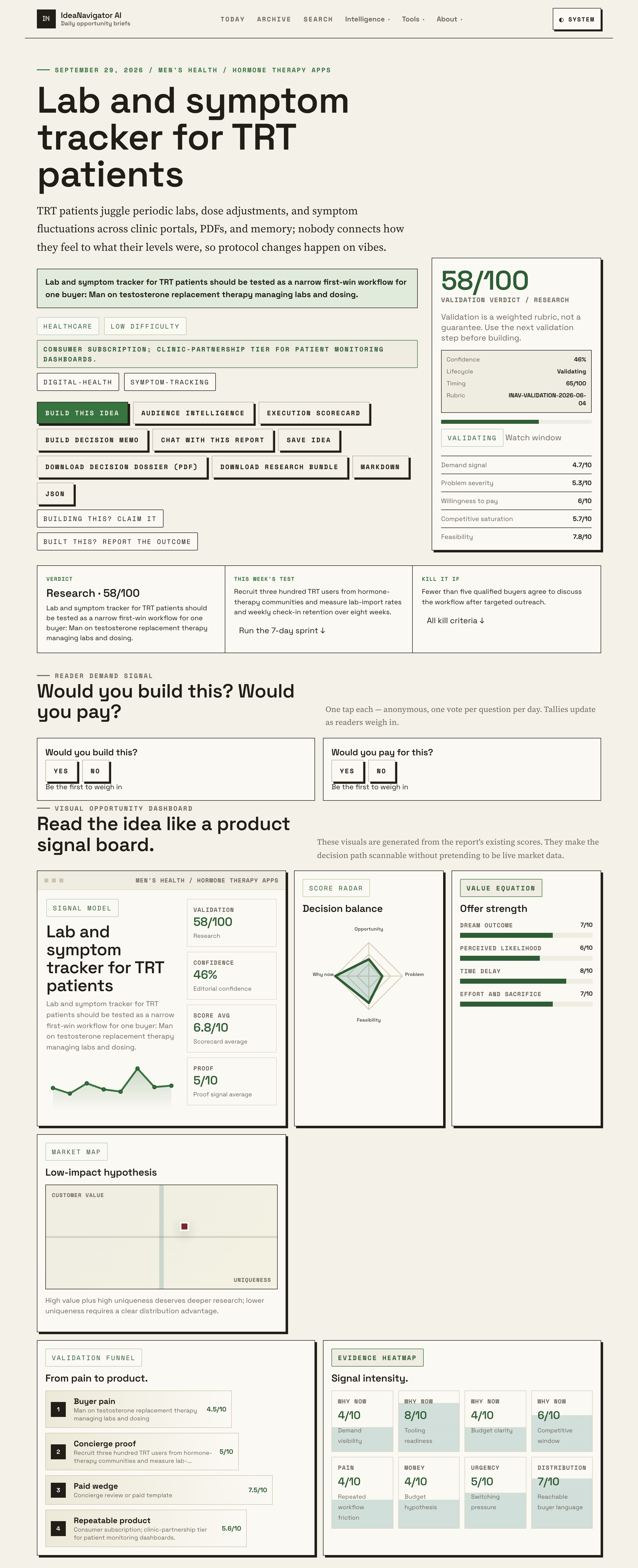
IdeaNavigator AI has published a product concept for a lab and symptom tracker aimed at men on testosterone replacement therapy (TRT). The proposal describes a fragmented self-management experience — labs, dose changes and symptoms scattered across portals and PDFs — and calls for testing a tracker with 300 users over eight weeks.
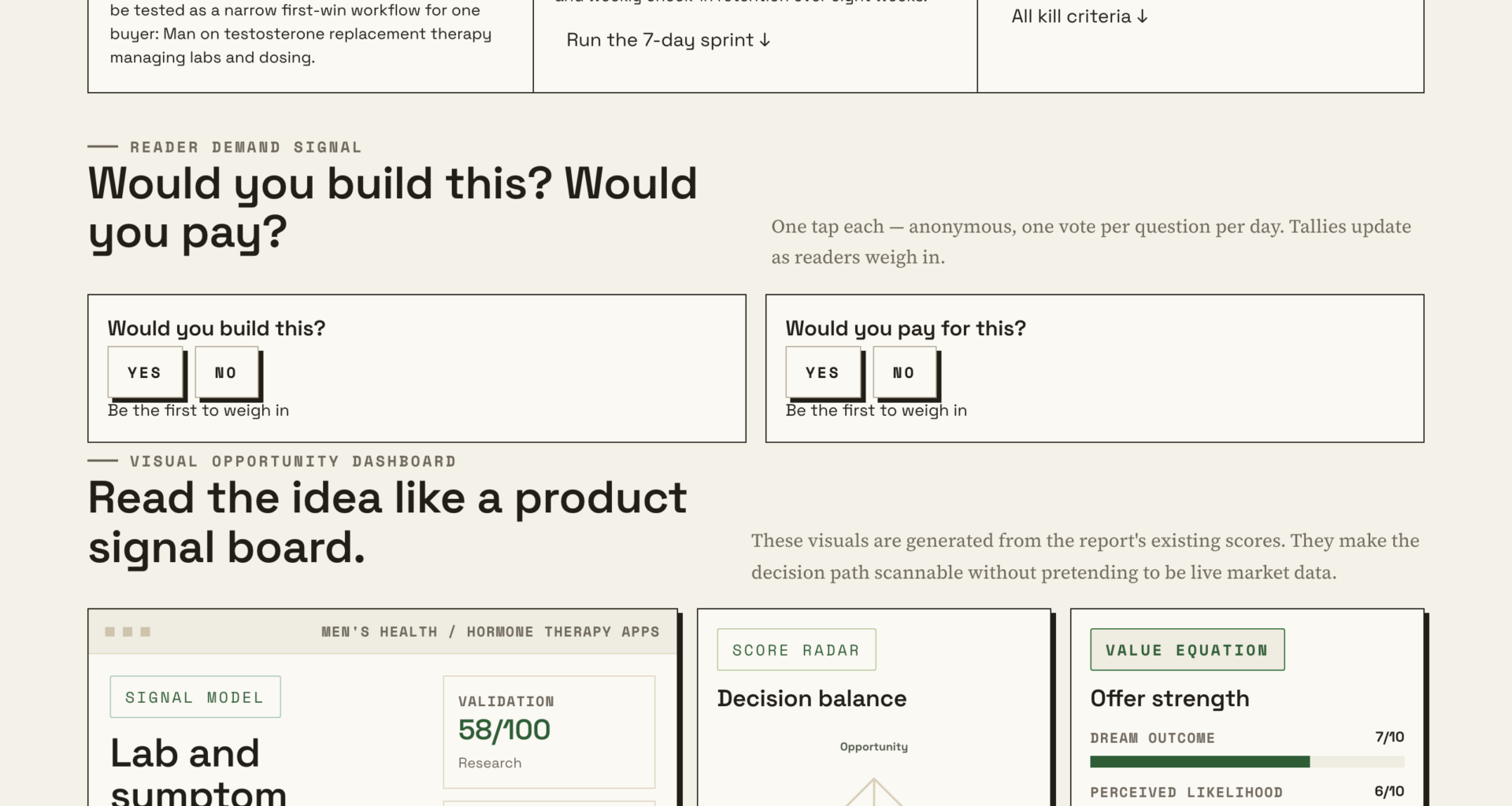
A new product proposal from IdeaNavigator AI argues that men on testosterone replacement therapy (TRT) lack a practical way to connect how they feel to what their lab panels show, and recommends building a lab and symptom tracker as a narrowly scoped first product for this group. The proposal, framed as a startup idea to be validated rather than a launched product, describes TRT patients who juggle periodic labs, dose adjustments and symptom fluctuations across clinic portals, PDF files and memory — with no tool linking symptoms to measured hormone levels.
The core problem the proposal identifies is fragmentation. TRT patients typically receive lab results at intervals, adjust doses in consultation with a clinician, and experience symptoms that fluctuate between those lab draws. According to the proposal, protocol changes happen “on vibes” because no system connects symptom reports to the hormone values recorded at the time. The proposed target user is a single, specific buyer: a man on TRT actively managing his labs and dosing.
The proposed minimum viable product has four components. It would import lab PDFs so results live in one place; it would chart hormone panels over time alongside dose changes and daily symptom check-ins; it would generate trend summaries for clinic visits; and it would flag values drifting outside target ranges. These features are described as a proposal only — no product has been built or released, and IdeaNavigator AI does not claim any clinical validation.
On monetization, the proposal outlines a consumer subscription as the primary revenue model, with a secondary clinic-partnership tier that would give providers patient-monitoring dashboards. The market is identified as men’s health and hormone therapy apps. To validate demand, the proposal calls for recruiting 300 TRT users from hormone-therapy communities and measuring two metrics over eight weeks: lab-import rates and weekly check-in retention.
Why Self-Managing TRT Patients Are Underserved
The proposal’s timing argument rests on a structural shift: TRT prescriptions and telehealth clinics have surged, producing a large population of men who manage much of their own care. Because treatment often spans multiple providers — a prescribing clinic, a lab company, sometimes a primary-care physician — the patient himself becomes the integration point for his own data.
For readers on TRT, the significance is practical. Between lab tests, which may occur only every few months, patients notice changes in energy, mood, libido and sleep but rarely record them systematically. When the next lab draw arrives, recollection of the intervening weeks is imprecise. A tracker that pairs daily check-ins with lab timelines and dose history would give both patient and clinician a clearer basis for adjusting protocol — a claim the proposal makes but has not yet demonstrated with data.
The validation plan is also notable for its modesty. Rather than assuming broad demand, it tests two narrow behaviors — whether users actually import labs and whether they keep checking in weekly — over a fixed eight-week window with 300 recruits from communities where TRT patients already gather.
How the Tracker Would Fit Existing TRT Workflows
TRT care typically follows a cycle: baseline labs, a starting dose, follow-up labs after several weeks, then dose titration. Telehealth hormone clinics have shortened the path to a prescription while distributing the record-keeping burden to the patient. Lab results arrive as PDFs or portal entries from whichever lab performed the draw, and dose instructions may change between visits without any consolidated record.
The proposed tracker would sit between these touchpoints. By importing lab PDFs, it would build a longitudinal hormone panel history. By layering dose-change events and symptom logs onto that history, it would create a timeline a clinician could review at the next visit. The out-of-range flagging feature would alert users when values drift from target ranges, though the proposal does not specify who defines those ranges or how clinical thresholds would be set — a question any implementation would need to answer with clinician input.
What the Proposal Has Not Demonstrated
No product exists yet. Everything described — lab imports, trend charts, symptom check-ins, out-of-range flags — is a proposed feature set, not a shipping capability, and IdeaNavigator AI makes no claim of user testing or clinical endorsement.
Several questions are unresolved in the proposal itself. It does not specify which lab formats would be supported for PDF import, a common technical obstacle given the variation in lab-report layouts. It does not state who sets the target ranges used for flagging, or whether the tool would account for individualized ranges set by a patient’s own clinician. It does not address health-data privacy obligations that would apply to an app storing lab results, or whether the clinic-partnership tier would require regulatory review. The market-claim of surging TRT prescriptions is presented without cited figures, so its magnitude cannot be independently confirmed from the proposal alone.
Whether symptom check-ins can be retained weekly over eight weeks — the central behavioral bet — is precisely what the validation plan is designed to test, and the outcome is unknown.
Testing the Eight-Week Validation Plan
The stated next step is recruitment: 300 TRT users from hormone-therapy communities, such as forums and subreddit groups where patients already discuss protocols. Over eight weeks, the two success signals to watch are lab-import rates — whether users actually feed their PDF results into the tool — and weekly check-in retention, the percentage who keep logging symptoms.
If those metrics hold, the proposal envisions progressing from the MVP to a subscription product and then a clinic-facing monitoring tier. If they do not, the narrow-scope recommendation implies the idea would be revised or abandoned rather than expanded. For readers on TRT, near-term developments to watch include whether any team takes up the proposal and whether comparable tracking spreadsheets or existing men’s-health apps begin adding the same lab-versus-symptom overlay.
Patients interested in better between-lab tracking today can, in the meantime, keep manual symptom logs and retain dose-change dates to bring to clinic visits — a low-tech version of the workflow the proposal aims to formalize.
Source: IdeaNavigator AI
Key Questions
Is a TRT lab and symptom tracker available now?
No. The IdeaNavigator AI document is a product proposal and validation plan. No app has been built, released or tested, and no clinical results are claimed.
How would the proposed tracker connect symptoms to lab results?
According to the proposal, it would import lab PDFs to build a hormone-panel timeline, layer dose changes on top, and collect daily symptom check-ins. Charts and trend summaries for clinic visits would show what symptoms coincided with which levels and doses.
How would the idea be validated?
The plan calls for recruiting 300 TRT users from hormone-therapy communities and measuring lab-import rates and weekly check-in retention over eight weeks.
What should TRT patients do between lab tests in the meantime?
A practical substitute is a manual log: record daily symptoms such as energy, mood, sleep and libido, along with the dates of any dose changes, and bring both to clinic visits alongside lab results.
How would the proposed product make money?
The proposal outlines a consumer subscription as the primary model, plus a clinic-partnership tier offering providers patient-monitoring dashboards.
Source: IdeaNavigator AI
Fall Picks
fall essentials
As an affiliate, we earn on qualifying purchases.