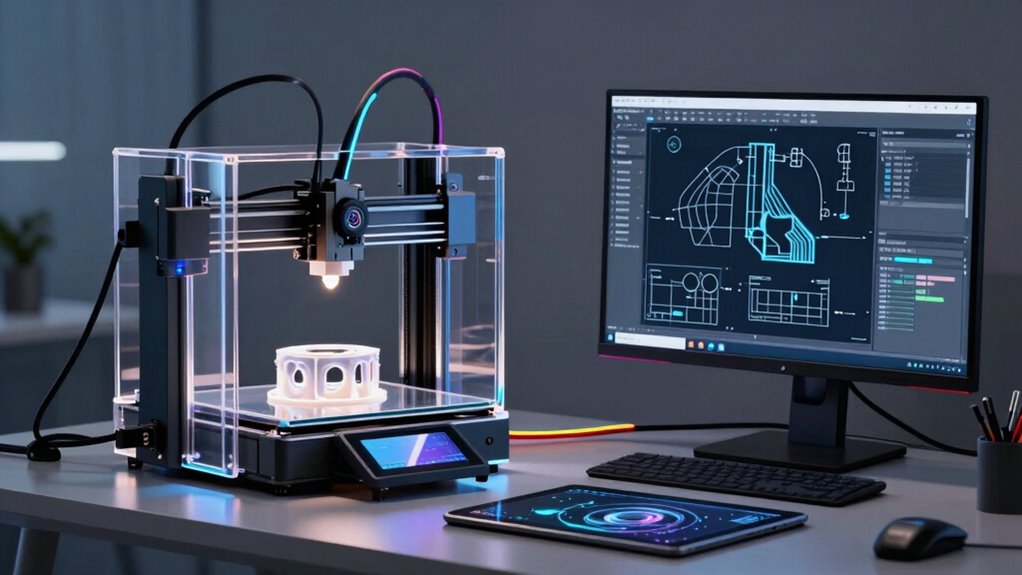

In your workflow, 3D printing and AI connect through rapid prototyping and design optimization. AI accelerates idea refinement by analyzing designs and suggesting improvements, while 3D printing quickly turns those ideas into physical models for testing. This synergy reduces development time, minimizes revisions, and enhances innovation. By combining these technologies, you can explore materials and concepts more freely. Keep exploring to uncover how this powerful collaboration shapes the future of product development.

Get business pricing on tech for your team
- Business-only prices and quantity discounts
- Tax-exempt purchasing
- Multiple users, one account, clear invoices
Key Takeaways
- The workflow integrates AI-driven design optimization with rapid 3D printing for efficient prototyping and testing.
- AI analyzes material properties, guiding 3D printing to produce stronger, lighter, and more functional prototypes.
- Rapid iteration enabled by 3D printing combined with AI reduces development time and minimizes costly revisions.
- The synergy accelerates innovation by enabling quick exploration of design variations and material options.
- Future workflows will increasingly blend AI insights with 3D printing to enable agile, market-responsive product development.
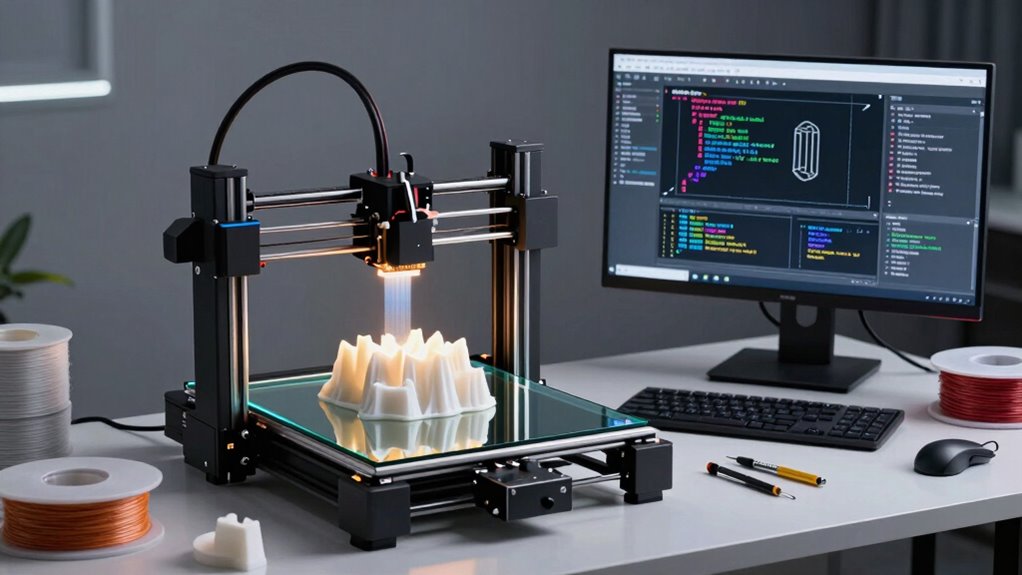
3D printing and AI prototyping are transforming how we design and develop new products, making the process faster and more efficient. With these advancements, you can iterate quickly, test concepts, and refine designs without the traditional delays associated with manufacturing. One of the key drivers behind this shift is material innovation. As new materials become available, you gain access to a broader range of properties—lighter, stronger, more flexible, or more durable—that can be tailored to specific needs. This expands the possibilities of what you can create, allowing you to push boundaries previously limited by conventional manufacturing methods. The rapid prototyping capabilities of 3D printing, combined with AI’s ability to analyze and predict material performance, enable you to select the most suitable materials early in the development process. This synergy accelerates innovation and reduces costly trial-and-error phases. Additionally, material properties are evolving rapidly, giving you even more options to customize your designs for optimal performance.
At the same time, design optimization plays an essential role in this connected workflow. AI-driven algorithms help you refine your designs by analyzing complex variables and suggesting improvements that maximize efficiency and functionality. Instead of relying solely on traditional design intuition, you leverage AI to explore multiple iterations quickly, guaranteeing your product is lightweight, structurally sound, and optimized for manufacturing constraints. This process not only shortens development cycles but also results in more innovative, high-performance products. When integrated with 3D printing, design optimization ensures that each prototype is a closer reflection of your ideal concept, reducing the need for multiple revisions and saving valuable time and resources.
Furthermore, this interconnected workflow fosters a more collaborative and agile environment. As you test and modify your prototypes, AI continuously learns from each iteration, providing insights that guide material choices and design adjustments. This iterative loop enhances your ability to innovate faster while maintaining precision. The combination of material innovation and design optimization powered by AI and 3D printing means you’re not just producing prototypes—you’re actively shaping the future of product development. You gain the flexibility to experiment with new ideas without the traditional constraints, making the entire process more dynamic and responsive to market demands. In this landscape, your ability to adapt quickly and make informed decisions becomes your greatest asset, empowering you to stay ahead in a competitive environment and turn ideas into reality faster than ever before.
3D printer for rapid prototyping
As an affiliate, we earn on qualifying purchases.
As an affiliate, we earn on qualifying purchases.
Frequently Asked Questions
How Cost-Effective Is Integrating AI With 3D Printing?
Integrating AI with 3D printing boosts cost efficiency by reducing material waste and speeding up design iterations. You’ll optimize resources by automating complex tasks and minimizing errors, which cuts costs and saves time. While initial investments might seem high, the long-term benefits include streamlined workflows and better resource management, making the integration highly cost-effective overall. This approach helps you maximize productivity while keeping expenses in check.
What Are the Security Concerns in Ai-Driven Prototyping?
You face serious security concerns with AI-driven prototyping, like risking your ideas being stolen or leaked. Data privacy becomes a nightmare if sensitive information gets into the wrong hands, and your intellectual property could be exposed or copied, causing huge losses. You need robust security measures, encryption, and strict access controls to protect your designs and data, or your innovations could be compromised in an instant—like a castle under siege.
Can AI Improve 3D Print Material Selection?
Yes, AI can improve 3D print material selection through material optimization and design automation. You can leverage AI algorithms to analyze properties like strength, flexibility, and cost, ensuring you choose the best material for your project. AI-driven tools streamline the decision-making process, reduce trial and error, and help you optimize designs for performance and sustainability, ultimately making your 3D printing more efficient and precise.
How Does AI Handle Complex Geometries in Printing?
You might think complex geometries are impossible to print flawlessly, but AI optimization makes it a reality. It analyzes every intricate detail, predicts potential issues, and adjusts the printing process in real-time. AI handles complex geometries with astonishing precision, ensuring your designs come alive with perfect accuracy. This technology transforms impossible shapes into achievable masterpieces, pushing the boundaries of what you thought 3D printing could accomplish.
What Are the Future Trends in AI and 3D Printing Integration?
You’ll see future AI and 3D printing integration focus on enhancing creative design with smarter algorithms that optimize complex geometries and materials. As this tech advances, you’ll need to contemplate ethical implications, like intellectual property and environmental impact. Expect AI to enable more personalized, sustainable prototypes, pushing the boundaries of innovation while prompting you to stay mindful of responsible use and the broader societal effects of these powerful tools.
As an affiliate, we earn on qualifying purchases.
Conclusion
As you navigate the world of 3D printing and AI prototyping, remember they’re like two gears turning in harmony—each enhancing the other’s potential. Embracing their connection streamlines your workflow, making innovation feel as smooth as a well-oiled machine. By integrating these cutting-edge tools, you release faster development, smarter designs, and more efficient iterations. So, jump in with confidence and watch your ideas take shape, like a sculpture emerging from a block of marble—full of possibility.
As an affiliate, we earn on qualifying purchases.
3D printing filament for durable prototypes
As an affiliate, we earn on qualifying purchases.
As an affiliate, we earn on qualifying purchases.
Fall Picks
fall essentials
As an affiliate, we earn on qualifying purchases.