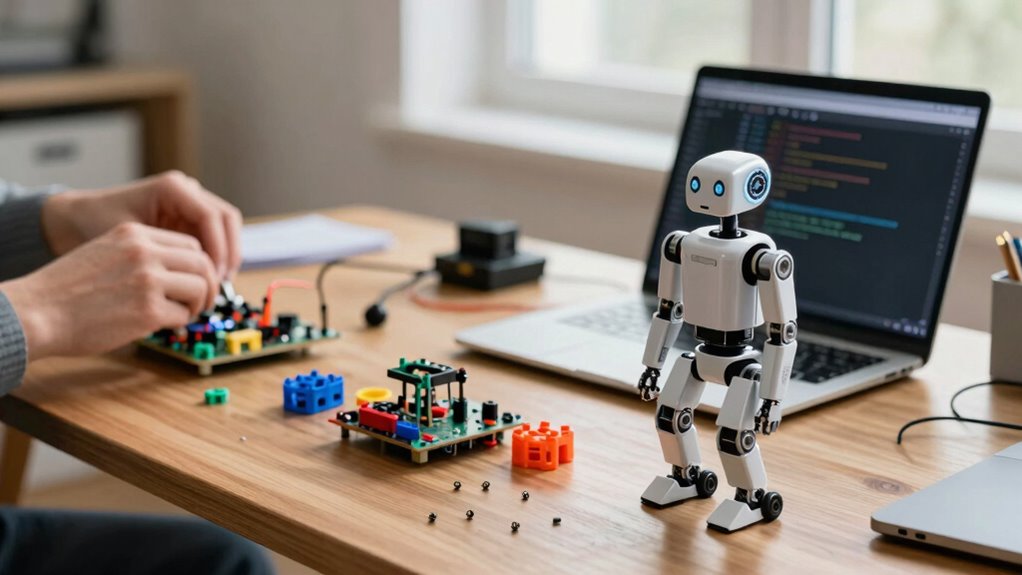

With robotics kits for AI learning, you’re practicing how sensors like infrared and ultrasonic communicate data to the robot’s brain, helping it navigate or react to its environment. You’ll write code to process this sensor data, teaching the robot to avoid obstacles, follow lines, or recognize objects. This hands-on experience sharpens your programming, problem-solving, and algorithmic thinking skills. Keep exploring, and you’ll uncover how these tools transform raw data into intelligent, responsive machines.

Get business pricing on tech for your team
- Business-only prices and quantity discounts
- Tax-exempt purchasing
- Multiple users, one account, clear invoices
Key Takeaways
- Hands-on experience with sensor integration and data communication in robotics systems.
- Programming skills such as coding for obstacle avoidance, line following, and object recognition.
- Development of algorithmic thinking through data processing, decision-making, and optimization.
- Practical understanding of how sensors enable environmental perception and adaptive behavior.
- Creativity in designing robot behaviors and troubleshooting hardware and software challenges.

With the rapid advancement of artificial intelligence, robotics kits have become essential tools for hands-on learning. These kits aren’t just about assembling parts; they’re gateways to understanding complex concepts like sensor integration and coding tutorials. When you dive into building and programming these robots, you’re practicing how to make sensors work seamlessly with hardware, which is crucial for creating responsive, intelligent machines. Sensor integration involves connecting various sensors—like infrared, ultrasonic, or touch sensors—to your robot, enabling it to perceive its environment. This process teaches you how different sensors communicate data to the robot’s brain, which then responds accordingly. It’s a fundamental skill in robotics and AI because it mimics how humans and animals interpret sensory information to navigate and make decisions. Developing proficiency in sensor integration also helps you understand biodiversity, as sensor-based systems can be used to monitor environmental changes and support conservation efforts. Additionally, understanding the data flow between sensors and controllers helps you grasp how real-time processing underpins intelligent behavior in machines.
As you follow coding tutorials included in most robotics kits, you get a practical understanding of programming logic and algorithms. These tutorials often guide you through writing code that processes sensor data, allowing your robot to perform tasks like obstacle avoidance, line following, or object recognition. You learn how to translate real-world inputs into digital commands, bridging the gap between hardware and software. This experience is invaluable because it reinforces core programming concepts—conditional statements, loops, and functions—applied in a tangible context. Through trial and error, you develop problem-solving skills, troubleshooting issues that arise from sensor malfunctions or incorrect code, which mirrors real-world engineering challenges.
Furthermore, working through these tutorials develops your ability to think algorithmically. You’re not just copying code; you’re understanding the logic behind it. For instance, you might learn how to calibrate sensors for more accurate readings or optimize code to improve your robot’s response time. These lessons deepen your comprehension of AI principles, such as data processing and decision-making, in a practical setting. The process also encourages creativity, as you experiment with different sensor combinations and programming approaches to achieve desired behaviors.
Products Worth Considering

LG UltraGear 27-Inch QHD OLED Gaming Monitor, 240Hz, 0.03ms, G-SYNC Compatible, FreeSync Premium Pro, HDMI 2.1

Samsung 32-Inch Odyssey OLED G8 (G80SH) 4K Gaming Monitor

Amazon Kindle Paperwhite Signature Edition (12th Generation, 2024), 32 GB, Metallic Black
As an affiliate, we earn on qualifying purchases.
Frequently Asked Questions
Are Robotics Kits Suitable for Complete Beginners?
Yes, robotics kits are suitable for complete beginners because they’re designed to be beginner-friendly and easy to understand. These kits help you develop essential skills through hands-on learning, offering educational benefits like problem-solving, coding, and engineering concepts. You’ll enjoy the process while building confidence in your abilities. Plus, many kits come with clear instructions and supportive communities, making it accessible and fun to start your robotics and AI learning journey.
How Much Do Most Robotics Kits for AI Learning Cost?
Most robotics kits for AI learning cost between $50 and $300, depending on features and complexity. You should do a cost comparison to find options that fit your budget. Popular brand options include LEGO Mindstorms, Makeblock, and Cozmo, offering varying levels of programming and building flexibility. Investing in a kit within this range provides a solid foundation for beginners to explore AI concepts hands-on, making it worth your investment.
Can Robotics Kits Be Used for Advanced AI Research?
Yes, robotics kits can support advanced AI research, especially when integrated with cutting-edge technologies like advanced neural networks and quantum computing. You can experiment with complex algorithms, develop sophisticated models, and even explore quantum-enhanced AI. While basic kits are great for learning fundamentals, advanced kits equipped with powerful processors and sensors enable you to push boundaries, conduct meaningful research, and innovate in AI development.
What Safety Precautions Are Necessary When Using These Kits?
You should always follow safety guidelines and wear protective gear, like goggles and gloves, when using robotics kits. Make certain your workspace is clear of hazards, and keep electronics away from water. Supervise younger users, and disconnect power before making adjustments. Regularly inspect components for damage. These precautions help prevent accidents and guarantee a safe, productive learning experience as you explore AI and robotics.
Are There Age Restrictions for Using Robotics Kits for AI Learning?
You’ll find that most robotics kits for AI learning are designed for ages 8 and up, with safety guidelines tailored for different age groups. Did you know that 75% of parents say their kids learn better with hands-on activities? Always check age suitability on the packaging, and follow safety guidelines closely to guarantee a safe, enjoyable experience. This way, you keep your child engaged while minimizing risks.
Conclusion
By exploring robotics kits for AI learning, you’re not just building machines—you’re shaping the future. Did you know that over 70% of AI jobs in the next decade will require hands-on robotics experience? This means your early practice today could lead to tomorrow’s innovations. Keep experimenting, stay curious, and remember, every robot you create brings you one step closer to transforming ideas into reality. The future of AI is in your hands.