

Agents and assistants are not the same. Assistants like Siri or Alexa focus on personal tasks and user interaction, making your daily life easier. They respond to your commands and learn your preferences. Agents, on the other hand, handle complex, strategic tasks independently, often managing large systems or making decisions without direct input. Understanding these differences helps you see how AI technologies evolve and function. Keep exploring to discover more about how these systems work and differ.

Get business pricing on tech for your team
- Business-only prices and quantity discounts
- Tax-exempt purchasing
- Multiple users, one account, clear invoices
Key Takeaways
- Assistants focus on personal, user-specific tasks, while agents handle broader, strategic operational decisions.
- Assistants respond passively based on user input; agents proactively analyze data and make autonomous decisions.
- Assistants mainly interact with users; agents operate behind the scenes managing large-scale systems or workflows.
- Personalization in assistants is user-centric; agents tailor actions based on contextual and operational data.
- Assistants enhance daily life convenience; agents perform complex, autonomous functions for organizational or strategic purposes.
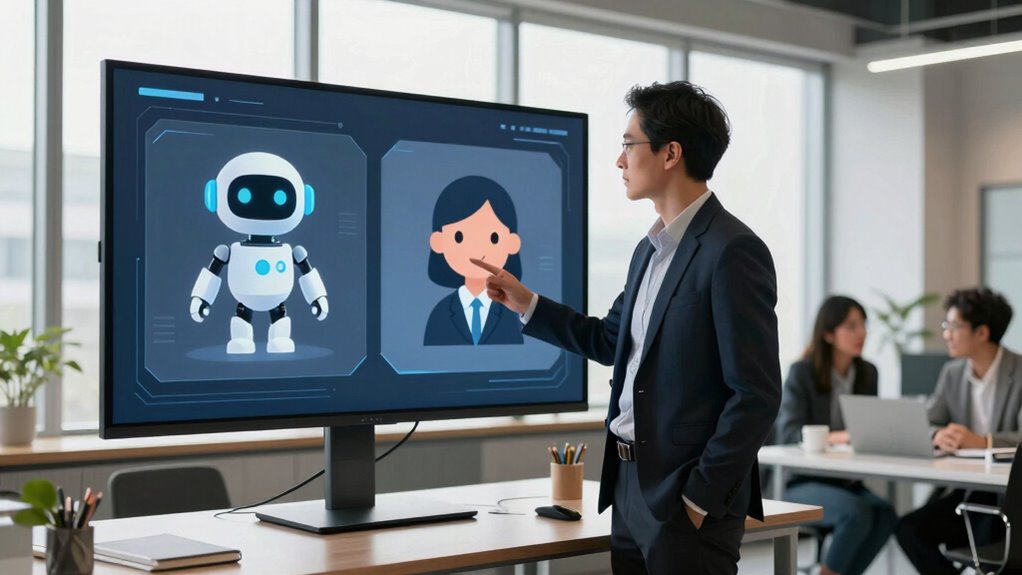
Have you ever wondered whether agents and assistants are the same? While they often get lumped together, they serve different purposes and operate in distinct ways. Understanding these differences starts with recognizing how each leverages AI decision making and user personalization. Assistants, like Siri or Alexa, are designed to help you with everyday tasks—setting reminders, playing music, or answering questions. They’re built to be user-friendly, with a focus on user personalization. This means they learn your preferences over time, adapting their responses to better suit your habits. Their goal is to make your life easier and more efficient through personalized interactions. You ask, they respond, and their responses are tailored based on your previous commands and preferences.
Assistants like Siri or Alexa personalize responses to make daily tasks easier and more efficient.
On the other hand, agents are more complex and are often used in broader applications, such as automated customer service, virtual agents in enterprises, or specialized decision-making systems. They don’t just respond passively; they actively make decisions based on AI decision making processes, analyzing a wide array of data to determine the best course of action. Think of agents as proactive problem solvers—they can assess situations, predict outcomes, and take initiative without constant human input. They’re designed to handle complex tasks that require reasoning, such as managing logistics, financial analysis, or technical troubleshooting. Their ability to operate in dynamic environments often depends on continuous data analysis and strategic planning. This strategic planning is essential for their effectiveness in unpredictable situations.
While assistants mainly focus on user interaction, agents operate more independently, often functioning behind the scenes to optimize workflows or manage large-scale systems. For example, an AI-powered agent might automatically adjust network security settings based on detected threats or reorder inventory when stock runs low. Their ability to make decisions rooted in AI decision making enables them to operate effectively in dynamic environments. This autonomy is what separates agents from assistants—they’re not just reacting to user commands but actively shaping processes based on data and strategic objectives. Additionally, understanding the role of AI decision making helps clarify how these systems are able to perform their functions more autonomously compared to assistants. Recognizing the importance of autonomous decision-making further highlights the differences in operational scope between these systems.
Furthermore, user personalization plays a role in both types of AI systems, but in different ways—assistants focus on adapting to individual user preferences, while agents tailor their actions based on broader contextual data. While they share some technological foundations, their core functions diverge—assistants serve as personalized helpers, and agents act as autonomous decision-makers. Recognizing this distinction helps you understand how AI systems are evolving to meet different needs, from simple user assistance to complex, strategic operations. This understanding can also inform the development of more sustainable AI solutions that align with principles of biodiversity and responsible technology use.
Products Worth Considering

Amazon Kindle Scribe Colorsoft 64GB with Premium Pen

Bose SoundLink Plus Portable Bluetooth Speaker, Black

Sonos Era 100 SL Compact Microphone-Free Speaker, Black
As an affiliate, we earn on qualifying purchases.
Frequently Asked Questions
How Do Agents and Assistants Differ in AI Capabilities?
You’ll find that agents and assistants differ mainly in AI capabilities. Agents handle autonomous decision-making and multi-task handling, allowing them to operate independently across complex tasks. Assistants, on the other hand, primarily support you through guided interactions, often requiring user input. Agents are more autonomous and versatile, while assistants excel at providing personalized help. This distinction impacts how each interacts with users and manages tasks effectively.
Can an AI Agent Function Without Human Intervention?
Think of an AI agent as a self-driving car—capable of autonomous decision making. Yes, it can function without human intervention, thanks to adaptive learning that helps it adjust to new situations. It continuously analyzes data, making decisions on its own and steering through complex environments. This independence allows the agent to perform tasks efficiently, but it still benefits from human oversight to guarantee safety and peak performance.
Are Assistants Limited to Specific Platforms or Devices?
Assistants are often limited by platform restrictions and device compatibility, meaning they typically work best on specific operating systems or devices. You may find some assistants only available on particular platforms like iOS or Android, and others may have limited features on certain gadgets. This means your experience can vary depending on your device or platform, making it important to choose assistants compatible with your preferred technology for seamless use.
What Industries Primarily Use AI Agents Versus Assistants?
Think of AI agents as skilled conductors orchestrating complex virtual collaboration, while assistants are more like helpful guides. Industries like finance, healthcare, and logistics mainly use AI agents for decision-making and automation, whereas customer service and personal productivity often rely on AI assistants. Ethical considerations are key in deploying both, ensuring transparency and trust. You’ll find agents shaping industries demanding high-level coordination, while assistants streamline everyday tasks.
How Do User Experiences Vary Between Agents and Assistants?
Your user experience differs because agents often handle complex tasks, requiring robust interface design that builds user trust through transparency and reliability. Assistants typically focus on simple, quick interactions, fostering trust through familiarity and ease of use. With agents, you might face more detailed interactions, while assistants aim for seamless, conversational exchanges. Overall, the interface design shapes how comfortable and confident you feel engaging with each, influencing your trust level.
Conclusion
So, next time you hear “agent” or “assistant,” remember they’re not interchangeable. While assistants handle simple tasks, agents are built to make complex decisions and act independently. It’s tempting to think they’re the same, but uncovering the truth reveals a world of difference. Who knows—maybe someday, you’ll rely on a true agent to navigate life’s toughest choices. The question is: are you ready to embrace the power of real agents?