TL;DR
An independent METR assessment published Nov. 5, 2026, found that Anthropic is likely improving model capabilities on well-specified tasks about twice as fast as before, with high uncertainty and primarily through AI assistance to researchers. Google DeepMind has also reported a specific training efficiency gain from AlphaEvolve. These examples show how AI could contribute to its own improvement, but they do not establish a self-sustaining or accelerating cycle across the industry.
AI assistance may be speeding up some AI research, according to an independent METR assessment of work at Anthropic published Nov. 5, 2026. METR judged that Anthropic is likely improving model capabilities on well-specified tasks at about twice its earlier rate, while stressing substantial uncertainty; the assessment described the work primarily as AI assistance to researchers, not autonomous AI research.

Get business pricing on tech for your team
- Business-only prices and quantity discounts
- Tax-exempt purchasing
- Multiple users, one account, clear invoices
METR said it would not be surprised by estimates ranging from 1.3 times to three times the earlier rate. That range reflects uncertainty in the assessment, rather than a measured acceleration that applies to every part of model development. METR also redacted much of the evidence it considered most informative, limiting what outside readers can independently inspect.
A separate example comes from Google DeepMind’s AlphaEvolve. The company reported on May 14, 2025, that AlphaEvolve made a matrix-multiplication component used in Gemini 23% faster, reducing overall Gemini training time by 1%. The reported result concerns one component and one training system; it does not show that all AI development has sped up by a similar amount.
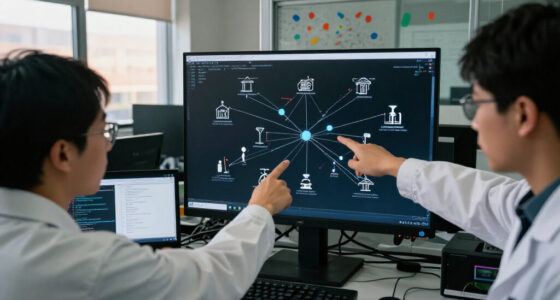
The proposed mechanism is a research loop: an AI model helps propose changes, write code, run experiments or check results; researchers test whether those contributions hold up; and validated improvements may be used in a stronger model that can assist with later work. The loop is a schematic argument, not a documented process measured across any lab. Each proposed gain needs fair tests, since differences in compute, data or evaluation can make an apparent improvement misleading.

How Research Gains Could Compound
If AI tools reliably reduce the time or compute required for research, teams could test more ideas with the same resources. Small efficiency improvements may add up: in a simplified illustration, three independent savings of 10% each would leave a task using about 73% of its original compute. With a fixed compute budget, that would allow roughly 37% more of the same jobs to run. This is an illustration, not a measured result from either METR or DeepMind.
The broader consequence depends on whether assistance extends beyond isolated tasks and remains useful as experiments grow more complex. If models can help researchers produce and evaluate improvements, development pace could change, affecting companies and people planning around AI. The evidence cited here does not establish that outcome, or show that AI systems can independently set research priorities and carry a development program forward.
Potential effects also depend on who can access the systems, who controls computing infrastructure, and how gains are distributed. Technical progress alone will not determine those outcomes; deployment choices and institutions will matter as well.
Products Worth Considering

DJI Mini 5 Pro Fly More Combo Plus with DJI RC 2

Bose QuietComfort Wireless Noise-Cancelling Headphones, Petal Pink

Apple AirPods Pro 3 Wireless Earbuds with Active Noise Cancellation
As an affiliate, we earn on qualifying purchases.
Two Examples, Different Evidence
The METR assessment concerns the pace of capability improvement on well-specified tasks at Anthropic. Its characterization is probabilistic and explicitly uncertain. The finding should not be read as a direct measurement of a doubling in every research activity, nor as evidence that models are independently designing their successors.
DeepMind’s AlphaEvolve report offers a more concrete engineering example: a reported speedup in a matrix-multiplication component, alongside a smaller reduction in total Gemini training time. The difference between the component-level and overall figures illustrates why the scope of a metric matters. A faster component does not translate one-for-one into a faster full training process.
Both examples fit the idea that AI can assist people doing AI research. But the evidence comes from distinct organizations, tasks and reporting methods. METR’s assessment includes redactions, while the AlphaEvolve figures were reported by Google DeepMind. Neither source, as described here, establishes a general rate at which AI research is accelerating across the field.
““would not be surprised” by 1.3x or 3x”
— METR
Limits on Measuring the Feedback Loop
How much AI contributed to the Anthropic work, which tasks were covered, and how the estimate was calculated are not fully clear from the available account. METR redacted much of the evidence it found most informative, and its estimate carries a broad uncertainty range.
It is also unclear how reliably current systems can handle longer research sequences, distinguish real gains from flawed experiments, or choose promising directions. Experiment time and hardware availability can constrain progress, as can the gap between small tests and large-scale systems. Data quality and continuity of work may also affect results.
The available examples do not show that AI research is already self-sustaining, that gains will compound at a fixed rate, or that progress toward superintelligence is assured. The pace may vary across tasks and over time.
What Future Evaluations Need to Show
Further assessments will need to clarify how researchers measure AI’s contribution, what tasks are included, and whether gains persist under fair, repeatable tests. More transparent evidence would help readers compare estimates and judge how much of a reported improvement comes from AI assistance.
For the broader feedback-loop claim, the key developments to watch are whether AI systems can contribute across more stages of research, whether those contributions hold up at larger scales, and whether improved systems then produce measurable gains in later work. The sources cited here do not set out a specific next milestone or timeline.
Key Questions
Did METR find that AI research at Anthropic is twice as fast?
METR judged that Anthropic is likely improving model capabilities on well-specified tasks at about twice its earlier rate. It emphasized high uncertainty, saying it would not be surprised by estimates from 1.3 times to three times the earlier rate.
Does the assessment show that AI is conducting research autonomously?
No. METR described the work primarily as AI assistance to researchers. The assessment does not establish that AI systems independently run a full research program.
What did AlphaEvolve improve?
Google DeepMind reported that AlphaEvolve made a matrix-multiplication component used in Gemini 23% faster, reducing overall Gemini training time by 1%.
Are these examples proof that AI improvement will accelerate continuously?
No. They are examples of AI assistance and an engineering efficiency gain. The evidence does not establish a continuous or self-sustaining cycle; experiment time, hardware, evaluation quality and research choices can all affect progress.
Source: Thorsten Meyer AI