
TL;DR
Google opened Gemini 4 Carbon to paying developers, businesses and Google AI Ultra subscribers on November 10, 2026, and published its model card. On the new MKA benchmark, Carbon scored 54.3%, just behind Claude Fable 5.2 at 56.6%; Google DeepMind reported Carbon cost $5.63 per task compared with Fable’s $35.28.
Google opened Gemini 4 Carbon to paying developers, businesses and Google AI Ultra subscribers on November 10, alongside a new benchmark that puts the model second on tasks involving blueprints, scans and charts. Google DeepMind and Artificial Analysis reported Carbon scored 54.3% on MKA, close to Claude Fable 5.2’s 56.6%, while Google’s report put Carbon’s cost at $5.63 per task versus $35.28 for Fable.

Get business pricing on tech for your team
- Business-only prices and quantity discounts
- Tax-exempt purchasing
- Multiple users, one account, clear invoices
Carbon is available through the paid Gemini API, Google AI Studio and Gemini for business. In the Gemini app and AI Mode in Search, access is limited to Google AI Ultra subscribers. Google’s introductory API price is $2 per million input tokens and $10 per million output tokens through November 30. Starting December 1, the prices rise to $4 per million input tokens and $20 per million output tokens.
MKA, short for Multimodal Knowledge and Analysis, contains 200 expert-built tasks across 10 sectors, according to the source report. It tests agents on work that requires interpreting documents such as blueprints, scans and charts, rather than relying only on plain text. Claude Fable 5.2 scored 56.6%, Carbon 54.3% and Claude Opus 5.5 53.0%. The report says the three leading scores are within the margin of error, so the ranking does not establish a clear performance gap.
The cost figures reported for MKA show a larger difference: $5.63 per Carbon task against $35.28 for Fable 5.2. Google DeepMind’s report is the source for those figures. Carbon’s published model card also says it uses more reasoning tokens than Gemini 4 Argon and may use more tokens overall, particularly at higher thinking settings. Google lists low, medium and high thinking levels, with medium as the default.
The Cost of Document Reasoning
MKA focuses on a practical class of work: extracting and reasoning over information presented in visual or technical materials. For businesses considering AI agents for document-heavy processes, the results offer an early comparison of both task performance and reported cost. Carbon’s 54.3% score is close to the leading result, while its reported per-task cost is substantially lower in this test.
Those numbers do not show what a company would pay for its own workload. MKA’s task costs are tied to the benchmark’s tasks and the reported setup; actual costs can depend on input size, output length, reasoning settings and retries. The score also measures performance on this particular set of tasks. It is not proof that Carbon will be cheaper or more accurate across every business process.
Access and pricing shape the immediate impact. Carbon can be tested by paid API users and business customers, but some consumer-facing access requires the highest Google AI subscription tier. The introductory API rates expire at the end of November, giving developers a short window to evaluate the model at lower listed prices before the announced increase.
Products Worth Considering

Amazon Kindle Paperwhite (12th Generation, 2024), 16GB, 7-Inch Display, Raspberry

DJI Mini 4 Pro Fly More Combo with DJI RC 2

Logitech MX Keys S Combo Wireless Keyboard and Mouse, Graphite
As an affiliate, we earn on qualifying purchases.
Carbon’s Place in Google’s Lineup
Google describes Carbon as its top-tier model, built on Gemini 4 Argon, for difficult tasks such as complex coding and open-ended scientific research. Its model card says Carbon spends more tokens exploring hypotheses and checking work. Google also says Argon remains the preferred choice for most software engineering and knowledge work, positioning Carbon for harder cases rather than routine use.
The model accepts text, images, audio and video, and produces text. Google lists a context window of up to one million tokens combined across input and output, and a March 2026 knowledge cutoff, with the caveat that information can be less current in some areas. Its model card flags hallucinations, occasional slowness or timeouts, and higher token use as limitations.
Carbon had previously been made available to a small group of cyber defenders through Google’s Fairwind Program, with Artificial Analysis listing October 28 as its release date. The November 10 announcement expanded paid access and came after Anthropic released Claude Fable 5.2 on November 9. That newer model was not included in Google’s model-card comparison, which Google says reflects results as of October 2026.
““tasks that test the limits of a model’s intelligence””
— Google, in the Gemini 4 Carbon model card
Limits of the MKA Comparison
Google DeepMind helped build MKA, and the source report notes that Google’s own model performs well on it. The tasks are private, limiting outside scrutiny of how they were selected and making it difficult for independent researchers to reproduce the comparison. The close scores are also reported to fall within the margin of error.
The reported costs do not establish performance or spending on real customer workflows. The available material does not specify enough detail to translate the benchmark’s per-task amounts into a general cost estimate for businesses. Nor does it settle how Carbon compares with every current rival: Google’s model-card table omits Fable 5.2, and the independent index uses a different set of tests and scoring method.
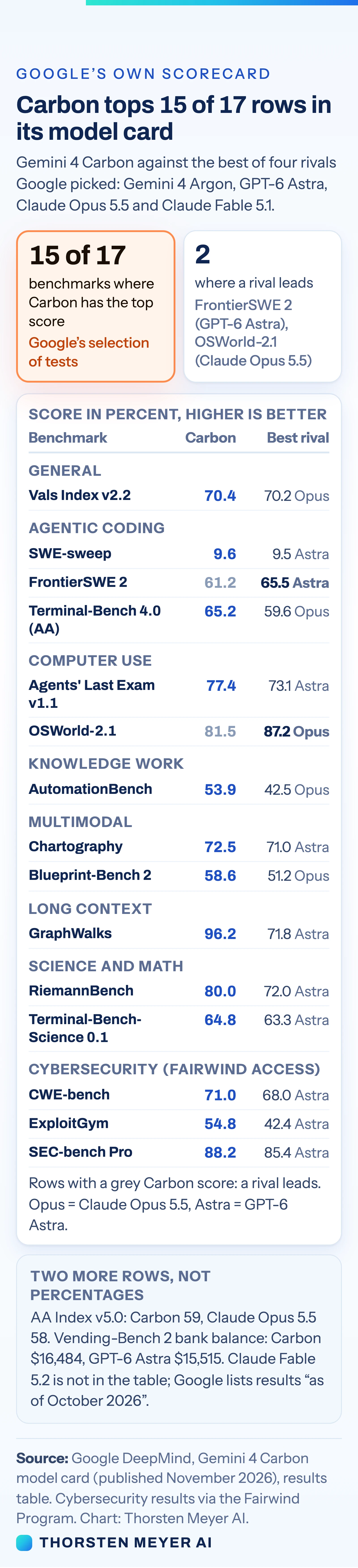
Google’s model card reports top scores on 15 of the 17 benchmarks it selected, but that result reflects Google’s choice of tests and competitors. On two listed tests, GPT-6 Astra led on FrontierSWE 2 and Claude Opus 5.5 led on OSWorld-2.1. The published figures therefore show strengths and weaknesses across particular evaluations, not a universal ranking.
Pricing Changes in December
Developers and business customers can evaluate Carbon through Google’s paid platforms at the introductory API rates until November 30, 2026. Google has announced that standard rates begin December 1. The next useful evidence will come from customers’ own workload tests and further independent evaluations of MKA or comparable document-based tasks.
Readers should watch for updates to the benchmark, model comparisons that include Claude Fable 5.2, and more detail on how task costs were calculated. The source material does not announce a date for those developments. For now, Carbon’s published result is a near-leading MKA score paired with a lower reported benchmark cost, subject to the test’s design and limited external reproducibility.
Key Questions
Who can use Gemini 4 Carbon?
It is available through the paid Gemini API, Google AI Studio and Gemini for business. Access in the Gemini app and AI Mode in Search is limited to Google AI Ultra subscribers.
What did Carbon score on MKA?
Carbon scored 54.3%, behind Claude Fable 5.2 at 56.6% and ahead of Claude Opus 5.5 at 53.0%. The report says the top three are within the margin of error.
How much did Carbon cost per MKA task?
Google DeepMind’s report put Carbon at $5.63 per task, compared with $35.28 for Claude Fable 5.2. These are benchmark-specific reported costs, not general estimates for customer workloads.
When does Carbon’s API price increase?
The introductory rate of $2 per million input tokens and $10 per million output tokens runs through November 30, 2026. The listed rates rise to $4 and $20, respectively, on December 1.
Can outside researchers verify the MKA results?
Verification is limited because the MKA tasks are private. Google DeepMind also helped develop the benchmark, so independent replication would help clarify how broadly the results apply.
Source: Thorsten Meyer AI