
📊 Full opportunity report: Acoustic Dampening, Placement, and the “Rig in the Closet” Setup on ThorstenMeyerAI.com — validation score, market gap, and execution plan.

Get business pricing on tech for your team
- Business-only prices and quantity discounts
- Tax-exempt purchasing
- Multiple users, one account, clear invoices
TL;DR
Placing AI workstations in separate rooms or closets significantly reduces noise. Proper ventilation is crucial when placing high-heat rigs in enclosed spaces. Acoustic treatment alone is less effective.
Moving high-power AI workstations into separate rooms or closets with proper ventilation is the most effective way to reduce noise, according to experts. This approach surpasses traditional acoustic treatment and is especially relevant as AI hardware becomes more powerful and louder.
Experts emphasize that the most effective noise reduction strategy involves relocating the workstation away from the user, such as into another room or a dedicated closet, and accessing it remotely via network. This method effectively eliminates noise at the source, which is more efficient than absorbing or blocking sound within the workspace.
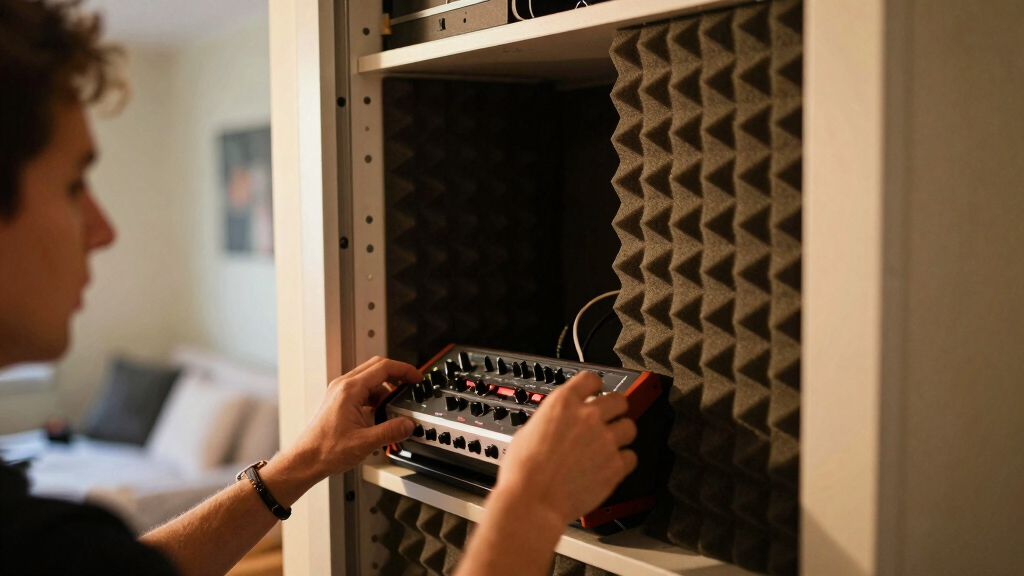
However, placing a heat-generating rig in an enclosed space introduces the challenge of heat buildup. To prevent overheating, proper ventilation is essential. Passive vents, exhaust fans, or purpose-built soundproof cabinets with temperature control are recommended to ensure adequate airflow and cooling.
While acoustic foam and barriers can help soften sound reflections and block airborne noise, they are less effective against structure-borne noise transmitted through solid materials. Mechanical decoupling with rubber feet or anti-vibration pads further reduces low-frequency hums that foam cannot address.
Acoustic dampening
& the rig in the closet.
The most powerful noise fix isn’t a material — it’s a floor plan. A rig you can’t hear because it’s in another room beats any amount of foam. Tap the approaches in Part 1 to see what actually works.
(another room)
(levers 1–4)
(door / barrier)
(acoustic foam)
Contain the noise, not the heat
Why Placement and Ventilation Are Critical for Noise Control
This approach matters because it offers a practical, scalable solution for managing noise pollution in environments with high-power AI hardware. Moving the rig out of the workspace minimizes disruption and improves comfort, especially for shared or open-plan offices. Proper ventilation ensures that this setup remains safe and sustainable over long periods, preventing thermal throttling and hardware damage.
As AI hardware continues to grow more powerful and louder, these strategies are becoming essential for maintaining productive and quiet work environments. They also reduce the need for expensive acoustic treatments, making high-performance AI setups more accessible.
soundproof server closet enclosure
As an affiliate, we earn on qualifying purchases.
As an affiliate, we earn on qualifying purchases.
The Evolution of Noise Management in AI Hardware Setups
Traditionally, users attempted to mitigate noise by adding acoustic foam and soundproofing within their workspaces. However, these methods address airborne noise and do little for structure-borne hums or heat-related noise issues. The shift toward relocating hardware into separate rooms or closets aligns with broader trends in data center design and high-performance computing, where isolation and cooling are prioritized.
Recent discussions on AI hardware management highlight that the hierarchy of noise reduction effectiveness starts with distance and isolation, followed by source reduction, barriers, and finally acoustic treatment. This sequence reflects a growing understanding that moving the source away from the user is the most impactful step.
"The most effective way to reduce noise from high-power workstations is simply to move them into another room or closet and access them remotely. Acoustic foam cannot replace physical separation."
— Thorsten Meyer, AI hardware expert
high airflow computer ventilation fan
As an affiliate, we earn on qualifying purchases.
As an affiliate, we earn on qualifying purchases.
Remaining Questions About Long-Term Use and Safety
It is not yet clear how different enclosure designs perform over extended periods or how best to optimize airflow without introducing new noise sources. Further research is needed on the durability of soundproof cabinets and the long-term thermal management of enclosed AI rigs.
As an affiliate, we earn on qualifying purchases.
Next Steps for Implementing Quiet AI Workstations
Future developments will likely include more sophisticated, integrated soundproof and cooling cabinets tailored for AI hardware. Users will need to evaluate the trade-offs between cost, noise reduction, and thermal management, and adopt best practices for ventilation and placement.
Additionally, hardware manufacturers may develop quieter components or built-in cooling solutions that reduce the need for enclosure-based noise mitigation.
anti-vibration pads for computer rigs
As an affiliate, we earn on qualifying purchases.
As an affiliate, we earn on qualifying purchases.
Key Questions
Is placing my AI workstation in a closet safe?
Yes, if proper ventilation and airflow are maintained. Enclosed spaces must have active cooling or passive vents to prevent overheating and thermal throttling.
Can acoustic foam alone significantly reduce noise?
No, acoustic foam mainly absorbs reflections within a room and does not block airborne or structure-borne noise. Placement and barriers are more effective for noise control.
What are the best ways to ventilate a closet containing a high-power GPU?
Use active exhaust fans, passive vents, or purpose-built soundproof cabinets with ducted airflow and temperature control to ensure heat escapes efficiently while minimizing noise.
Does moving the rig to another room affect performance?
No, as long as the rig is accessed remotely over a wired or strong wireless connection, performance remains unaffected. The main concern is ensuring proper ventilation and cooling.
Are there commercial solutions for quiet, cooled AI enclosures?
Yes, specialized soundproof cabinets with integrated cooling and temperature regulation are available, though they tend to be expensive. They are designed to balance noise reduction and thermal management effectively.
Source: ThorstenMeyerAI.com
Halloween Picks
halloween
As an affiliate, we earn on qualifying purchases.