
📊 Full opportunity report: AI Changelog Digest For Open-source Maintainers on IdeaNavigator AI — validation score, market gap, and execution plan.

Get tech for your team delivered free — and shop member deals
- Fast, free delivery on millions of items
- Access to Prime Big Deal Days deals on October 6–7
- Prime Video, Amazon Music and more included
TL;DR
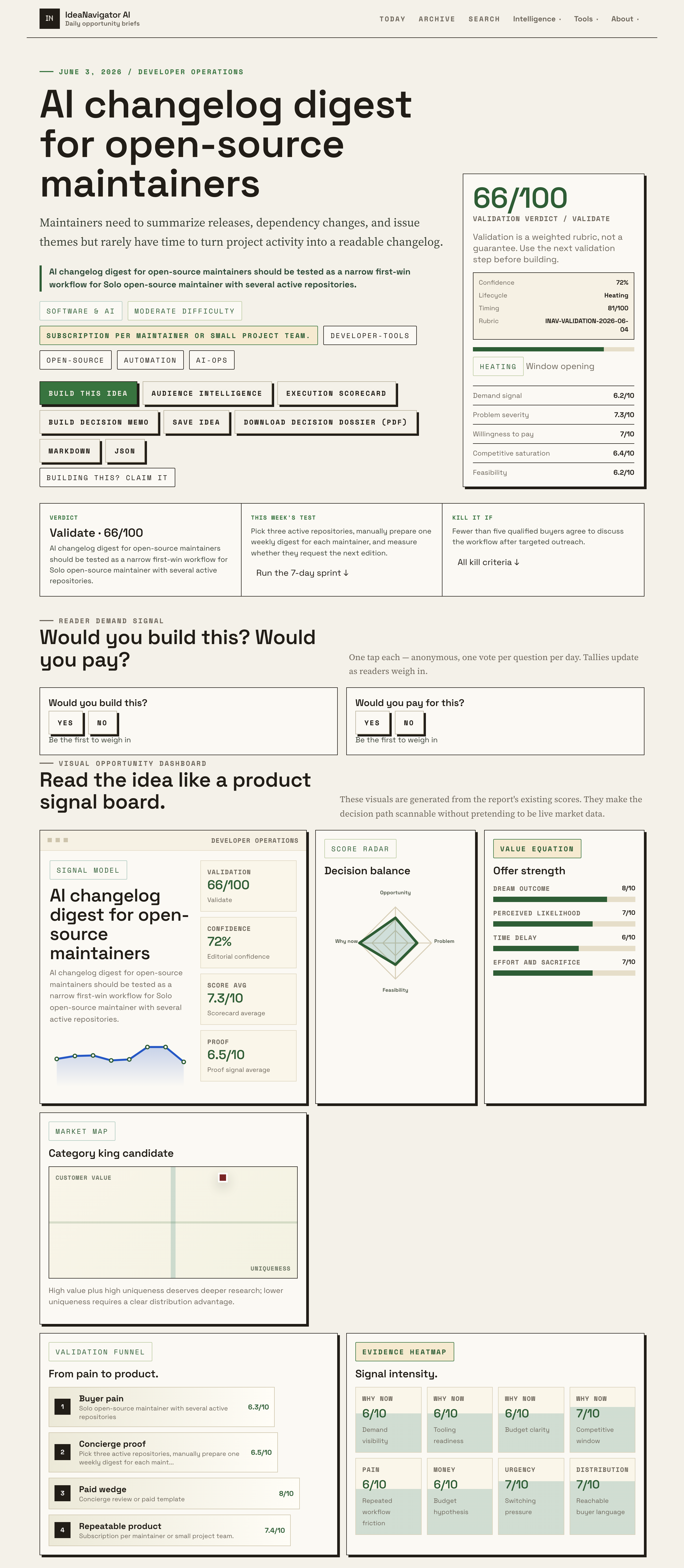
A proposed AI changelog digest system targets solo open-source maintainers managing multiple projects. It automates summarizing releases, dependencies, and issues, potentially easing maintenance burdens. Validation is ongoing, with initial testing planned.
An AI-powered changelog digest system is being proposed as a workflow for solo open-source maintainers managing multiple repositories. The tool aims to automatically summarize releases, dependency changes, and top issues, providing a weekly email digest that reduces manual effort and improves project transparency.
The concept, developed by IdeaNavigator AI, focuses on creating a narrow, targeted workflow that leverages AI summarization and repository metadata. It is designed specifically for maintainers who lack dedicated developer-relations teams but oversee several active projects. The proposed minimum viable product (MVP) would automatically read release feeds, merged pull requests, and top issues to generate a draft changelog email, which the maintainer can review and approve.
To validate this approach, the plan involves selecting three active repositories, manually preparing weekly digests for each, and measuring whether maintainers request continued editions. The initiative aims to demonstrate whether this automated process can effectively reduce manual workload while maintaining accurate, useful summaries for project transparency and communication.
Potential Impact on Solo Open-Source Maintenance Efficiency
This development could significantly reduce the time and effort required for solo maintainers to produce comprehensive changelogs and updates. By automating the summarization of release notes, dependency changes, and issue themes, maintainers can focus more on development and less on documentation. If successful, this tool could set a new standard for automated project summaries in open-source communities, especially for small teams or individual contributors managing multiple repositories.
AI-powered changelog generator for open-source projects
As an affiliate, we earn on qualifying purchases.
As an affiliate, we earn on qualifying purchases.
Growing Need for Automated Changelog Summaries in Open-Source Projects
As open-source projects expand, maintainers face increasing complexity in managing updates across multiple repositories. Traditionally, creating detailed changelogs involves manual compilation of release notes, dependency updates, and issue tracking. Recent advances in AI and repository metadata aggregation have opened the possibility of automating these tasks. The idea of an AI-driven digest aligns with broader trends toward automation in developer operations, aiming to streamline project communication and reduce maintenance overhead.
This initiative builds on the increasing availability of release feeds, pull request data, and issue tracking, making it feasible to generate meaningful summaries without extensive manual input. The concept is still in early testing phases, with validation focused on real-world applicability and accuracy.
“Leveraging AI to automate changelog summaries could transform how solo maintainers manage multiple projects, saving time and improving transparency.”
— an anonymous researcher
automated release notes tool for developers
As an affiliate, we earn on qualifying purchases.
As an affiliate, we earn on qualifying purchases.
Uncertainties Around Implementation and Adoption
It is not yet clear how accurately the AI summarization will reflect the nuances of project updates or whether maintainers will adopt the tool at scale. The validation process is still in the planning stage, and effectiveness may vary depending on repository activity levels and data quality. Additionally, the long-term impact on maintainer workflows and community transparency remains to be seen.
dependency update summarization software
As an affiliate, we earn on qualifying purchases.
As an affiliate, we earn on qualifying purchases.
Next Steps for Testing and Validation
The immediate next step involves selecting three active repositories and manually preparing weekly digests to serve as benchmarks. The project team will then deploy the AI tool to generate automated summaries, comparing results with manual versions. Success will be measured by maintainers’ willingness to request continued use and the accuracy of the summaries. Further development may include refining AI models and expanding the scope based on initial feedback.
issue tracking automation tool for GitHub
As an affiliate, we earn on qualifying purchases.
As an affiliate, we earn on qualifying purchases.
Key Questions
How will the AI digest improve project maintenance?
The AI digest aims to automate the summarization of releases, dependency updates, and issues, saving time for maintainers and providing clearer communication to users.
Who is this tool designed for?
The primary target is solo open-source maintainers managing several active repositories who lack dedicated teams for documentation and communication.
Will the AI summaries be accurate?
Initial validation will assess accuracy by comparing AI-generated digests with manually prepared ones. Effectiveness will depend on data quality and model training.
When will the tool be available for broader use?
The project is still in early testing stages. Broader availability depends on validation results and further development efforts.
Could this replace manual changelogs entirely?
It is unlikely to replace manual efforts entirely but aims to serve as a helpful automation aid, especially for routine summaries.
Source: IdeaNavigator AI
Fall Picks
fall essentials
As an affiliate, we earn on qualifying purchases.