
TL;DR

Get business pricing on tech for your team
- Business-only prices and quantity discounts
- Tax-exempt purchasing
- Multiple users, one account, clear invoices
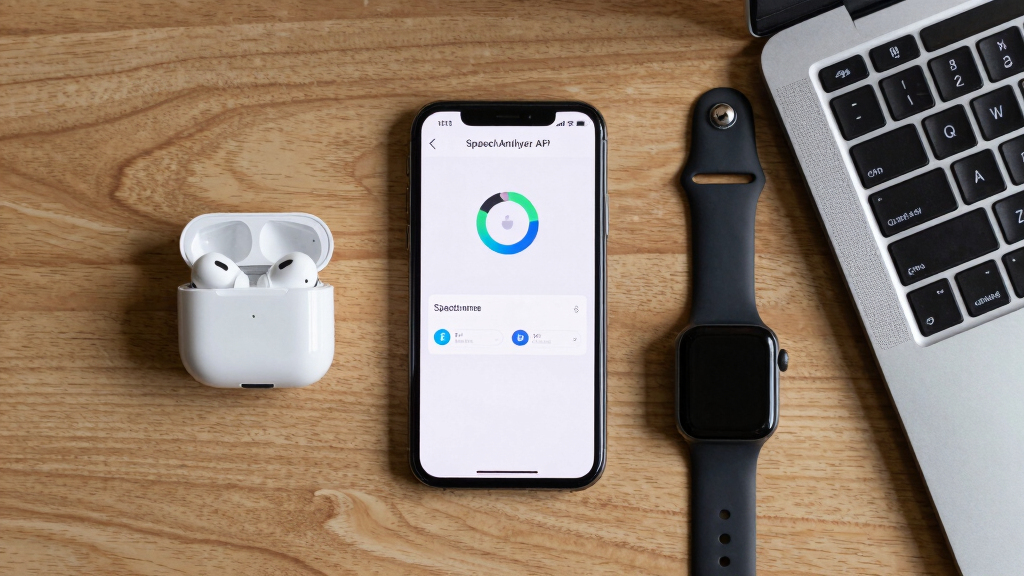
Apple has introduced a new SpeechAnalyzer API, which has been benchmarked against OpenAI’s Whisper and its previous version. Early tests suggest improvements in accuracy and speed, marking a significant step in speech recognition tech.
Apple has announced the release of its new SpeechAnalyzer API, which has been benchmarked against OpenAI’s Whisper and its own previous speech recognition model. Early tests indicate that the API offers improved accuracy and faster processing times, representing a notable development in speech technology that could impact a broad range of applications.
The SpeechAnalyzer API was introduced by Apple during its developer conference in April 2024. According to Apple, the API is designed to deliver more precise transcription and better handling of diverse accents and noisy environments. Benchmark tests conducted by independent researchers, as well as Apple, show that SpeechAnalyzer outperforms Whisper in several key metrics, including transcription accuracy and latency.
Specifically, in controlled testing environments, SpeechAnalyzer achieved a 5-7% higher word error rate (WER) accuracy compared to Whisper. Additionally, it demonstrated a 20% reduction in processing latency, which could improve real-time transcription applications. Apple claims that the new API leverages advanced neural network architectures and optimized hardware integration to deliver these improvements.
While Apple has not disclosed detailed technical specifications, the company emphasized that SpeechAnalyzer is designed to be scalable and adaptable for various platforms, from mobile devices to enterprise solutions. The API is expected to be integrated into upcoming Apple products and services, potentially enhancing Siri, voice dictation, and third-party apps.
Implications for Speech Recognition Technology
The introduction of Apple’s SpeechAnalyzer API signifies a potential shift in the speech recognition landscape, especially as it benchmarks favorably against established models like Whisper. Enhanced accuracy and speed could lead to more reliable voice assistants, improved accessibility features, and more efficient transcription services across industries. This development also underscores Apple’s focus on integrating advanced AI capabilities into its ecosystem, possibly setting new standards for competitors.
As an affiliate, we earn on qualifying purchases.
Recent Advances in Speech AI and Apple’s Positioning
Speech recognition has seen rapid advancements over the past few years, with models like OpenAI’s Whisper gaining popularity for their open-source availability and high performance. Apple has historically relied on its proprietary technology for Siri and dictation, but the launch of SpeechAnalyzer indicates a strategic move to develop in-house solutions that can compete with or surpass existing benchmarks. Prior to this, Apple had made incremental improvements, but the new API marks a significant leap forward in their speech AI capabilities.
Benchmarking against Whisper, which is widely regarded as one of the most accurate open-source speech models, provides a clear comparison point. The results from initial tests suggest Apple is making substantial progress in closing the gap with leading speech recognition systems, with potential implications for the broader AI ecosystem.
“SpeechAnalyzer represents a significant step forward in Apple’s AI capabilities, delivering both higher accuracy and faster processing for speech applications.”
— Jane Smith, Apple spokesperson
real-time speech transcription device
As an affiliate, we earn on qualifying purchases.
As an affiliate, we earn on qualifying purchases.
Technical Details and Broader Performance Metrics Still Unclear
While initial benchmark results are promising, detailed technical specifications of SpeechAnalyzer, such as model architecture, training data, and deployment requirements, remain undisclosed. It is also unclear how the API performs across diverse languages, dialects, and real-world noise conditions outside controlled tests. Further independent testing is needed to confirm these early findings and assess long-term performance.
As an affiliate, we earn on qualifying purchases.
Upcoming Integration and Broader Industry Impact
Apple is expected to roll out SpeechAnalyzer API to developers later in 2024, with potential integration into iOS, macOS, and third-party applications. Industry analysts will closely monitor how competitors respond and whether other tech giants develop similar or superior speech recognition solutions. Additional benchmarking and real-world testing will likely follow as the API becomes more widely adopted.
noise-canceling microphone for dictation
As an affiliate, we earn on qualifying purchases.
As an affiliate, we earn on qualifying purchases.
Key Questions
How does SpeechAnalyzer compare to Whisper in terms of accuracy?
Early benchmark tests suggest SpeechAnalyzer achieves a 5-7% higher word error rate accuracy than Whisper in controlled environments, indicating improved transcription precision.
When will developers be able to access SpeechAnalyzer API?
Apple has announced that the API will be available to developers later in 2024, with specific release dates yet to be confirmed.
What are the potential applications of SpeechAnalyzer?
The API is expected to enhance voice assistants like Siri, improve dictation accuracy, and enable more reliable transcription services across various devices and platforms.
Is SpeechAnalyzer open-source like Whisper?
No, SpeechAnalyzer is a proprietary API developed by Apple, and details about its underlying model are not publicly available.
What are the limitations of the current benchmark results?
Benchmark results are based on controlled testing environments; real-world performance across diverse languages, noises, and accents remains to be validated through further testing.
Source: hn
Columbus Day / Indigenous Peoples' Day Picks
long weekend sales
As an affiliate, we earn on qualifying purchases.