
TL;DR

Get business pricing on tech for your team
- Business-only prices and quantity discounts
- Tax-exempt purchasing
- Multiple users, one account, clear invoices
Apple’s Silicon executive revealed that increasing AI workloads on Mac Mini are driving demand for on-device processing. The company envisions a future with more powerful, AI-capable Macs focused on local computation.
An Apple Silicon executive has confirmed that the rising demand for AI capabilities on the Mac Mini is shaping the company’s hardware development, emphasizing a future where on-device processing becomes central to Mac computing.
During a recent Apple developer event, an Apple Silicon executive stated that the increasing use of AI applications on the Mac Mini has significantly influenced the company’s hardware strategy. The executive highlighted that the demand for local AI processing is growing rapidly, driven by developers and users seeking privacy, speed, and efficiency.
The executive explained that Apple’s custom silicon is designed to support advanced AI workloads directly on the device, reducing reliance on cloud services and enhancing user privacy. This approach aligns with Apple’s broader goal of integrating AI capabilities seamlessly into its hardware ecosystem.
Implications of AI-Driven Hardware Strategy
This development indicates that Apple is prioritizing on-device AI in its hardware roadmap, which could lead to more powerful, privacy-focused Macs. For consumers and developers, this means devices capable of handling complex AI tasks locally, reducing latency and dependence on internet connectivity. It also suggests a shift away from cloud-centric AI processing, emphasizing privacy and security.
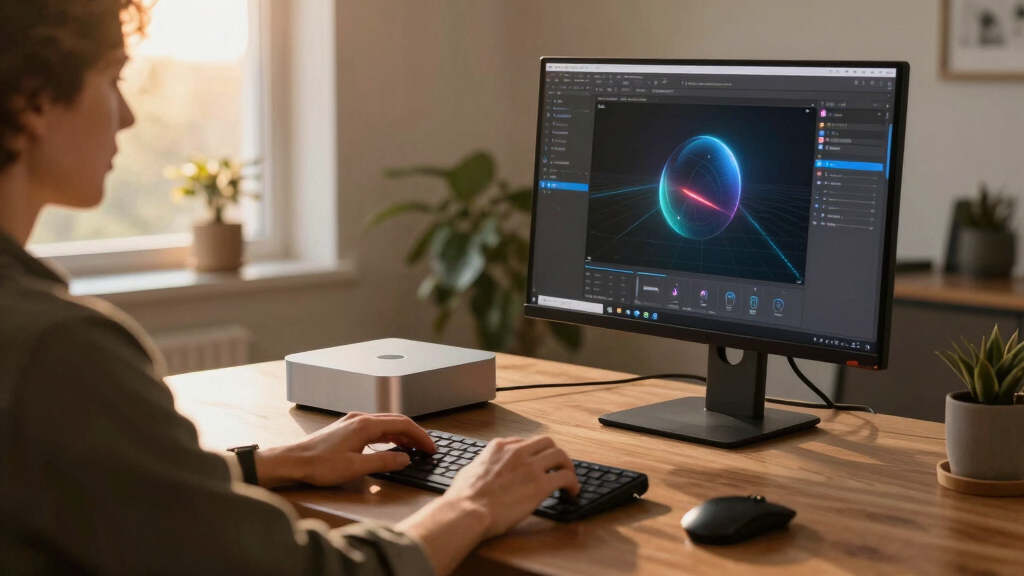
Apple Silicon Mac Mini with AI processing
As an affiliate, we earn on qualifying purchases.
As an affiliate, we earn on qualifying purchases.
Apple’s Push Toward On-Device AI Capabilities
Over the past few years, Apple has been steadily enhancing its Silicon chips to support AI and machine learning. The introduction of the M1 chip marked a significant milestone, integrating neural engines for AI tasks. The Mac Mini, popular among developers and power users, has increasingly been used for AI applications, prompting Apple to focus on hardware that can handle these demands locally.
Recent industry trends show a surge in AI workloads across consumer and professional devices, with Apple positioning itself to capitalize on this shift by embedding AI processing directly into its chips. This aligns with broader industry movements toward edge computing and privacy-centric AI solutions.
“The demand for AI capabilities on Mac Mini is accelerating, and our focus is on enabling powerful on-device processing that respects user privacy and enhances performance.”
— Apple Silicon Executive
As an affiliate, we earn on qualifying purchases.
Unanswered Questions About Future Hardware and Software
While the executive emphasized the importance of on-device AI, it remains unclear how soon new Mac models with enhanced AI processing will be released or what specific hardware features will be introduced. Details about upcoming chip architectures and software integration are still undisclosed.
Additionally, the extent to which Apple will phase out reliance on cloud AI services remains uncertain, as some applications may still require cloud-based processing for complex tasks.
As an affiliate, we earn on qualifying purchases.
Next Steps for Apple’s AI Hardware Development
Apple is expected to continue refining its silicon for AI workloads, with upcoming chip announcements likely to feature more advanced neural engines. The company may also showcase new Mac models at future events, emphasizing local AI capabilities. Developers and users should watch for software updates that leverage these hardware improvements to enable richer AI experiences on Mac devices.
privacy-focused AI Mac peripherals
As an affiliate, we earn on qualifying purchases.
As an affiliate, we earn on qualifying purchases.
Key Questions
When will Apple release Macs with enhanced on-device AI processing?
Specific timelines have not been announced, but industry speculation suggests upcoming Apple Silicon chips could debut within the next year, possibly alongside new Mac models.
Will Apple phase out cloud-based AI services entirely?
It is unclear. Apple emphasizes on-device processing, but some complex tasks may still rely on cloud services for the foreseeable future.
How will this focus on on-device AI affect developers?
Developers may need to optimize their applications for Apple’s new silicon features, enabling more powerful and privacy-preserving AI functionalities directly on Macs.
What specific hardware features are expected in future Macs?
Details are still under wraps, but expect more advanced neural engines, increased processing power, and possibly dedicated AI accelerators integrated into upcoming chips.
Source: hn
Halloween Picks
halloween
As an affiliate, we earn on qualifying purchases.