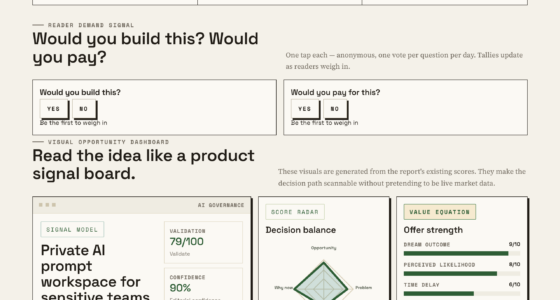

📊 Full opportunity report: Different Game, or Already Lost? Reading Mistral’s Sovereignty Bet on ThorstenMeyerAI.com — validation score, market gap, and execution plan.

Get business pricing on tech for your team
- Business-only prices and quantity discounts
- Tax-exempt purchasing
- Multiple users, one account, clear invoices
TL;DR
Mistral presents itself as a full-stack AI provider focusing on on-prem solutions for European enterprises. Its strategy raises questions about whether it has a genuine edge or has already fallen behind frontier models.
Mistral has declared itself a full-stack AI provider, emphasizing ownership of compute, models, and platforms, as it aims to serve European enterprises with on-prem solutions. This marks a strategic shift from its previous focus solely on developing AI models, raising questions about whether it has a competitive edge or has already fallen behind industry leaders.
During the AI Now Summit in Paris, Mistral CEO Arthur Mensch outlined the company’s new positioning as a builder of the entire AI stack, including data centers, models, and platforms. The company owns a 40MW data center near Paris and plans to expand to 200MW of European compute capacity by 2027, with a €1.2 billion project in Sweden. Mistral launched Vibe for Work, a conversational agent targeting enterprise applications, and highlighted partnerships with firms like ASML, BNP Paribas, and Amazon. Its core differentiation is offering open, customizable models that customers can own and run locally, contrasting with the closed-API models of OpenAI and Anthropic. Critics noted the summit lacked new model announcements or technical breakthroughs, fueling skepticism about Mistral’s technical competitiveness. The company’s enterprise focus is exemplified by clients like BNP Paribas, which uses Mistral models on-prem for compliance, and Abanca, which employs Mistral’s agent orchestration for sensitive customer data. The debate centers on whether this on-prem approach is a sustainable competitive advantage or a niche that can be easily filled by free open-weight models like Qwen. Strategically, Mistral advocates for small, specialized models optimized for speed, energy efficiency, and cost, which are suited for production environments, as opposed to large general-purpose models. These narrow models are used in applications such as document AI, multilingual voice, and industrial robotics, emphasizing efficiency over raw reasoning power. The debate remains unresolved whether this focus on small models is a strategic strength or a constraint, especially given the rapid evolution of open-weight models from China and elsewhere.Different game, or already lost?
Mistral now pitches itself as Europe’s full-stack AI provider — compute, models, platform, consultancy — not a frontier-model lab. Is that a real strategic insight, or making the best of a race it can’t win? Both readings fit the same facts.
From model lab to full-stack provider
The clearest signal from the summit wasn’t a model — it was a posture. Heavy on enterprise logos and partnerships (ASML, BNP Paribas, Alexa+), light on new-model announcements. That absence is exactly what skeptics seized on.
Compute
40MW Paris DC + Sweden build · 200MW target by 2027
Models
Open & custom · efficient · you own and run them
Platform
Forge for custom models · Vibe for Work agent
Consultancy
Sales teams, integrators, EU provenance & support
Small & focused, or large & general?
Mistral bets on specialized small models. The claim isn’t that they win a reasoning leaderboard — they don’t. It’s that on the metrics that matter in production agent systems, a purpose-built small model wins. Flip the metric to see the case reverse.
Small specialized vs large general — by what you measure
In token-heavy agentic apps making hundreds of calls, speed/energy/cost compound. Toggle the metric.
Narrow models doing real work
Each is one model doing one thing efficiently — the tangible version of the strategy. Strong on their own terms; the open question is whether the bundle beats a free Chinese open-weight download.
On-prem KYC compliance
Mistral models run inside the bank’s walls for know-your-customer checks. Sensitive financial data never leaves. (BNP was Mistral’s first customer, 2023.)
Voxtral multilingual voice
A focused voice model powering Alexa+ across Europe — speed and efficiency over raw size.
Robostral industrial robotics
Plus a “physics AI” push (via the Emmi acquisition) into aerospace, automotive & semiconductor design and simulation.
Document AI / OCR at scale
Large-scale text extraction — the unglamorous, high-volume enterprise work small models excel at.
The strategy is downstream of the compute gap
Once you see the raw numbers, “why is Mistral behind?” answers itself — and the specialized-small-model strategy starts looking partly like a smart adaptation to a binding constraint, not a pure philosophical choice.
Compute & capital · Mistral vs a frontier leader, this same week
Not a knock — it’s the constraint that forces the efficiency-first, sovereignty-wedge strategy. Adapting intelligently to your position is what good strategy is.
“I want them to win, but I’m worried”
That ambivalence is the most accurate read of where Mistral sits. The enterprise pivot gets read two opposite ways — and both deserve airing.
On-prem, real sales teams, the Koyeb deployment acquisition, EU provenance — exactly what regulated enterprises want, and stickier than consumer mindshare. Targeting €1B revenue in 2026 with 1,000 staff, up from 15 people and one customer in 2023. US closed-API labs structurally can’t match the sovereignty axis.
“Software consultancy with a data center,” not a foundation-model moat. Enterprise B2B is where European startups go when they can’t win consumer or world-scale SaaS. Why pay Mistral on-prem when you could run Qwen free? One paying Le Chat Pro user said the quality gap with frontier labs is now hard to ignore.
Implications of Mistral’s Full-Stack Strategy for AI Competition
Mistral’s pivot to a full-stack, on-prem enterprise AI provider highlights a potential niche in privacy-conscious, regulated markets like Europe. If successful, it could challenge the dominance of US-based closed-API giants by offering more control and customization. However, skepticism remains about whether this approach can keep pace technically, especially as open-weight models from China and elsewhere rapidly improve. The company’s focus on small, efficient models could be a strategic advantage for specific applications, but whether it can sustain a broader competitive edge remains uncertain. This development signals a possible shift in AI industry dynamics, emphasizing local, customizable solutions over monolithic, general-purpose models.
As an affiliate, we earn on qualifying purchases.
Mistral’s Industry Position and Recent Strategic Moves
Founded in 2023, Mistral quickly gained attention for its ambitious plans to develop high-quality AI models. The company’s early emphasis was on model innovation, but recent statements at the AI Now Summit reveal a broader strategic shift toward building a full-stack AI ecosystem, including data centers and enterprise platforms. This move appears driven by the European Bet: How Mistral, Aleph Alpha, and Black Forest Labs Are Playing a Different Game regulatory environment and the desire to serve clients with strict data sovereignty requirements. Prior to this, industry giants like OpenAI, Google, and Anthropic focused on API-based models, leaving a gap for companies like Mistral to offer on-prem solutions. The company’s partnerships with firms like BNP Paribas and ASML reinforce its focus on regulated sectors. The industry is watching whether Mistral’s approach can carve out a sustainable niche or if it will struggle against the rapid advancement of open-weight models from China and elsewhere and the technical capabilities of larger players.
"To deploy AI in the enterprise, you actually need, as an AI provider, to own the full stack."
— Arthur Mensch, CEO of Mistral
customizable AI models for business
As an affiliate, we earn on qualifying purchases.
As an affiliate, we earn on qualifying purchases.
Unclear Technical Edge and Long-term Viability
It remains uncertain whether Mistral’s focus on small, specialized models and full-stack solutions can match the technical performance and innovation pace of larger, more established AI firms. The summit lacked new model announcements or breakthroughs, raising questions about the company’s current technological edge. Additionally, the competitive landscape is evolving rapidly, with open-weight models from China and other regions improving quickly, which could erode Mistral’s niche if it cannot keep pace.
As an affiliate, we earn on qualifying purchases.
Next Steps in Mistral’s Strategic and Technical Development
Mistral is expected to continue expanding its European compute capacity and deepen enterprise partnerships. The company may also release new models or platforms aimed at demonstrating technical competitiveness. Industry analysts will watch whether Mistral can deliver on its promise of efficient, customizable models at scale or if it will need to innovate further to stay relevant amid rapid advances from competitors. The upcoming months will clarify whether its full-stack approach can carve out a sustainable market position or if it remains a niche player.
As an affiliate, we earn on qualifying purchases.
Key Questions
Is Mistral’s full-stack strategy a sign of industry leadership or a fallback?
It is currently debated. Some see it as a strategic move to serve regulated markets better, while skeptics question whether it can keep pace technically with larger AI firms.
Will Mistral’s focus on small models give it a competitive advantage?
It could in specific applications requiring efficiency and on-prem deployment, but whether it can scale this advantage remains uncertain.
How does Mistral’s European focus affect its global competitiveness?
Focusing on European clients with strict data laws may limit its global reach but could position it as a leader in privacy-conscious AI solutions.
What technical evidence supports Mistral’s claims of competitiveness?
As of now, the company has not announced new models or breakthroughs at the summit, leading to skepticism about its technical edge.
Source: ThorstenMeyerAI.com
Fall Picks
fall essentials
As an affiliate, we earn on qualifying purchases.