
TL;DR
A manifesto published November 16 by European game union members urges employers to avoid generative AI across game development and asks workers, players and regulators to take related action. The unions argue the tools threaten jobs, working conditions and creative rights; the document does not establish how many workers it represents or whether studios will respond.
Members of six European game unions have issued a manifesto urging studios to avoid generative AI throughout game development, including early work that players may never see. Published November 16 by the IWGB Game Workers branch, the document also calls on workers to negotiate company agreements, players to support games made without the tools, and regulators to require consent and fair compensation for work used in AI training.

Get business pricing on tech for your team
- Business-only prices and quantity discounts
- Tax-exempt purchasing
- Multiple users, one account, clear invoices
The manifesto, titled On Generative AI Usage in the Games Industry, says generative AI is harming workers and the games they make. Its authors advise workers to avoid genAI services where possible, organise and negotiate agreements governing their use. They say no worker should be required to use the tools and urge employers to avoid them entirely. If a studio considers use unavoidable, the text calls for precise labeling.
The document covers AI-generated material that appears in a finished game, including art, sound, code and dialogue, as well as behind-the-scenes uses such as concept art, reference material and pre-translations. The unions argue that keeping AI out of the final product would not meet their standard if it was used during development.
The IWGB page identifies its own branch members as authors, collaborating with members of Game Workers Unite Ireland, Spain’s CSVI and the FIOM-CGIL Milan Work Council. Rock Paper Shotgun and Kotaku also identify France’s STJV and Germany’s GDRT, bringing the reported total to six unions. The manifesto asks regulators to prevent work being added to AI training datasets without consent and fair compensation, and says workers should be able to withdraw their work.
How the Demands Reach Studios
The manifesto turns concerns about genAI into demands aimed at four groups: workers, employers, players and regulators. For studios, its scope extends beyond visible game assets to internal production tasks, which could affect decisions about tools, contracts and disclosure. Its call for players to support games made without genAI also seeks to make production choices part of consumer discussion.
The document is a union position, not evidence that studios have adopted its proposals. The number of workers represented and the unions’ membership reach are not stated in the source material. Its influence will depend in part on whether workers seek agreements and whether employers or policymakers respond.
Products Worth Considering

Amazon Kindle Scribe (16GB) with Premium Pen, Tungsten

DJI Mini 4K Drone with 4K UHD Camera, Under 249 g

Logitech MX Brio Ultra HD 4K Webcam
As an affiliate, we earn on qualifying purchases.
Industry Debate Behind the Manifesto
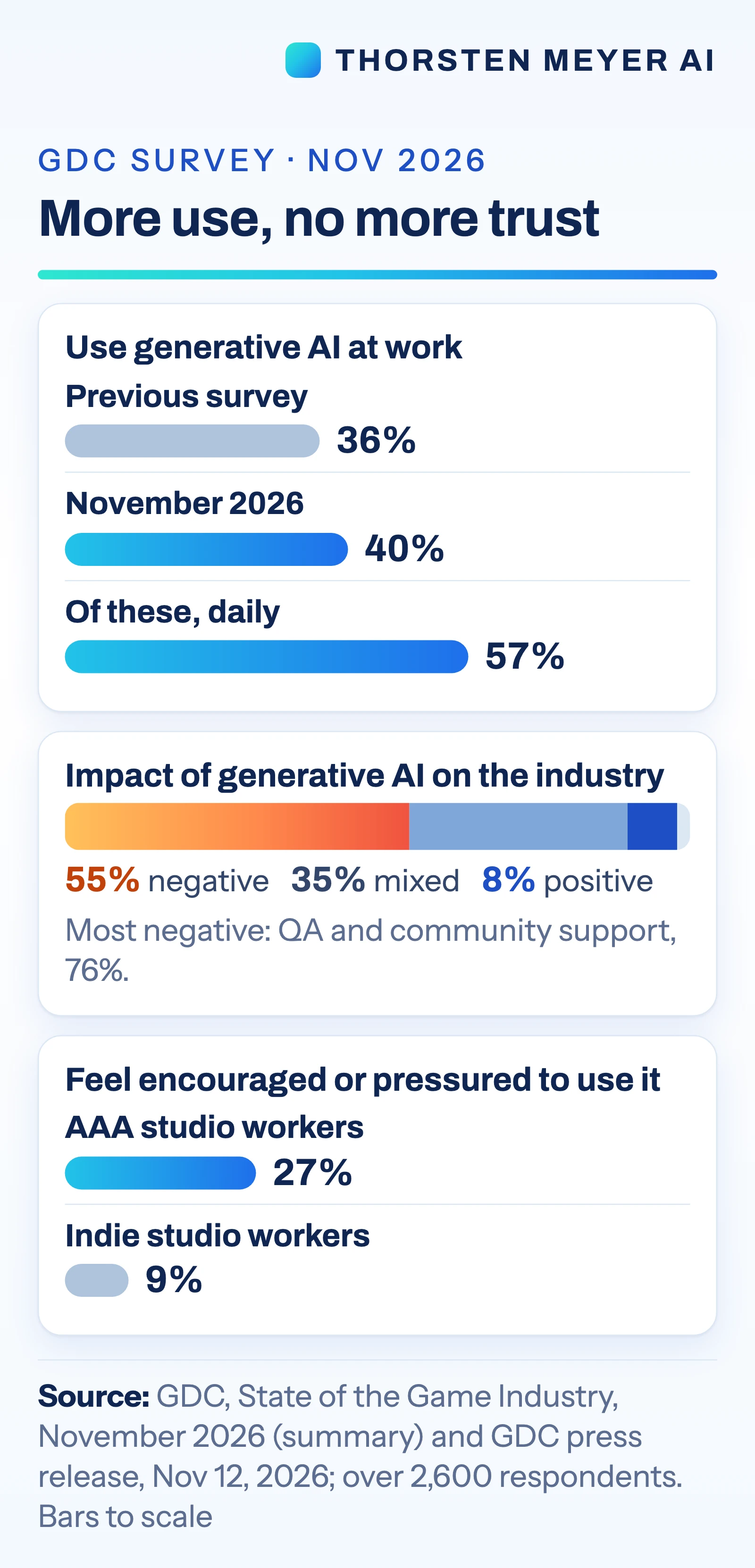
The call comes amid wider disagreement over AI’s place in game development. A Game Developers Conference survey published November 12 found that 40% of respondents used generative AI at work, up from 36% in the previous survey. In the same survey, 55% said the technology was having a negative impact on the industry. The findings describe respondents’ reported use and views; they do not establish that AI caused job losses.
Other developments reported in the source material include a group of Independent Games Festival jurors saying they would not vote for games using genAI in any capacity, and the studio behind Big Walk disclosing that large language models touched “well under 0.1%” of its code. These examples show that the debate spans both industry policy and individual production choices.
Video Games Europe, a trade body, took a more favorable position in 2024, saying genAI was widely expected to advance game development and arguing against AI labels in games. On November 12, Xbox CEO Asha Sharma wrote that a small team could build worlds that currently require hundreds of developers, without naming AI. The source material reports no public studio or trade-body response to the unions’ manifesto as of its publication.
““Avoid the use of generative AI entirely.””
— The manifesto’s authors
Reach and Studio Response
The manifesto does not say how many workers its authors represent, and the source material reports no public response from studios or industry trade bodies at the time of publication. It is also unclear whether any employer will change its policies or negotiate agreements in response.
The unions say genAI is replacing workers and contributing to a decline in junior roles. Those are claims made in the manifesto; the material provided does not independently establish the scale of those effects or show that AI caused the layoffs reported in the GDC survey. The legality of training models on disputed third-party material also remains contested, according to the source.
Whether Studios Change Policy
The next signs to watch are whether workers seek company agreements, whether studios publish rules for genAI use, and whether employers disclose its use in game production. Regulators’ response to the unions’ demands on consent, compensation and withdrawal will also matter. The manifesto sets out what its authors want; the source material does not identify a formal response deadline or a specific upcoming policy decision.
Key Questions
What are the unions asking game studios to do?
The manifesto urges employers to avoid generative AI entirely, says no worker should be required to use it, and calls for precise labels if use cannot be avoided.
Does the call cover AI used behind the scenes?
Yes. The text includes early development work such as concept art, reference material and pre-translations, even when the output does not appear in the finished game.
Which unions are associated with the manifesto?
The IWGB Game Workers page names members of its branch working with members of Game Workers Unite Ireland, Spain’s CSVI and the FIOM-CGIL Milan Work Council. Rock Paper Shotgun and Kotaku also list France’s STJV and Germany’s GDRT.
Have studios agreed to follow the recommendations?
The source material reports no public studio response by the time of publication and does not say that any studio has adopted the recommendations.
What did game developers report about genAI use?
A GDC survey published November 12 found that 40% of respondents used genAI at work, up from 36%; 55% said it was having a negative impact on the industry.
Source: Thorsten Meyer AI