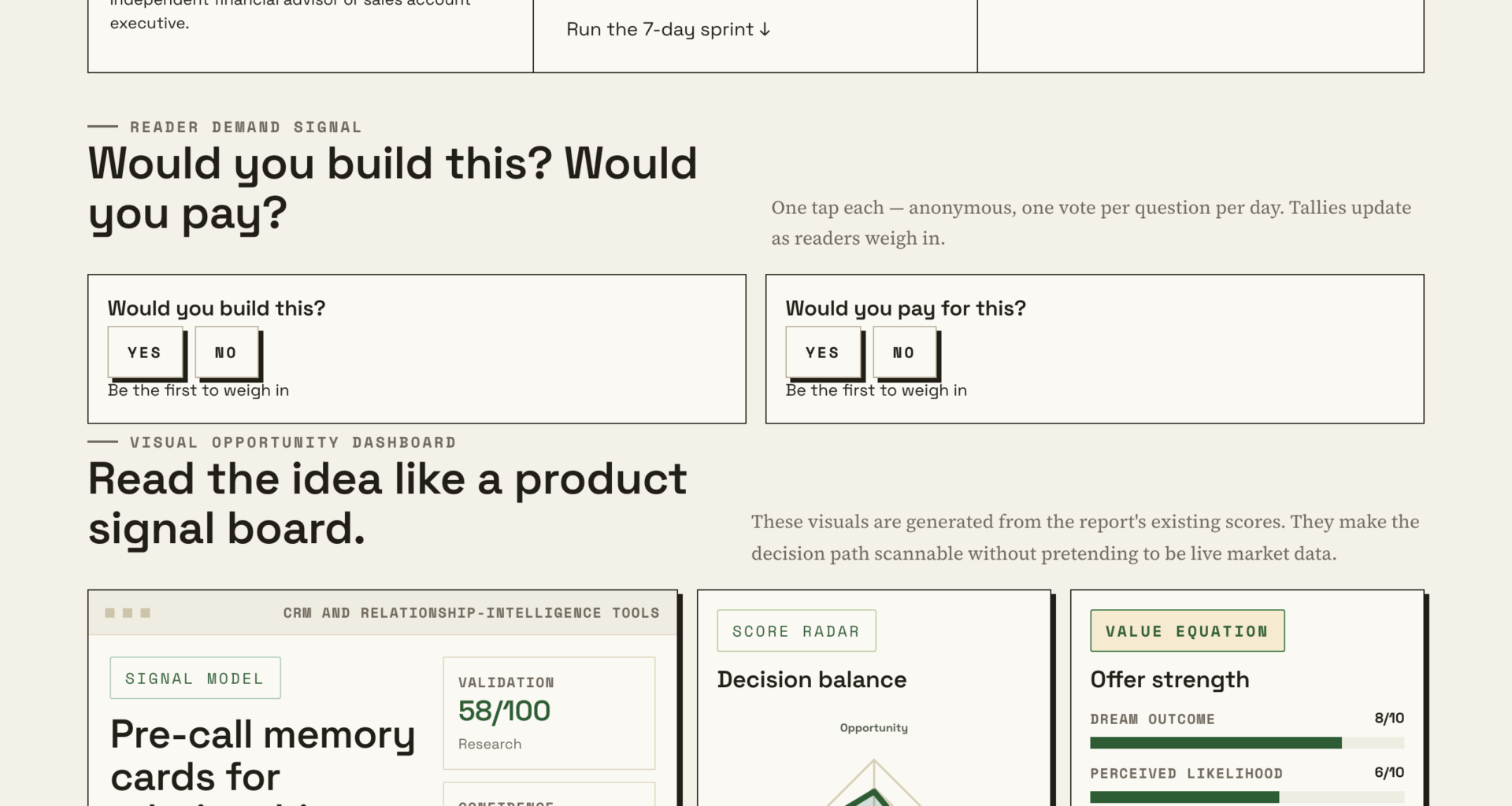

📊 Full opportunity report: Pre-Call Memory Cards: The Key To Relationship-Driven Sales Excellence on IdeaNavigator AI — validation score, market gap, and execution plan.
Prime for Young Adults — start your free trial
Fast free delivery, streaming and member deals for eligible 18–24 year olds.
Try it freeAs an affiliate, we earn on qualifying purchases.
TL;DR
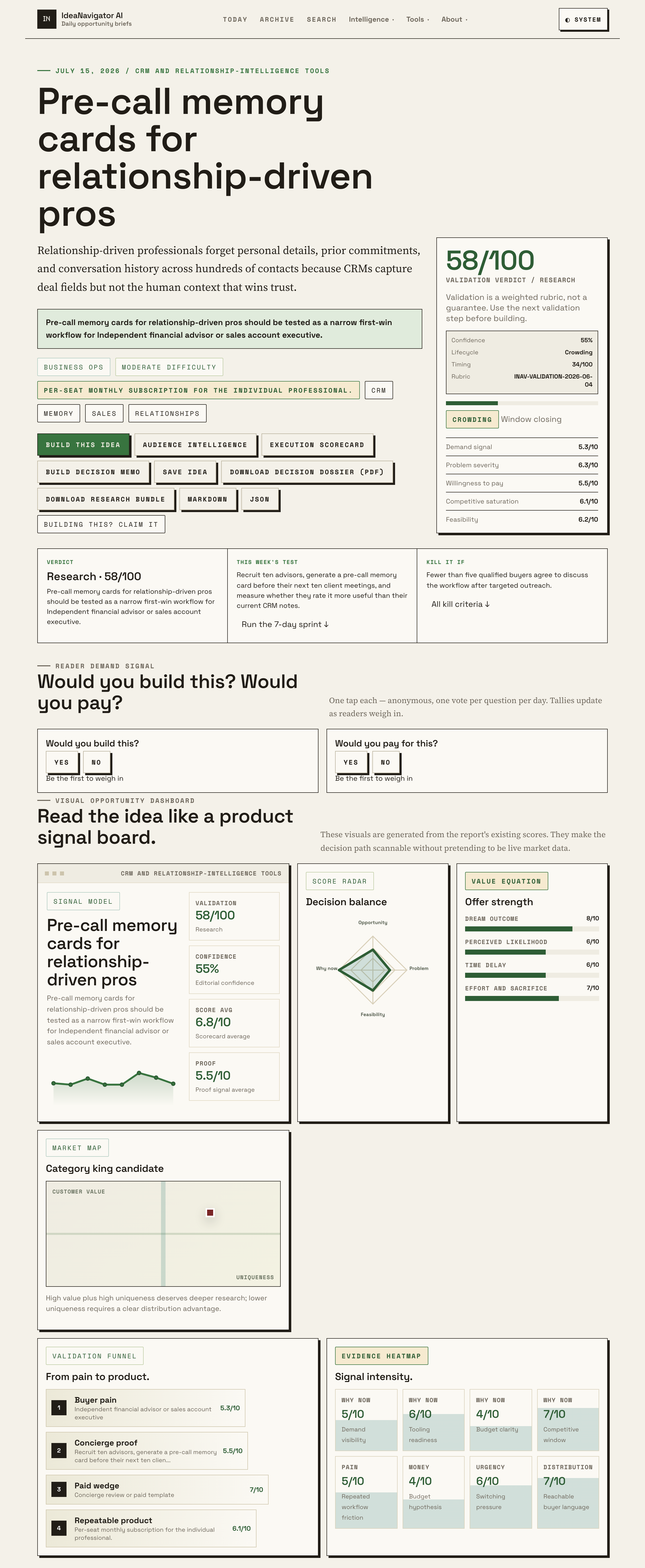
Pre-call memory cards are being tested as a new tool for relationship-driven sales professionals. They aim to improve client interactions by summarizing past conversations and commitments, potentially transforming how advisors manage client relationships.
Pre-call memory cards are emerging as a potential solution for relationship-driven professionals such as independent financial advisors and sales account executives. These cards aim to provide a concise, comprehensive summary of a client’s history and recent interactions, addressing the limitations of current CRM systems. The development is in the testing phase, with early pilots showing promise for improving client trust and engagement.
The concept involves creating a one-page pre-call brief that synthesizes information from a contact’s past emails, notes, and interactions. This brief highlights key details such as who the client is, what was last promised, and open threads, making it easier for professionals to recall important context before meetings. The approach leverages recent advances in large-language-model summarization technology, which can distill lengthy conversation histories into searchable, durable summaries.
According to sources familiar with the initiative, the goal is to test this workflow by recruiting ten advisors, generating pre-call memory cards before their next ten client meetings, and measuring whether these summaries are rated as more useful than traditional CRM notes. The model aims to offer a per-seat subscription service, providing a tailored, scalable tool for relationship-driven sales professionals.
Why Pre-Call Memory Cards Could Transform Client Relationships
This development could significantly improve how professionals manage client relationships by ensuring they remember critical details that foster trust. By capturing human context that current CRMs often overlook, these memory cards may lead to stronger, more personalized interactions. The technology also offers a scalable way to enhance relationship management without requiring extensive manual note-taking, which can be inconsistent or incomplete.
For independent financial advisors and sales professionals, this innovation addresses a common pain point: forgetting personal details, prior commitments, or conversation history across hundreds of contacts. The ability to quickly access a concise, accurate summary before meetings could lead to higher client satisfaction and loyalty, potentially impacting overall business success.
client relationship management memory cards
As an affiliate, we earn on qualifying purchases.
As an affiliate, we earn on qualifying purchases.
Limitations of Current CRMs and the Rise of AI Summarization
Existing customer relationship management (CRM) systems tend to focus on deal fields and transaction data, often neglecting the human elements that drive trust and rapport. Many professionals report difficulty recalling nuanced details about clients, which can hinder relationship-building efforts. Recent advances in large-language models (LLMs) have made it feasible to generate summaries from extensive conversation histories, making it possible to surface relevant context quickly and reliably.
This shift aligns with broader trends in AI-assisted sales and relationship management, where automation and intelligent summaries are increasingly used to enhance productivity and personalization. The initiative to develop pre-call memory cards is an early step in integrating AI more deeply into client-facing workflows.
“Leveraging AI to distill conversation histories into searchable summaries could be a game-changer for relationship-driven professionals.”
— an anonymous researcher
As an affiliate, we earn on qualifying purchases.
Uncertainties Around Implementation and Effectiveness
It is not yet clear how well the memory cards will perform in real-world settings, or whether advisors will find them more useful than their existing notes. The pilot testing is still in early stages, and results on usability, accuracy, and impact on client relationships are pending. Additionally, questions remain about the integration process with existing CRM tools and the cost structure for individual professionals.
As an affiliate, we earn on qualifying purchases.
Next Steps for Validation and Broader Adoption
The initial pilot involving ten advisors will conclude with an assessment of the memory cards’ usefulness and impact. If results are positive, the developers plan to expand testing, refine the technology, and explore broader market adoption. Further research will also examine long-term effects on client trust and business outcomes.
financial advisor client interaction tools
As an affiliate, we earn on qualifying purchases.
As an affiliate, we earn on qualifying purchases.
Key Questions
How do pre-call memory cards differ from traditional CRM notes?
Pre-call memory cards synthesize past interactions into a concise, searchable summary, focusing on human context like promises and open threads, whereas traditional CRM notes often contain detailed but unstructured data.
What technology enables the creation of these memory cards?
Large-language-model summarization technology, which can condense lengthy conversation histories into key points, is the core enabler for generating these memory cards.
Who is the target user for this tool?
Independent financial advisors and sales account executives who rely on relationship-building to succeed are the primary target users.
What are the potential benefits of using pre-call memory cards?
They can improve client trust, enhance meeting preparation, reduce forgetting important details, and streamline relationship management workflows.
When might this technology become widely available?
Following successful pilot testing and validation, broader rollout could occur within the next year or two, depending on market interest and integration capabilities.
Source: IdeaNavigator AI
Fall Picks
fall essentials
As an affiliate, we earn on qualifying purchases.