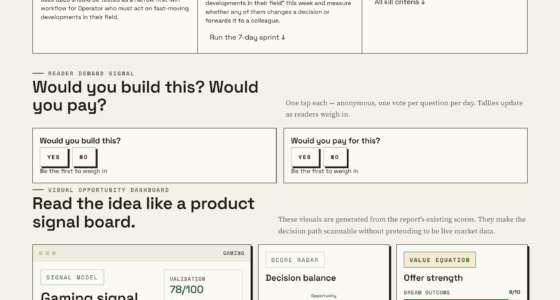

📊 Full opportunity report: The Bubble Is Not in Valuations: It’s in the Productivity Gap on ThorstenMeyerAI.com — validation score, market gap, and execution plan.

Get tech for your team delivered free — and shop member deals
- Fast, free delivery on millions of items
- Access to Prime Big Deal Days deals on October 6–7
- Prime Video, Amazon Music and more included
TL;DR
Despite high valuations and widespread hype, AI’s measurable productivity impact remains small. A significant expectation bubble is forming, driven by inflated projections that are not yet supported by data. This could lead to market corrections and strategic shifts.
Recent data reveals that AI’s actual impact on corporate productivity remains minimal, contradicting the high valuations and optimistic projections that have driven AI stocks to record levels in early 2026.
In Q1 2026, AI-exposed companies traded at a median forward revenue multiple of 22×, compared to 7× for the S&P 500. Despite this, a National Bureau of Economic Research (NBER) working paper reported that 90% of firms see no measurable AI impact on productivity, while executives project only a 1.4% median productivity gain. This stark discrepancy suggests that the current valuation premium is based on inflated expectations rather than evidence of actual productivity improvements.
While some narrow tasks, such as code generation and document extraction, show measurable gains of 20–50%, these are limited to specific domains and do not translate into large-scale enterprise productivity boosts. The overall firm-level impact remains small, and token cost reductions do not drive demand for unimplemented workflows. The $650 billion AI capex committed by major firms reflects belief in future gains, but if these do not materialize, it could lead to margin pressure, valuation corrections, and workforce adjustments in the coming years.
Why the Expectation Gap Matters for Markets
The disconnect between high valuations and minimal measurable productivity gains indicates a structural expectation bubble. If companies’ projections are overly optimistic, market corrections could be severe, impacting investor confidence and corporate strategies. This misalignment also risks leading to costly restructuring, layoffs, and a reassessment of AI’s role in economic growth, making it a critical issue for stakeholders across sectors.
AI productivity tools for enterprise
As an affiliate, we earn on qualifying purchases.
As an affiliate, we earn on qualifying purchases.
AI Valuations and the Reality of Productivity Gains
Throughout 2025 and into 2026, AI stocks surged amid widespread hype, with some firms trading at multiples that price in aggressive future growth. The narrative of AI transforming productivity became mainstream, supported by high-profile investments and optimism. However, recent research from the NBER and market data challenge this view, showing that actual productivity improvements are limited and concentrated in narrow tasks. The divergence between expectations and reality is now a focal point for investors and policymakers.
“The valuation premium is defensible if AI delivers what executives say it will. But the gap between expectation and measurable impact is widening, revealing a structural bubble in outlook, not just asset prices.”
— Thorsten Meyer
“90% of firms report no measurable AI impact on productivity, despite projections of a 1.4% median gain.”
— NBER working paper authors
AI coding and document extraction software
As an affiliate, we earn on qualifying purchases.
As an affiliate, we earn on qualifying purchases.
Uncertainties Surrounding AI’s Long-Term Impact
It remains unclear how quickly and broadly AI will eventually deliver larger productivity gains, if at all. The pace of technological adoption, potential breakthroughs, and corporate strategies could alter current projections. Additionally, the timing and severity of market corrections driven by the expectation bubble are still uncertain, as is the impact on employment and economic growth.
As an affiliate, we earn on qualifying purchases.
What Comes Next in the AI Productivity Narrative
Looking ahead, the market will closely monitor key indicators such as quarterly revenue per employee growth, changes in price-to-sales multiples, and new academic or industry research findings. A persistent growth rate below 2% or significant multiple compression could signal an impending correction of the current expectation bubble. Furthermore, ongoing corporate disclosures and technological developments will help determine whether productivity gains will align with optimistic projections or if the gap will widen, prompting strategic adjustments across sectors.
Source: ThorstenMeyerAI.com
As an affiliate, we earn on qualifying purchases.
Halloween Picks
halloween
As an affiliate, we earn on qualifying purchases.