
📊 Full opportunity report: The Convergence Of Govtech And Benefit Check Bots In Social Services on IdeaNavigator AI — validation score, market gap, and execution plan.

Get business pricing on tech for your team
- Business-only prices and quantity discounts
- Tax-exempt purchasing
- Multiple users, one account, clear invoices
TL;DR
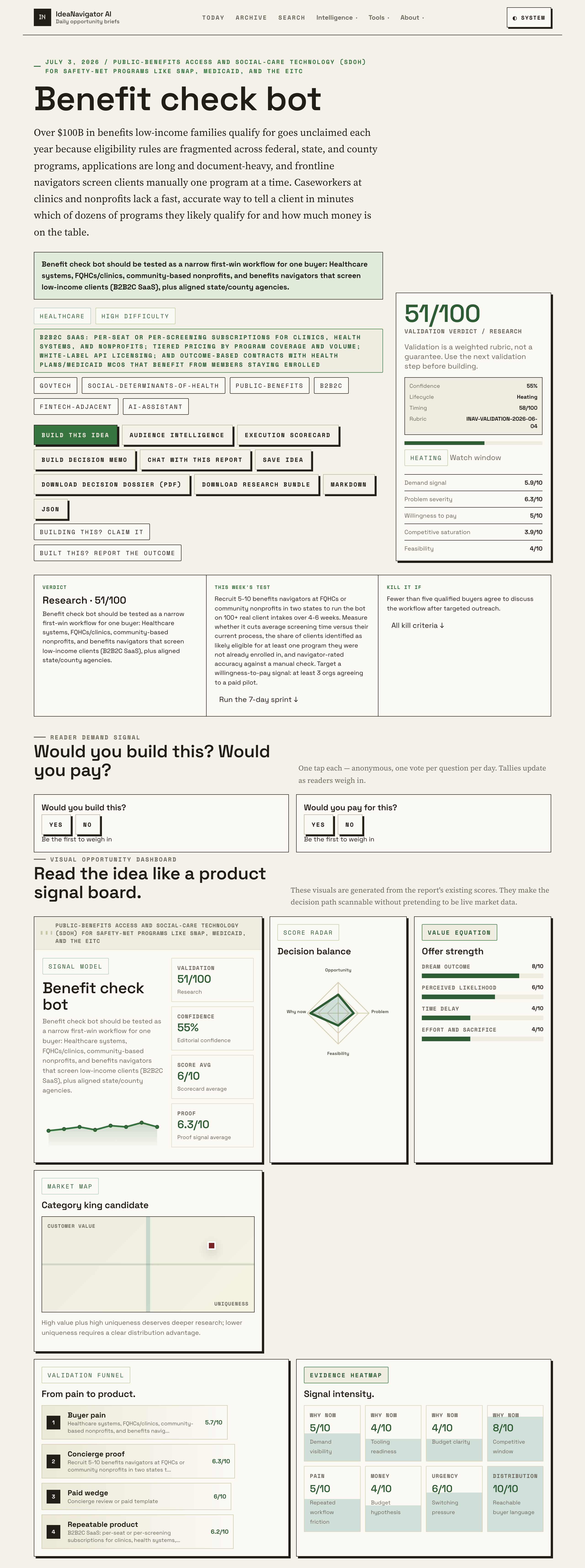
Benefit check bots are emerging as a key tool for social service providers to quickly identify eligible benefits for low-income clients. This development responds to gaps left by nonprofit shutdowns and increased eligibility checks post-pandemic. The initiative aims to improve efficiency and access, but validation and scalability remain ongoing questions.
Benefit check bots are being piloted across several states to automate eligibility screening for low-income assistance programs, marking a significant step in integrating govtech solutions into social services. These conversational AI tools aim to help healthcare providers, clinics, and nonprofits quickly identify benefits clients may qualify for, addressing longstanding fragmentation and manual screening challenges. The development comes after the shutdown of a major nonprofit and amidst increased eligibility redeterminations, highlighting the urgent need for scalable, cost-effective solutions.
The benefit check bot initiative is designed as a white-label SaaS product, enabling clinics and nonprofits to embed a conversational screening tool directly into their websites or communicate via SMS. The bot asks a short series of yes/no and multiple-choice questions to determine likely eligibility for programs such as SNAP, Medicaid, EITC/CTC, WIC, and LIHEAP, providing estimates of potential benefits and next steps for application. The pilot phase involves testing in 2-3 states with 5-10 organizations, focusing on measuring reductions in screening time, accuracy, and the share of clients identified for benefits they were not previously enrolled in.
Following the closure of Benefits Data Trust in 2024—an organization that had been screening and enrolling clients across seven states—health systems and state agencies faced a critical capacity gap. This gap coincided with the post-pandemic Medicaid unwinding, which has triggered tens of millions of redeterminations, often overwhelming manual screening processes. Conversational AI now offers a promising alternative, promising near-zero marginal costs and multilingual support, making large-scale screening more feasible.
The convergence of govtech and benefit check bots has the potential to significantly improve how social services are delivered by reducing manual screening time, increasing accuracy, and expanding access to benefits. These tools could help frontline workers identify eligible clients more quickly, reducing the number of unclaimed benefits—estimated at over $100 billion annually—by streamlining eligibility determination. As a result, low-income families may access vital resources faster, and public agencies could realize cost savings through automation. However, questions about scalability, data privacy, and integration with existing systems remain to be addressed.
benefit eligibility screening software
As an affiliate, we earn on qualifying purchases.
As an affiliate, we earn on qualifying purchases.
Background on Benefits Access and Technological Gaps
For years, low-income families have left billions of dollars in benefits unclaimed due to complex eligibility rules, lengthy application processes, and manual screening by caseworkers. The recent shutdown of Benefits Data Trust, a nonprofit that provided benefits screening in multiple states, has left a notable gap in capacity. Meanwhile, the post-pandemic Medicaid redetermination process has added to the workload of benefits navigators, many of whom rely on outdated, manual methods. Advances in conversational AI and SaaS have created opportunities to automate these processes, but practical implementation is still in early stages.
Initial pilots are testing whether these bots can accurately identify benefits eligibility, reduce screening times, and support multilingual communication. The approach aligns with broader trends in govtech, which aims to leverage technology to improve public service delivery and reduce administrative burdens.
As an affiliate, we earn on qualifying purchases.
Uncertainties Around Scalability and Data Privacy
It is not yet clear how well these benefit check bots will scale across different states, programs, and client populations. Questions remain about the accuracy of eligibility estimates, integration with existing government and nonprofit systems, and data privacy protections. The pilot programs are still in early phases, and wider adoption will depend on demonstrating consistent performance and securing funding for broader deployment.
government benefits eligibility tool
As an affiliate, we earn on qualifying purchases.
As an affiliate, we earn on qualifying purchases.
Next Steps for Pilot Expansion and Evaluation
The immediate next step involves expanding pilot programs to include more organizations and states, with a focus on measuring impact metrics such as screening speed, accuracy, and client outcomes. Success in these pilots could lead to wider adoption and potential integration into state and federal benefits systems. Additionally, developers and stakeholders will need to address technical challenges, privacy concerns, and funding models to support scale-up. Results from ongoing evaluations will inform whether these bots become a standard component of social service delivery.
multilingual benefit screening chatbot
As an affiliate, we earn on qualifying purchases.
As an affiliate, we earn on qualifying purchases.
Key Questions
How do benefit check bots improve eligibility screening?
They automate the process by asking clients a series of questions to quickly estimate eligibility for multiple programs, reducing manual effort and time.
What programs can these bots screen for?
Initial pilots focus on programs like SNAP, Medicaid, EITC/CTC, WIC, and LIHEAP, with potential to expand to others.
Are these bots accurate enough for real-world use?
Early pilot results are promising, but full validation is ongoing to ensure accuracy and reliability across diverse populations and regions.
What are the main challenges for scaling benefit check bots?
Key challenges include system integration, data privacy, multilingual support, and ensuring consistent performance across different jurisdictions.
Will these tools replace human benefits navigators?
They are intended to augment, not replace, human workers by handling routine screening tasks and freeing up staff for complex cases.
Source: IdeaNavigator AI
Fall Picks
fall essentials
As an affiliate, we earn on qualifying purchases.