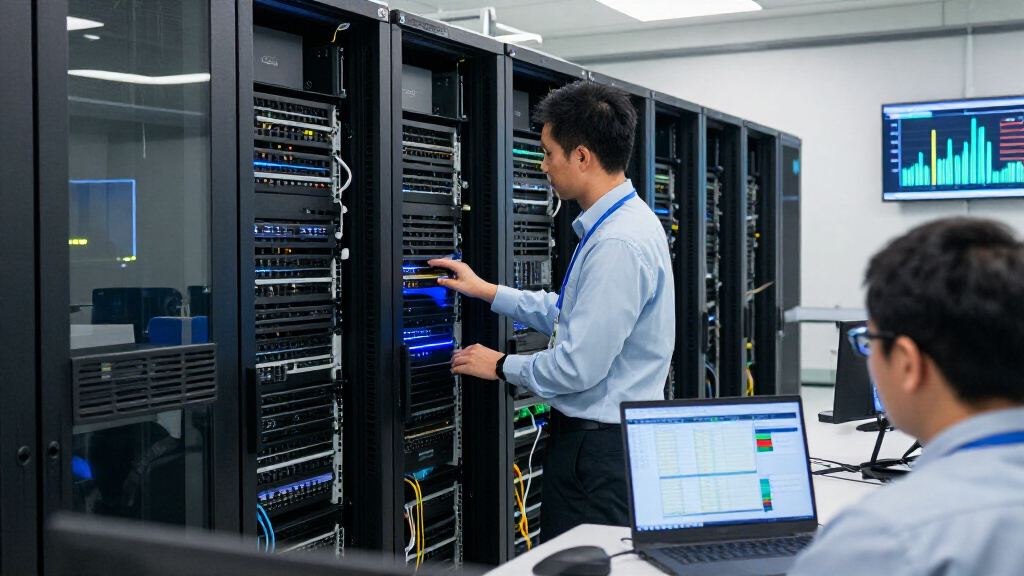

🔍 Read the full analysis: Why Volume Matters In IBM’s On-Prem AI Calculus on ThorstenMeyerAI.com

Get business pricing on tech for your team
- Business-only prices and quantity discounts
- Tax-exempt purchasing
- Multiple users, one account, clear invoices
TL;DR
IBM CEO Arvind Krishna argued on the company’s October 21 earnings call that open-weight AI models can deliver about 90% of frontier-model performance at a fraction of the token cost, supporting on-premises deployment. An October 26 comparison puts the best downloadable model at 80% of the leading proprietary model; the economics of buying hardware depend heavily on how consistently it is used.
IBM CEO Arvind Krishna used the company’s October 21 earnings call to make the case that enterprises can run open-weight AI models on their own infrastructure for a fraction of the cost of leading proprietary models. The argument matters to companies weighing large AI workloads against the cost of servers, staffing and operations, but an October 26 benchmark comparison puts the best currently downloadable model at 80% of the leading proprietary model, not 90%.
In the call’s question-and-answer session, Krishna said open-weight models cost “25% to 10% of the token cost” of frontier models while being “90% as effective.” He pointed to routine tasks such as summarizing email, reviewing contracts and answering customer calls as work that may not require the strongest available model. He also said an enterprise could begin with “two or three racks.” These are Krishna’s estimates, not independently verified measures of total deployment cost.
The October 26 Artificial Analysis Intelligence Index comparison shows MiMo-V2.6-Pro as the top downloadable model at 46.3, against Claude Opus 5.5 at 57.6, or about 80% of the proprietary score. The figures indicate that open models have gained ground: the source’s comparable chart puts the open-model share at 51% of the leading proprietary score at the end of 2024 and 80% on October 26, 2026. The comparison does not establish that every enterprise task will show the same gap or cost.
A possible exception is Kimi K3.1 Pro, which scores 55.1 on the index, about 96% of Claude Opus 5.5. But the source says Moonshot had only promised to release its weights “by Nov 4.” Until they are available, Kimi is not a downloadable open-weight option. Its licence also had not been published, according to the source material.
IBM's 90% claim, checked
Open weights reach 80% of the leader
Krishna says open-weight models are "90% as effective". On an independent index the best model you can download today reaches 80% of the best closed one, up from about half two years ago.
Best open model as a share of the best closed
Artificial Analysis Intelligence Index, current version, best downloadable vs. best proprietary model at each date.
What Krishna said
Illustrations from the earnings call, not a named benchmark.
- Late 2024"70" vs. "20 or 30"Krishna, Q3 call, 21 Oct · no named benchmark
- Late 2025"70 to 50"Krishna, Q3 call, 21 Oct · no named benchmark
- Now"90% as effective"Krishna, Q3 call, 21 Oct · no named benchmark
Top downloadable models today
Intelligence Index score and licence type. Read the licence before the leaderboard.
| Model | Index | Licence |
|---|---|---|
| MiMo-V2.6-Pro Xiaomi | 46.3 | MIT |
| DeepSeek V4.1 Flash 1017 DeepSeek | 45.1 | MIT |
| GLM-5.3 Z AI | 44.8 | own commercial licence |
| Step 5 Preview StepFun | 43.7 | own commercial licence |
| Muse Spark Open Meta | 38.9 | licence with conditions |
In points the gap did not shrink: 7.5 points at the end of 2024, 11.3 today. Closed models moved too.
Sources: Artificial Analysis, Intelligence Index v4.3.2 (read 26 Oct 2026), IBM Q3 2026 earnings call transcript (21 Oct 2026), Artificial Analysis on Kimi K3.1 Pro (23 Oct 2026).
Powered by Thorsten Meyer AI
Why Utilization Drives the Savings
The choice is not simply whether an open model’s token price is lower. An enterprise buying servers takes on upfront hardware costs and must keep equipment busy enough to justify them. The source lists an eight-GPU H200 server from $172,643 and AWS rental of the same GPU class at $63.30 an hour. On those list prices, it estimates a purchase would match rental cost after about 114 days at full utilization, but around 15 months at 25% utilization. Those calculations exclude staff, cooling and networking, so they are not a complete ownership-cost comparison.
That makes workload volume and steady usage central to the on-premises case. Organizations with repeatable, high-volume inference may spread hardware costs across more work; intermittent or unpredictable demand can make rented capacity more attractive. The comparison also depends on model quality, hardware availability and the cost of operating a private deployment.
There is a separate strategic reason for some buyers. Krishna said banks and trading firms want AI deployment that is “sovereign,” with control over underlying data and logs. Running models on private infrastructure may help meet those needs, but it does not by itself establish that a system satisfies every security, regulatory or data-governance requirement.
Products Worth Considering

Jackery Solar Generator 1000 V2 with 200W Solar Panel

Amazon Kindle Paperwhite (12th Generation, 2024), 16 GB, 7-inch Display, Jade

Logitech MX Keys S Wireless Keyboard, Graphite
As an affiliate, we earn on qualifying purchases.
IBM’s Pitch and Its Trade-Offs
IBM is an interested party in this debate: it sells infrastructure intended for enterprise AI deployments, including its Spyre cards. Krishna’s comments therefore describe IBM’s view of the market as well as a broader cost argument. The source also reports that IBM’s mainframe revenue fell 20% in the quarter, 18 months into the z17 cycle, citing The Register. That fact does not establish what caused the revenue change or how much AI infrastructure sales may contribute.
Krishna acknowledged that on-premises AI requires people who can manage kernel engineering and networking. He said that skills gap remains outside the most sophisticated enterprises and called frontier cloud services the “easy answer,” despite describing them as four times more expensive. IBM also said its llm-d project can run large models at “5 to 10 times lower cost”; the source material presents that as an IBM claim, not an independently checked result.
Model scores are only one part of the decision. Weights, licences and deployment terms differ: the source identifies MiMo-V2.6-Pro and DeepSeek V4.1 Flash 1017 as MIT-licensed, while other models use custom or commercial licences. A high leaderboard score does not automatically mean an enterprise can use a model in its intended way or run it economically on its own equipment.
The Open-Model Gap Is Still Moving
The benchmark comparison captures a snapshot, not a settled measure of real-world performance. Artificial Analysis applies the same ten evaluations across models, but a score does not show whether a particular model performs adequately on an organization’s own tasks, or what additional prompting and engineering those tasks require. Krishna’s 90% figure was not tied in the source material to a named benchmark.
Kimi’s status remains conditional: the source says its weights were promised for November 4, 2026, but had not shipped as of the October 26 data snapshot. Its score cannot be treated as evidence of an available open-weight deployment, and its licence was not yet published. Hardware payback figures also remain estimates based on listed prices and assumed usage; actual operating and financing costs are not included.
Watch for Weights and Real Costs
The next near-term marker is whether Moonshot releases Kimi K3.1 Pro’s weights as promised for November 4, 2026, and what licence accompanies them. Enterprises considering on-premises deployment will also need to compare their own workload volumes, utilization, staffing and infrastructure costs with cloud alternatives. The available figures support a conditional case for buying hardware—not a universal verdict that on-premises AI is cheaper.
Key Questions
What did IBM’s CEO claim about open-weight AI?
Arvind Krishna said open-weight models could cost 10% to 25% of frontier-model token costs while being about 90% as effective. That is his estimate from the October 21 earnings call, not an independently verified cost comparison.
How close is the best downloadable model to the leading proprietary model?
In the October 26 Artificial Analysis comparison cited in the source, MiMo-V2.6-Pro scored 46.3 and Claude Opus 5.5 scored 57.6. The open model’s score is about 80% of the proprietary model’s score on that index.
Why does AI workload volume matter for buying servers?
Purchased hardware has a large upfront cost, so its economics depend on how much it is used. The source estimates an eight-GPU H200 server matches rental costs after about 114 days at full use, compared with around 15 months at 25% use, before staffing and other operating costs.
Is Kimi K3.1 Pro available as an open-weight model?
Not according to the source’s October 26 snapshot. Moonshot had promised to release the weights by November 4, but they had not shipped, and the licence had not been published.
Source: ThorstenMeyerAI.com