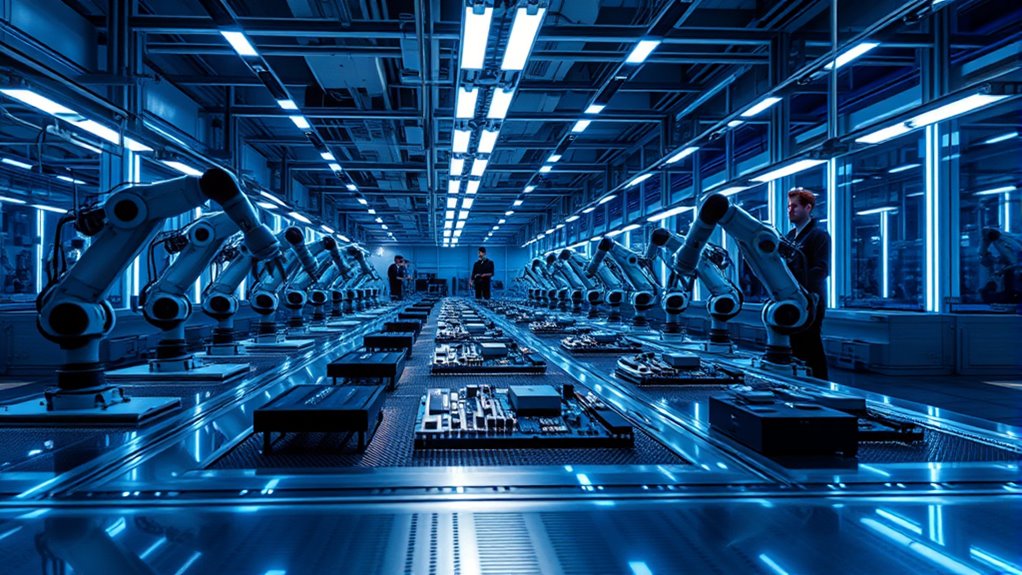

Ethical challenges in automation involve addressing moral dilemmas where machines make decisions affecting human lives. You’ll face questions about responsibility when accidents happen, as it’s often unclear if developers, companies, or users are to blame. Gaps in laws and regulations make accountability harder, risking trust and justice. By understanding these issues, you’ll see why designing transparent systems and aligning them with societal values is essential to navigate these complex moral landscapes.
Key Takeaways
- Machines making life-impacting decisions raise moral dilemmas about fairness, harm, and responsibility.
- Determining accountability for autonomous system errors involves developers, companies, and end-users.
- Existing legal frameworks often lag, creating gaps in regulation and oversight of automated decision-making.
- Lack of transparency in algorithms complicates blame assignment and undermines trust in automation systems.
- Implementing ethical design and regulation strategies can mitigate risks and align automation with societal values.

As automation becomes increasingly integrated into our daily lives, it brings not only efficiency but also complex ethical challenges. One of the most pressing concerns is the moral dilemmas that arise when machines are making decisions that impact human lives. You might wonder, who bears the responsibility when an autonomous vehicle causes an accident? These situations force us to confront questions about morality—what is the right thing to do when a machine must choose between two harmful outcomes? For example, if an AI system in healthcare decides to prioritize one patient over another based on algorithms, it raises questions about fairness and bias. These moral dilemmas aren’t hypothetical; they’re real issues that demand careful consideration to prevent harm and ensure ethical standards are upheld.
Alongside moral dilemmas, accountability issues pose a significant challenge. When automation leads to errors or harm, determining who is responsible gets complicated. Was it the developers who programmed the AI? The company that deployed it? Or the end-user who relied on it? You must understand that accountability becomes murky when decisions are made by algorithms that learn and adapt over time. This opacity can make it difficult to assign blame or seek justice when things go wrong. If an AI-driven financial system causes a market crash, for instance, pinpointing the responsible party isn’t straightforward. This lack of clarity can hinder justice and accountability, making it harder to implement remedies or prevent future mistakes.
Furthermore, accountability issues extend into legal and ethical frameworks that often lag behind technological advances. You might find that current laws are ill-equipped to handle the nuances of automated decision-making, leaving gaps in regulation. This creates a dangerous environment where companies may prioritize profit over ethics, knowing that accountability is uncertain. As a result, you face the risk of a “blame game,” where responsibility is deflected or obscured, undermining trust in automation systems. The challenge is to develop transparent mechanisms and regulations that clearly define accountability, ensuring that when automation fails or causes harm, there’s a pathway for recourse. Additionally, incorporating diverse design approaches, such as ethical design principles, can help mitigate some of these issues by aligning automation with societal values.
Frequently Asked Questions
How Can Companies Ensure Transparency in Automated Decision-Making?
You can guarantee transparency in automated decision-making by prioritizing algorithm accountability and engaging stakeholders. Regularly audit your algorithms to identify biases and errors, then clearly communicate how decisions are made. Involve stakeholders in the process, gathering their insights and concerns to build trust. By openly sharing information about your algorithms and their impact, you create a transparent environment that fosters ethical practices and improves decision-making reliability.
What Are the Rights of Workers Displaced by Automation?
You have the right to fair worker compensation if you’re displaced by automation. Companies should provide support like job retraining programs to help you shift to new roles. These initiatives make certain you’re not left behind as technology advances, giving you opportunities to develop new skills. Advocacy for your rights also involves clear communication from employers and policies that protect your economic stability during these changes.
How Do We Address Bias in AI Algorithms?
To address bias in AI algorithms, you should prioritize algorithmic fairness by designing models that minimize discrimination. Incorporate data diversity by using varied and representative datasets, which helps prevent skewed outcomes. Regularly audit and test your algorithms for bias, and involve diverse teams in development. By actively promoting fairness and diversity, you guarantee your AI systems are more equitable and trustworthy for all users.
What Legal Frameworks Govern Automation Ethics Globally?
You need to understand that international regulations and ethical standards shape automation ethics globally. These frameworks, like the GDPR in Europe and similar laws elsewhere, set rules for data privacy, accountability, and transparency. By staying informed about these regulations, you can guarantee your automation practices comply with legal requirements and uphold ethical standards worldwide, fostering trust and responsibility in your automation projects.
How Can Consumers Protect Their Privacy With Automated Systems?
Think of your privacy as a delicate shield, and you’re the guardian. You can protect it by using strong data encryption and anonymization techniques, which act like invisible armor around your personal info. Stay vigilant with privacy settings, limit data sharing, and review permissions regularly. These steps help keep your data secure, ensuring automated systems serve you without exposing your identity to unnecessary risks.
Conclusion
As you navigate automation’s rise, remember it’s like steering a ship through unpredictable waters. Just as a captain must balance speed with safety, you must weigh innovation against ethics. When a factory replaced workers with robots, productivity soared, but at what cost to community? Your choices shape this landscape. By staying vigilant and responsible, you can steer automation toward a future that benefits all, ensuring progress doesn’t come at the expense of our shared humanity.