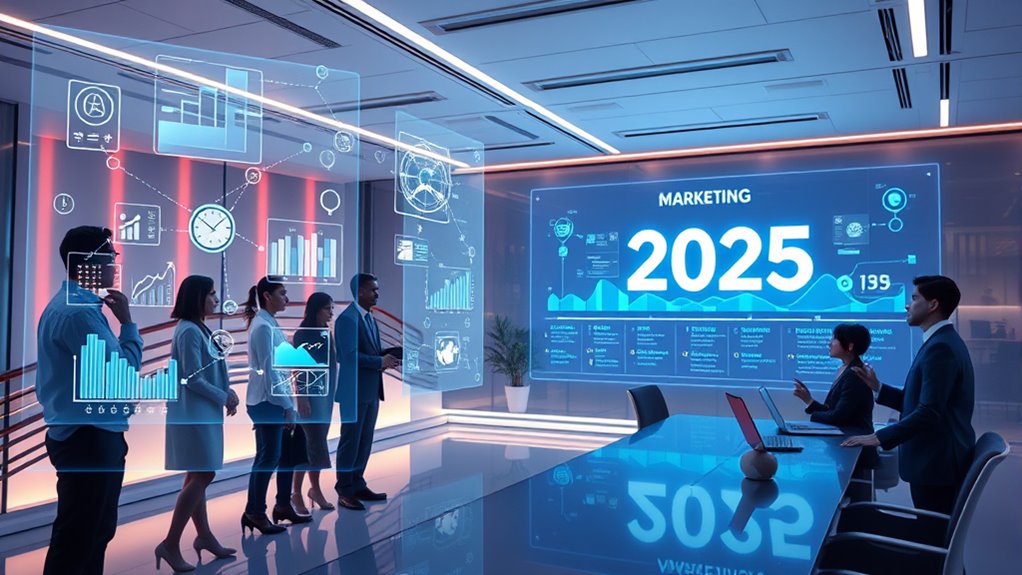

By 2025, marketing automation will be powered by advanced AI to deliver highly personalized, predictive, and seamless experiences across all channels. You’ll see deeper customization based on real-time behaviors and preferences, along with smarter integration that adapts to customer interactions automatically. This evolution will help you build stronger relationships, boost engagement, and increase conversions with less effort. Stay tuned to discover how these innovations will transform your marketing strategies even further.
Key Takeaways
- AI-driven personalization will enable hyper-targeted, real-time customer experiences across all channels.
- Predictive analytics will forecast customer needs, allowing proactive campaign strategies and improved customer lifetime value.
- Automation systems will continuously learn and adapt, enhancing efficiency and accuracy in customer engagement.
- Omnichannel integration will deliver seamless, consistent interactions, strengthening brand loyalty and trust.
- Future marketing tools will incorporate mindfulness principles, fostering more empathetic, relevant, and effective messaging by 2025.
Have you wondered how marketing automation will evolve by 2025? The landscape is set to become more intelligent and tailored to your audience than ever before. With advancements in AI personalization, you’ll be able to craft highly customized experiences for your customers, making interactions feel seamless and relevant. AI personalization will analyze individual behaviors, preferences, and purchase history in real time, allowing you to deliver targeted content that resonates deeply. Instead of generic messages, your campaigns will adapt dynamically, reflecting each customer’s unique journey and increasing engagement rates considerably.
By 2025, AI-driven personalization will create seamless, highly tailored customer experiences boosting engagement and loyalty.
Predictive analytics will play a central role in shaping your marketing strategies. By harnessing vast amounts of data, you’ll forecast customer behaviors with greater accuracy, enabling you to anticipate needs before they even arise. This means you can proactively reach out with offers, recommendations, or content precisely when your audience is most receptive. The integration of predictive analytics into automation platforms will streamline decision-making processes, reducing guesswork and optimizing your marketing efforts efficiently. You’ll gain insights into future trends, customer lifetime value, and churn probability, empowering you to allocate resources where they’ll have the most impact.
In 2025, these technological advancements won’t just be tools—they’ll be integral to your daily operations. Imagine your automation system continuously learning from ongoing interactions, refining its predictions, and personalizations without constant manual input. This level of sophistication will free up your time, letting you focus on strategic initiatives while the system handles routine communication and targeting. The combination of AI personalization and predictive analytics will enable you to nurture leads more effectively, convert prospects faster, and foster lasting customer relationships.
Moreover, these innovations will foster a more connected and cohesive customer experience across channels. Your automation platform will seamlessly coordinate email campaigns, social media interactions, chatbots, and website content, all tailored to individual preferences and behaviors. This omnichannel consistency will boost brand loyalty and trust, as customers feel understood and valued at every touchpoint. As AI continues to evolve, it will also improve the accuracy of personalization, reducing irrelevant messaging and increasing the likelihood of conversions. Additionally, incorporating mindfulness principles like focused attention can help optimize your strategies by ensuring your messaging remains relevant and empathetic to customer needs.
Frequently Asked Questions
How Will Privacy Regulations Impact Automation Strategies in 2025?
Privacy regulations will ensure your automation strategies in 2025 by emphasizing data privacy and consumer consent. You’ll need to guarantee your data collection complies with evolving laws, gaining clear consent from consumers before using their information. This means designing your automation processes to prioritize transparency and consent management, reducing risks of violations. Staying updated on regulations helps you build trust and maintain effective, compliant marketing automation that respects consumer rights and privacy standards.
What Emerging Technologies Will Shape Marketing Automation Next Decade?
You’ll see emerging technologies like AI-powered predictive analytics and advanced personalization tools shape marketing automation in the next decade. These innovations enable you to deliver highly personalized content, anticipate customer needs, and optimize campaigns in real-time. As these technologies evolve, you’ll gain deeper insights into customer behaviors, making your marketing efforts more targeted and effective. Staying ahead means integrating these cutting-edge tools into your automation strategies now.
How Can Small Businesses Leverage Advanced Automation Tools Effectively?
Imagine wielding a laser-guided marketing wand that targets your customers with pinpoint accuracy. You can do this by mastering personalization strategies and refining customer segmentation. Small businesses should start by automating simple tasks, like email campaigns, and gradually incorporate advanced tools that analyze customer behavior. By doing so, you turn generic messages into tailored experiences, making your audience feel seen and valued without breaking the bank.
Will AI Replace Human Marketers Entirely by 2025?
AI dominance won’t replace human marketers entirely by 2025. You’ll still need human oversight to bring creativity, empathy, and strategic thinking that AI can’t replicate. While AI automates routine tasks and enhances data analysis, it complements your skills rather than replaces them. By combining AI’s efficiency with your insight, you’ll create more personalized and effective marketing campaigns, ensuring a balanced partnership between technology and human expertise.
What Are the Common Pitfalls in Implementing Automation at Scale?
You might face pitfalls like poor lead scoring accuracy if your data integration isn’t seamless, causing misaligned campaigns. Over-automating can lead to impersonal interactions, while neglecting to update your systems regularly hampers effectiveness. Be cautious of siloed data, which skews insights, and guarantee your automation scales smoothly by testing processes incrementally. Properly managing lead scoring and data integration helps you avoid these common errors and maximize automation benefits.
Conclusion
As you embrace marketing automation in 2025, think of it as steering a powerful ship through dynamic waters. With real-time data guiding your course, you’ll reach your destination faster and more efficiently. Remember, companies that leverage automation see a 14.5% increase in sales productivity. Just like a skilled captain, you’ll navigate challenges smoothly, turning technology into your trusted compass on this exciting journey toward smarter, more personalized marketing.