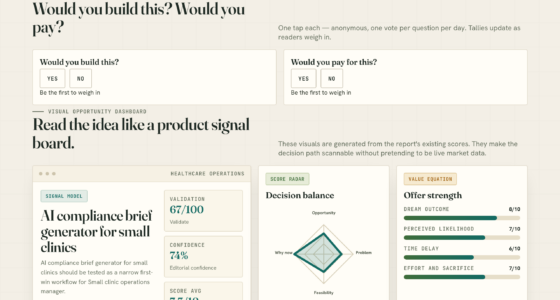

📊 Full opportunity report: Europe Regulated the Interface and Forgot to Build the Engine on ThorstenMeyerAI.com — validation score, market gap, and execution plan.

Get business pricing on tech for your team
- Business-only prices and quantity discounts
- Tax-exempt purchasing
- Multiple users, one account, clear invoices
TL;DR
Europe has concentrated on regulating user interfaces such as cookie banners, but has failed to develop or support the underlying AI engines. This shift highlights regulatory limitations and impacts Europe’s global AI competitiveness.
European regulators have primarily targeted the surface of digital technology, such as cookie banners and consent interfaces, while neglecting the development of the underlying AI engines that drive innovation and competitiveness. This focus on regulation without building the core technology risks leaving Europe behind in the global AI race.
European Union policymakers have spent years regulating user-facing features like cookie banners, which are now widely recognized as ineffective and often non-compliant with legal standards. Despite these efforts, the continent has little to show in terms of developing its own advanced AI engines. The only notable European AI lab, Mistral, remains a mid-tier player, trailing behind US and Chinese models in capability, investment, and global influence.
While China and the US have shipped near-frontier models openly and with significant investment, Europe’s AI industry is underfunded and constrained by regulatory burdens. Mistral, Europe’s leading AI company, has raised only a few billion dollars, far less than US giants like OpenAI or Chinese firms like Zhipu. Europe’s approach has been to regulate first and build later, which critics say hampers its ability to compete on the global stage.
Europe regulated the interface and forgot the engine
The cookie banner is the most-used European software of the decade. While Brussels perfected the consent pop-up, the frontier was built elsewhere — and now, in H2 2026, Europe wants to buy back in without changing what put it on the outside.
This isn’t about whether privacy or safety matter — they do. It’s that Europe mistook regulating the interface for having a seat at the table. You can’t grant your way out of a structural problem while keeping the structure — the laws, the capital gaps, the energy costs, the talent drain all left untouched. The fix isn’t another framework: it’s open weights as a product, sovereign compute on affordable power, real capital plumbing — and to stop mistaking a check for a strategy.
Implications of Europe’s Focus on Interface Regulation
This focus on regulating user interfaces like cookie banners illustrates a broader misalignment in Europe’s digital strategy. While the continent spends resources on superficial compliance, it risks falling behind in the development of powerful AI engines that underpin technological leadership. The lack of investment and innovation could weaken Europe’s influence in geopolitics and economic competitiveness, especially as AI becomes a key instrument of state power.
European AI engine development kit
As an affiliate, we earn on qualifying purchases.
As an affiliate, we earn on qualifying purchases.
Europe’s Regulatory Approach and Its Impact on AI Development
Europe pioneered comprehensive AI regulation with the AI Act, enacted before the technology had fully matured. This regulatory environment has contributed to a fragmented market and limited investment in European AI startups. Meanwhile, major competitors like the US and China continue to push forward, deploying and open-sourcing advanced models that attract global talent and capital. Europe’s focus on superficial regulation over core technological development has created a gap between policy and innovation.
“We are reacting to a board we do not control, and our funding remains limited compared to US and Chinese competitors.”
— Mistral CEO
As an affiliate, we earn on qualifying purchases.
Unclear Impact of Europe’s Regulatory Strategy on Future AI Leadership
It remains uncertain whether Europe’s regulatory focus will eventually shift toward supporting AI engine development or if the current approach will continue to hinder its global competitiveness. The long-term effects of this regulatory stance on innovation, investment, and talent retention are still unfolding, and policymakers have yet to demonstrate a concrete plan to bridge this gap.
As an affiliate, we earn on qualifying purchases.
Next Steps in Europe’s AI Policy and Industry Development
European policymakers may need to reconsider their emphasis on superficial regulation and instead foster innovation through funding and infrastructure support. Watch for potential initiatives aimed at boosting AI research, easing regulatory burdens for startups, or forming international collaborations. The coming months will reveal whether Europe can pivot toward building its own AI engines or remains confined to regulation of the surface.
As an affiliate, we earn on qualifying purchases.
Key Questions
European regulators prioritized surface-level controls like cookie banners to comply with privacy laws, but this approach neglected the development of core AI technology, which is crucial for competitiveness.
What are the consequences of Europe’s regulatory focus on innovation?
This focus risks leaving Europe behind in the global AI race, as major competitors develop and deploy advanced models while Europe remains constrained by regulation and underfunding.
Can Europe catch up in AI development?
It is uncertain. Success depends on whether policymakers shift toward supporting innovation and infrastructure, or continue emphasizing surface regulation without fostering technological growth.
How does Europe’s AI industry compare to the US and China?
Europe’s AI industry is significantly smaller and less capable, with only one notable lab (Mistral) that trails behind US and Chinese models in capability, investment, and global influence.
Source: ThorstenMeyerAI.com
Halloween Picks
halloween
As an affiliate, we earn on qualifying purchases.