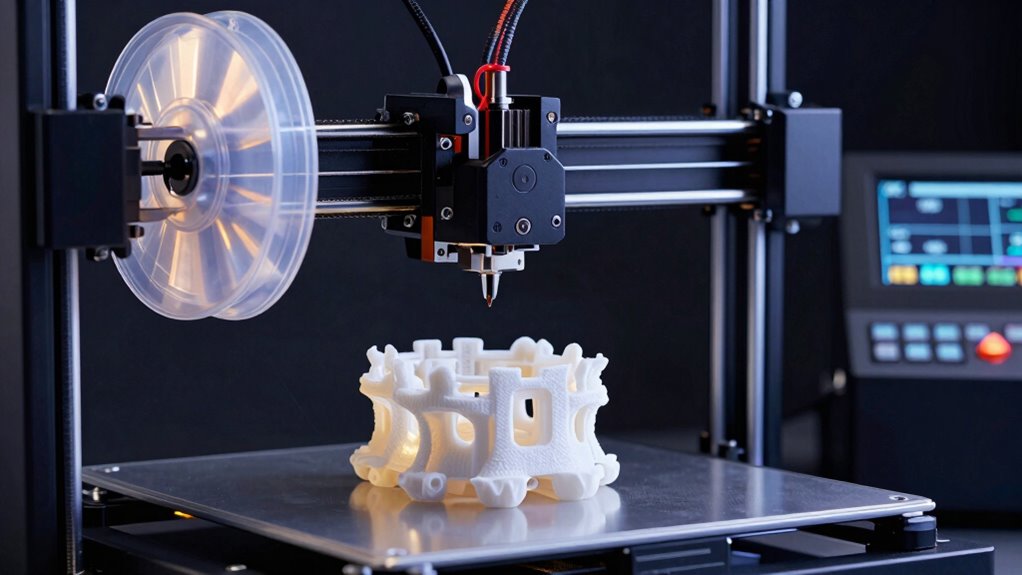

When choosing 3D printers for prototypes, you should first understand how material selection impacts strength, flexibility, and appearance, depending on your prototype’s purpose. Consider the print resolution to balance surface finish with production time, and be aware of how different materials perform at various settings. Cost, trend awareness, and process optimization are essential for efficiency. To make smarter decisions and streamline your development, explore the details that follow—you’ll find valuable insights to enhance your approach.

Get business pricing on tech for your team
- Business-only prices and quantity discounts
- Tax-exempt purchasing
- Multiple users, one account, clear invoices
Key Takeaways
- Choose 3D printing software compatible with your printer’s hardware and supported materials for optimal results.
- Ensure the software offers precise control over print resolution, layer height, and support structures.
- Use software with robust slicing capabilities to optimize print quality, speed, and material usage.
- Evaluate the software’s ability to simulate and preview prints to identify potential issues before printing.
- Select tools that support material-specific settings to manage properties like heat resistance, flexibility, and finish.
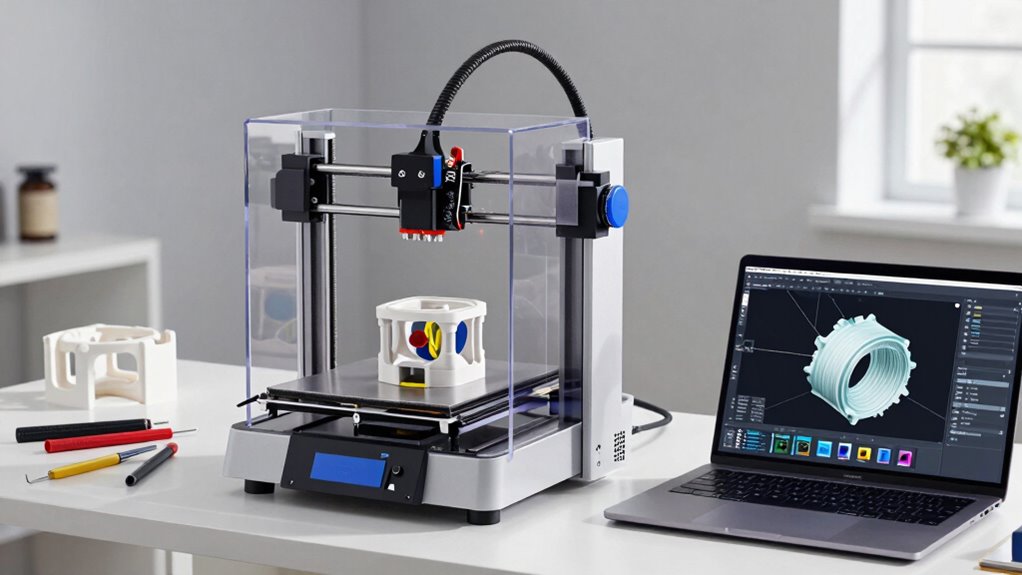
3D printers have revolutionized the way you create prototypes, making it faster and more cost-effective to bring ideas to life. When contemplating 3D printing for your projects, one of the most critical factors is material selection. The materials you choose directly impact the prototype’s strength, flexibility, and overall appearance. From plastics like ABS and PLA to resins and even metals, each material has unique properties suited for different testing and presentation needs. You need to evaluate the purpose of your prototype—whether it’s for form, fit, or functional testing—and select a material accordingly. For example, if you require a lightweight and easy-to-print model, a standard thermoplastic might suffice. However, for prototypes needing durability or heat resistance, you’ll want to explore more advanced materials like nylon or metal composites. That way, you guarantee your prototype can withstand real-world conditions or meet specific engineering standards.
Another essential aspect to contemplate is print resolution. This determines the level of detail and surface finish you can achieve with your 3D prints. Higher resolution settings produce finer layers, resulting in smoother surfaces and more precise features, which are especially important when you need to evaluate intricate designs or fit components together accurately. Conversely, lower resolution prints typically save time and material, making them suitable for quick, rough prototypes where surface finish isn’t a priority. As a software team, understanding how print resolution affects your output helps you balance quality and efficiency. You should also be aware that higher resolution prints take longer and may require more post-processing to remove visible layer lines.
Furthermore, your choice of print resolution can influence the success of your prototype’s functional testing. For parts with tight tolerances, finer resolution ensures critical features are accurately reproduced, reducing the risk of misfits or failures during testing. It’s also worth considering how different resolutions interact with your selected materials—some materials may not perform well at very high resolutions due to warping or layer adhesion issues. Being familiar with the different 3D printing materials can help you optimize your printing process and select the best options for your project’s needs. A thorough understanding of material properties is essential to prevent common issues like warping, cracking, or layer separation during printing. Additionally, being aware of printing technology limitations can help you set realistic expectations and avoid costly errors. Staying informed about emerging materials and technology trends can give your team a competitive edge by expanding the range of prototypes you can produce effectively. Moreover, understanding the cost implications of various materials and resolutions can help manage your project budget more effectively.
In essence, your initial focus should be on selecting the right material for your prototype’s purpose and understanding how print resolution affects quality, speed, and post-processing needs. These factors are fundamental to making the most of your 3D printer capabilities. By carefully contemplating material options and resolution settings, you’ll be better equipped to produce prototypes that meet your project’s specifications, reduce iteration cycles, and streamline your overall development process.
As an affiliate, we earn on qualifying purchases.
Frequently Asked Questions
What Is the Cost Range for Professional 3D Printers?
You can expect professional 3D printers to cost between $10,000 and $100,000, depending on features like material compatibility and printing resolution. Higher-end models offer advanced material options and finer resolutions, which are essential for detailed prototypes. Keep in mind, investing in a printer with the right material compatibility guarantees you can work with diverse materials, while superior printing resolution delivers more precise, high-quality prototypes that meet your project standards.
How Long Does It Take to Produce a Prototype?
On average, producing a prototype takes anywhere from a few hours to several days. Your material selection and print resolution significantly impact this timeline—finer resolutions and complex materials extend the process. Remarkably, 3D printing speeds have increased by up to 50% with recent technology advances. To optimize your prototype production, consider how quickly your chosen material and resolution settings can deliver the level of detail you need without sacrificing time.
Are 3D Printers Suitable for Small Batch Manufacturing?
Yes, 3D printers are suitable for small batch manufacturing, especially when you need material versatility and can handle design complexity. They allow you to produce customized parts quickly without the high costs of traditional manufacturing. You can experiment with different materials and intricate designs efficiently. However, consider the speed and consistency needed for larger batches, as 3D printing is ideal for limited runs rather than mass production.
What Safety Precautions Are Necessary When Operating 3D Printers?
When operating 3D printers, you should always wear safety gear like gloves and goggles to protect yourself from fumes and moving parts. Guarantee proper ventilation to avoid inhaling harmful fumes produced during printing. Keep your workspace clean, and follow manufacturer safety instructions. Regularly check for leaks or malfunctions. By taking these precautions, you minimize health risks and maintain a safe, efficient printing environment.
How Do I Choose the Right Filament or Resin for My Project?
To select the right filament or resin, consider your project’s material compatibility and desired properties like strength, flexibility, or detail. Think about curing techniques too—some resins require UV curing, while others set with heat or air. Match the material to your application, whether it’s for functional prototypes or detailed models, and guarantee your printer supports the chosen material for ideal results.
As an affiliate, we earn on qualifying purchases.
Conclusion
Now that you’ve uncovered the essentials, remember that choosing the right 3D printer and software is like finding the perfect brush for your masterpiece—it sets the stage for your ideas to come alive. With your newfound knowledge, you’re ready to turn concepts into tangible prototypes, turning dreams into reality one layer at a time. Keep experimenting, stay curious, and watch your innovations take shape—because in this world, your imagination is the only limit.
As an affiliate, we earn on qualifying purchases.
As an affiliate, we earn on qualifying purchases.
Halloween Picks
halloween
As an affiliate, we earn on qualifying purchases.