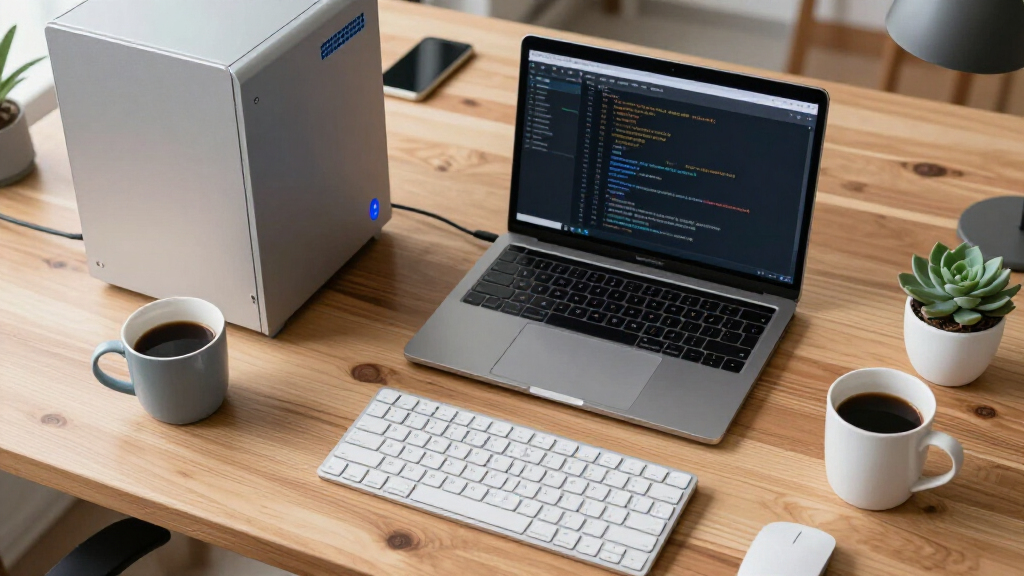

🔍 Read the full analysis: 2026’S Top Desktop Processors For AI Innovation on ThorstenMeyerAI.com

Get business pricing on tech for your team
- Business-only prices and quantity discounts
- Tax-exempt purchasing
- Multiple users, one account, clear invoices
TL;DR
In 2026, AMD and Intel have released new desktop processors tailored for AI innovation, with key models like AMD Ryzen 9 9950X3D and Intel Core i7-14700K leading the market. These processors focus on multi-core performance, cache, and compatibility, shaping the future of AI workloads.
AMD and Intel have unveiled their flagship desktop processors for 2026, designed specifically to advance AI development and high-performance computing. These new CPUs, including AMD’s Ryzen 9 9950X3D and Intel’s Core i7-14700K, are set to influence AI research, data science, and enterprise workloads, marking a significant step forward in desktop CPU technology.
The AMD Ryzen 9 9950X3D, launched in early 2026, features a 16-core architecture with AMD’s latest 3D V-Cache technology, offering exceptional multi-threaded performance critical for AI training and inference. Meanwhile, Intel’s Core i7-14700K combines 12 cores with high clock speeds and advanced AI acceleration features, making it a versatile choice for both AI development and gaming.
Both processors support the newest standards—DDR5 RAM and PCIe 5.0—ensuring compatibility with upcoming hardware and software innovations. AMD’s platform supports longer-term upgrade paths through the AM5 socket, while Intel’s latest sockets require careful consideration of motherboard support. Cost-wise, these CPUs are positioned at the high end, reflecting their focus on performance and future-proofing.
The 9 picks
- 1
 AMD Ryzen 9 9950X3D 16-Core ProcessorView on Amazon →
 - 2
 AMD Ryzen 7 9800X3D 8-Core, 16-Thread Desktop ProcessorView on Amazon →
 - 3
 Intel Core i7-14700K Desktop Processor with 20 Cores and Integrated GraphicsView on Amazon →
 - 4
 AMD Ryzen 7 5800X3D 8-core, 16-Thread Desktop Processor with AMD 3D V-Cache T…View on Amazon →
 - 5
 AMD Ryzen 7 7800X3D 8-Core, 16-Thread Desktop ProcessorView on Amazon →
 - 6
 Intel Core i5-14400F Desktop Processor (14th Gen), 10 cores, up to 4.7 GHzView on Amazon →
 - 7
 AMD Ryzen 5 9600X 6-Core, 12-Thread Unlocked Desktop ProcessorView on Amazon →
 - 8
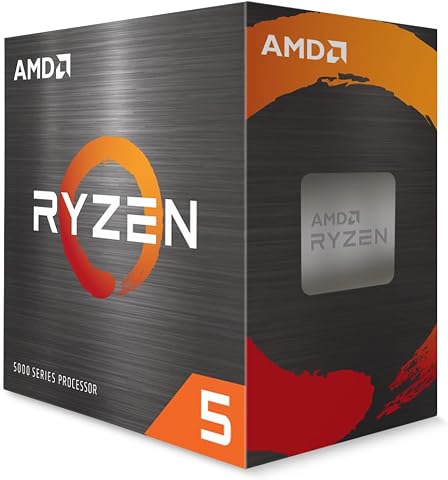 AMD Ryzen 5 5600 6-Core 12-Thread Unlocked Desktop Processor with Wraith Stea…View on Amazon →
 - 9AMD Ryzen 5 5500 6-Core, 12-Thread Unlocked Desktop Processor with Wraith Ste…View on Amazon →
Impact of 2026’s Top Processors on AI Development
The release of these processors marks a pivotal moment for AI innovation at the desktop level. Their high core counts, large caches, and specialized AI acceleration features enable faster training, inference, and data processing, which can accelerate AI research and deployment across industries. For consumers, this means more capable hardware for AI-powered applications, from creative tools to enterprise solutions. The emphasis on platform longevity and compatibility also suggests a shift towards more sustainable, upgradeable systems, supporting ongoing AI advancements.
2026 CPU Market and AI Hardware Trends
Prior to 2026, AMD and Intel had already established leadership in high-performance desktop CPUs, with innovations like AMD’s 3D V-Cache and Intel’s AI-optimized cores. The market has increasingly prioritized multi-core architectures, larger caches, and platform support for cutting-edge standards such as DDR5 and PCIe 5.0, driven by the rising demand for AI workloads. These developments reflect a broader industry trend towards hardware tailored for AI acceleration, high throughput, and energy efficiency, setting the stage for the 2026 processor launches.
Remaining Questions About 2026’s AI-Optimized CPUs
While specifications and early benchmarks indicate strong performance, detailed real-world testing on diverse AI workloads is still pending. It is not yet clear how these processors will perform under sustained AI training tasks or in energy-constrained environments. Compatibility with existing enterprise infrastructure and software optimizations remains to be fully validated, and long-term reliability data is still emerging.
Upcoming Benchmarks and Industry Adoption Trends
Expect comprehensive performance reviews from independent labs over the coming months, focusing on AI training and inference benchmarks. Software developers are also expected to optimize frameworks like TensorFlow and PyTorch for these new architectures. Further, enterprise adoption will depend on platform stability, software ecosystem support, and overall cost-effectiveness. Manufacturers may also release firmware updates to enhance AI features and compatibility.
Key Questions
How do these processors improve AI performance compared to previous models?
They feature increased core counts, larger caches, and dedicated AI acceleration capabilities, enabling faster data processing, training, and inference tasks.
Are these CPUs compatible with existing motherboards?
AMD’s Ryzen 9 9950X3D requires the latest AM5 socket motherboards supporting DDR5 and PCIe 5.0. Intel’s Core i7-14700K needs compatible 600-series or newer chipsets. Compatibility depends on motherboard support for these standards.
Will these processors be suitable for gaming as well as AI tasks?
Yes, both CPUs deliver high single-core performance and large caches, making them excellent for gaming, alongside their AI capabilities. However, their primary advantage lies in AI and productivity workloads.
What is the expected price range for these processors?
Both are positioned in the high-end segment, with prices likely between $600 and $900, depending on the model and retailer, reflecting their premium features.
How long will these processors remain relevant for AI development?
Supported by platform longevity, advanced standards, and future-proof features, these CPUs are expected to remain relevant for at least 3-5 years, especially for enterprise and research applications.
Source: ThorstenMeyerAI.com
Fall Picks
fall essentials
As an affiliate, we earn on qualifying purchases.