
TL;DR
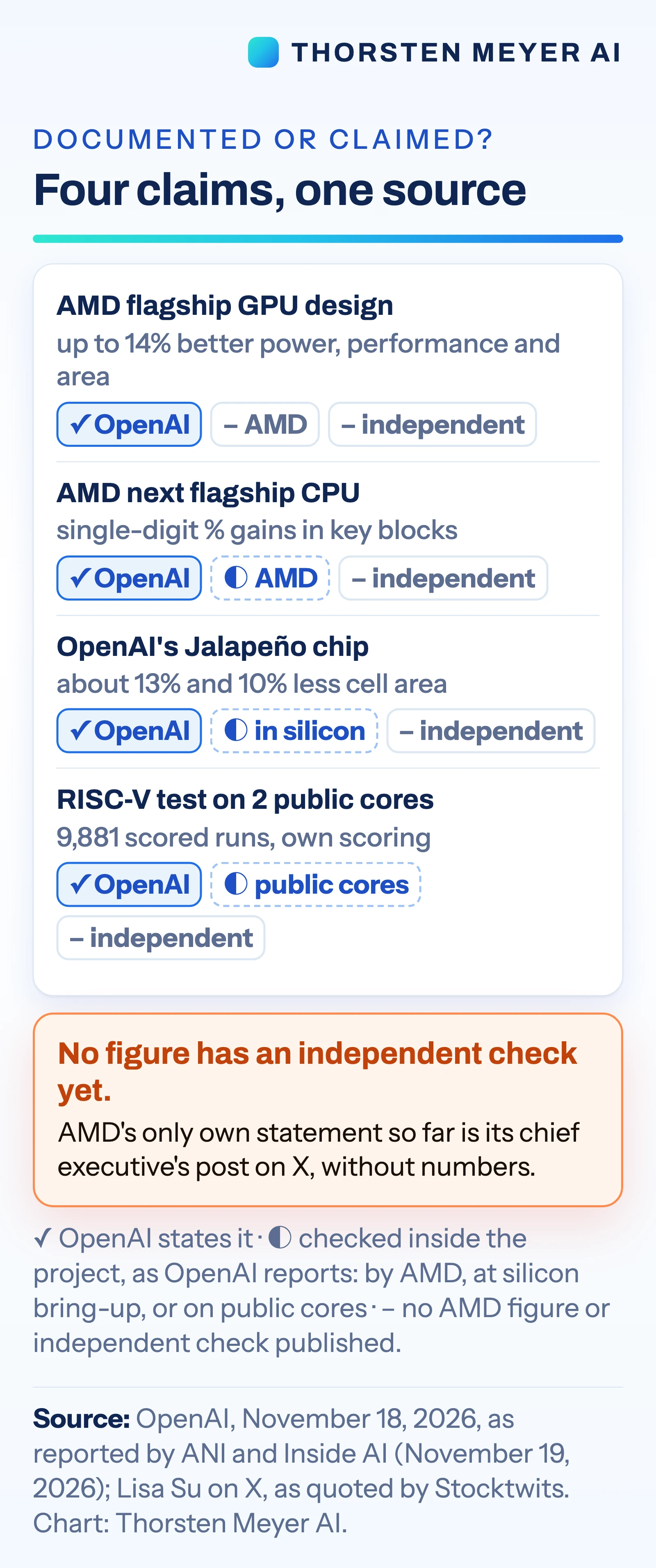
OpenAI said on November 18 that its models rewrote parts of AMD chip designs, reporting up to 14% gains in power, performance and area on a flagship GPU design. The figures come from OpenAI, which has a financial arrangement tied to AMD chip deployments, and no independent audit or AMD-published measurements are available.
OpenAI described the work in a post titled “Advancing chip design with OpenAI models.” Because the post could not be accessed directly for this report, details were drawn from accounts by ANI, The Decoder and Inside AI. Those reports attribute the figures and implementation claims to OpenAI. The company compared its results with what it called heavily optimised baselines, but has not identified the specific GPU blocks involved or reported an average improvement across the design.

Get business pricing on tech for your team
- Business-only prices and quantity discounts
- Tax-exempt purchasing
- Multiple users, one account, clear invoices
The models worked at the register-transfer level (RTL), rewriting SystemVerilog code that describes chip circuits. OpenAI said Synopsys design tools checked whether each proposed rewrite preserved the original behavior and assessed changes to PPA. The company reported “single-digit” percentage PPA gains in key blocks of AMD’s next flagship CPU, which it said AMD had verified. It has not released block-level figures or an AMD statement with supporting measurements.
OpenAI also reported results on its own Jalapeño inference chip. It said model-proposed changes reduced standard-cell area by about 13% in one unit and 10% in another, with the changes validated after the first chips came back. Accounts differ on the name of the first unit: ANI calls it a vector unit, while Inside AI calls it a warp engine. Separately, OpenAI said five of its models completed 9,881 scored runs on two open-source processor cores, PicoRV32 and Ibex; GPT-6.2 Astra had the highest score in that benchmark, according to the company.
AI Enters the Chip Design Loop
If the reported gains hold up, AI-assisted RTL changes could help chip designers improve power use, speed and silicon area before manufacturing. Those trade-offs affect the cost and performance of processors used to run AI systems, so even improvements in selected blocks could matter to companies building data-center hardware.
The announcement also points to a feedback loop: AI models are being used to help design the hardware that future AI systems may run on. But the headline figure is a best-case “up to” result, not a demonstrated improvement across an entire GPU. Without block names, averages and independently checkable measurements, readers cannot tell how broadly the gains apply.
OpenAI also has a direct commercial connection to AMD. Since October 2025, OpenAI has held a warrant for up to 160 million AMD shares, which vests as AMD chips are deployed. That relationship does not show that the reported results are wrong, but it is relevant when weighing claims that have not been independently audited.
Products Worth Considering

Apple Watch Series 12 GPS Smartwatch, 42 mm

Bose SoundLink Plus Portable Bluetooth Speaker, Black

Jackery Fridge Guard 1024Wh Backup Power Station with Mount
As an affiliate, we earn on qualifying purchases.
From RTL Rewrites to Manufacturing
RTL is an early stage in chip development: engineers describe what each circuit block should do in code, and design tools translate that description into logic. Later stages map, place and wire the logic for a physical chip. The reported work concerns rewriting RTL; it does not establish that AI handled the full design or manufacturing process.
OpenAI president Greg Brockman characterized the AMD work on X as “roughly an additional year of progress” achieved in less than five months using the company’s models. OpenAI also described some changes as already included in a design sent for manufacturing, with other changes added to production design files for future versions. These statements have been reported as OpenAI’s account; the companies have not released public documentation that would let outsiders inspect the design changes or their measured impact.
On Jalapeño, Inside AI described a multiplier redesign that used about 15% less cell area in synthesis and reduced latency from two clock cycles to one. That is a separate example from the reported 13% and 10% area reductions, and it concerns OpenAI’s own chip rather than AMD’s GPU. The supplied reporting does not provide enough detail to establish whether those figures use comparable baselines or measurement conditions.
The Missing Measurement Details
OpenAI has not published the identities of the AMD GPU blocks behind the up to 14% figure, the average gain, or detailed measurement conditions. The reports do not provide an independent audit, and AMD has not published figures of its own. It is also unclear how much of the claimed benefit remains after later design stages or how the changes affect a finished product.
The CPU result is described only as “single-digit” gains in key blocks, attributed to OpenAI’s statement that AMD verified them. The available accounts do not specify which blocks were measured or include AMD’s verification data. For Jalapeño, reports use different names for one unit, and the source material does not resolve that discrepancy.
The announcement provides no public, like-for-like comparison showing how the models performed against AMD engineers or other design methods under the same constraints. OpenAI’s financial arrangement with AMD is disclosed in the source material, but the companies have not detailed how that relationship affected the work or the timing of the announcement.
Awaiting AMD’s Public Figures
The next useful evidence would be AMD’s own measurements, block-level results, and details about the baselines and verification process. Those could clarify whether the reported gains apply to a few selected circuits or meaningfully improve a larger chip design.
OpenAI says some changes are in a design sent for manufacturing, but the source material gives no schedule for when that chip will be produced, evaluated or available in a product. Until the companies release more information or outside researchers can assess the results, the reported figures remain company claims rather than independently confirmed performance gains.
Key Questions
What did OpenAI announce about AMD chips?
OpenAI said its models rewrote parts of AMD chip designs and reported up to 14% PPA gains on a flagship GPU design. It said some changes were included in a design sent for manufacturing.
What does PPA mean?
PPA means power, performance and area—the linked trade-offs chip designers consider when optimizing circuits.
Have the AMD results been independently verified?
No independent audit has been published. OpenAI said AMD verified single-digit gains in key blocks of a next flagship CPU, but AMD has not released its own figures or supporting data.
What remains unknown about the 14% result?
OpenAI has not named the GPU blocks measured, reported the average gain, or provided enough detail about the measurements for an outside comparison. The figure is described as “up to” 14% against heavily optimised baselines.
Why is OpenAI’s relationship with AMD relevant?
OpenAI holds a warrant for up to 160 million AMD shares that vests as AMD chips are deployed. The arrangement is relevant context for evaluating OpenAI’s claims, though it does not by itself establish whether the results are accurate.
Source: Thorsten Meyer AI