
📊 Full opportunity report: How To Navigate GLP-1 Availability And Cash-Pay Pricing on IdeaNavigator AI — validation score, market gap, and execution plan.

Get business pricing on tech for your team
- Business-only prices and quantity discounts
- Tax-exempt purchasing
- Multiple users, one account, clear invoices
TL;DR
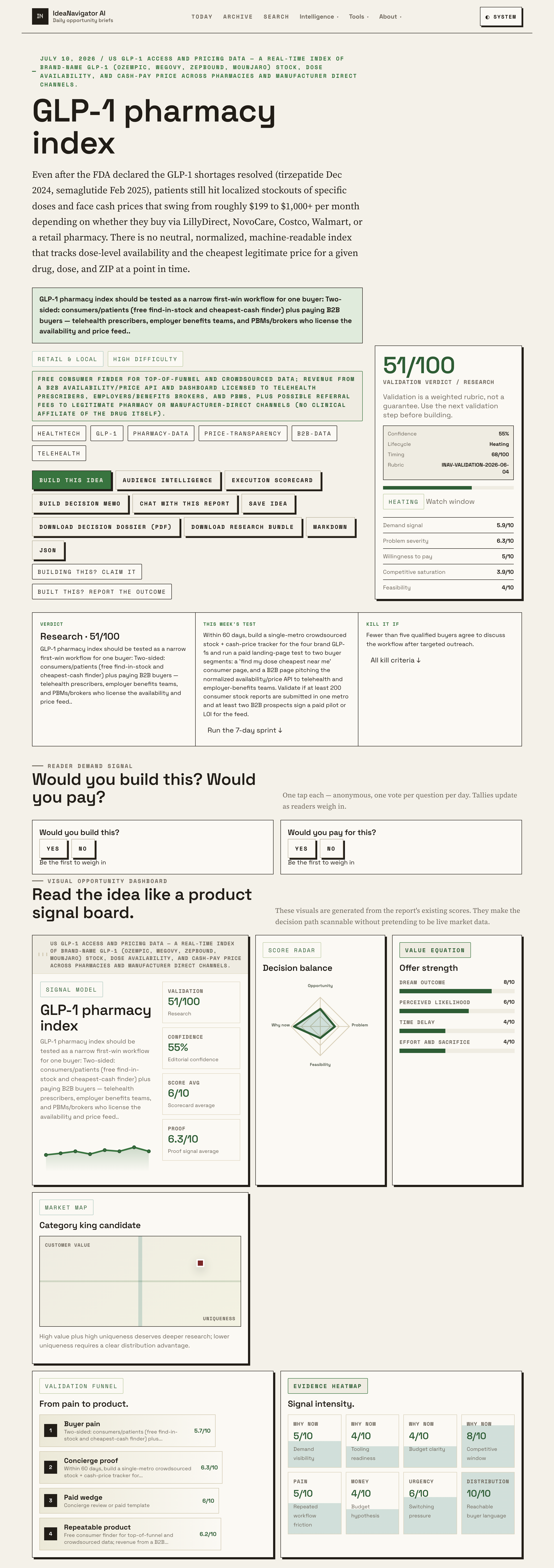
A proposal for a GLP-1 pharmacy index would help patients compare dose availability and cash prices by location, while licensing normalized data to health care and benefits buyers. The need is described as a market fragmentation problem after FDA shortage-list changes, but no index, pilot results or buyer commitments are confirmed.
IdeaNavigator AI has proposed a pharmacy index that would show patients where brand-name GLP-1 medicines are reported in stock and compare cash prices by drug, dose and ZIP code. The concept would also sell normalized availability and pricing data to telehealth providers, employers and pharmacy benefit intermediaries, but it remains a proposal rather than a launched service.
According to IdeaNavigator AI’s proposal, the consumer tool would cover Ozempic, Wegovy, Zepbound and Mounjaro. Patients could search for a particular dose and location, compare listed cash prices and sign up for dose-level availability alerts. The proposal says initial data could combine public prices from manufacturer direct channels, Costco and Walmart, and discount-price listings, alongside crowd-submitted reports of local stock.
IdeaNavigator AI describes the business as a two-sided service: a free finder for consumers and a paid data feed or dashboard for telehealth prescribers, employer benefits teams, pharmacy benefit managers and brokers. The proposal also identifies referral fees from legitimate pharmacy or manufacturer-direct channels as a possible revenue stream. It names no participating pharmacies, data agreements or paying customers.
For validation, the proposal sets a 60-day test in one metro area. Its stated targets are at least 200 consumer stock reports and paid pilots or letters of intent from at least two business prospects. These are proposed benchmarks; IdeaNavigator AI reports no evidence that the test has begun or met them.
Why Local Price Data Matters
IdeaNavigator AI’s proposal says patients paying out of pocket may face markedly different prices depending on the drug, dose and channel. It gives a range of roughly $199 to more than $1,000 per month, citing options such as LillyDirect, NovoCare, Costco, Walmart and retail pharmacies. The proposal provides no dated price survey or dose-by-dose comparison, so the figures describe its stated range rather than verified current quotes for every medicine.
A searchable index could make it easier to identify lower listed prices and reported stock nearby. That could matter when a particular dose is unavailable at one location, even if the medicine is generally obtainable elsewhere. For employers and benefits buyers, a normalized feed could help compare access and costs across channels. The proposal estimates that GLP-1 medicines account for roughly 20% of pharmacy spending for employers, but gives no survey, time period or calculation behind that estimate.
The usefulness of such a service would depend on whether reports are current and reliable. A listing may change before a patient reaches a pharmacy, and cash prices can depend on eligibility, dose, quantity and program terms. A comparison tool would need to make those conditions clear to avoid presenting unlike prices as equivalent.
Top picks for "navigate availability cash"
As an affiliate, we earn on qualifying purchases.
From Shortages to Scattered Listings
IdeaNavigator AI’s proposal frames the opportunity as a shift from nationwide shortage concerns to localized supply gaps and fragmented pricing. It says the FDA declared the tirzepatide shortage resolved in December 2024 and the semaglutide shortage resolved in February 2025. The proposal presents those dates as the point when the market began shifting; shortage-list status alone does not establish that every dose is continuously available at every pharmacy.
The proposal also points to the end of compounding periods tied to shortage status and the growth of manufacturer direct-pay options. It names LillyDirect and NovoCare, as well as cash-pay programs at Costco and Walmart, as channels whose prices would need to be gathered and standardized. It further cites a TrumpRx portal launch in February 2026 as part of the expanding landscape, without describing its coverage or terms.
The suggested index would not dispense medicines or provide treatment advice. According to the proposal, its role would be to organize public price information and local availability reports into a searchable resource. A price listing or stock report is not a guarantee of sale, a prescription, insurance coverage or clinical suitability.
Accuracy Depends on Fresh Reports
IdeaNavigator AI’s proposal documents no live inventory data, price feed, pharmacy participation or consumer reporting system. It does not say how often prices would be checked, how stock reports would be verified, how expired reports would be removed or how the service would handle differences in eligibility and purchase terms. It also identifies no launch metro, product operator or data partners.
The proposal’s stated price range and employer spending share lack a named methodology, comparison period and detailed breakdown. It is also unclear whether business buyers would pay for the proposed feed, which data fields they would require or whether referral arrangements could affect how options are ranked. The suggested 60-day targets are validation goals, not results.
A Metro Pilot Would Test Demand
IdeaNavigator AI describes a single-metro pilot combining crowd-sourced stock reports with normalized public cash prices for four brand-name medicines. The proposal would test a consumer search page and a separate business offering for telehealth and employer-benefits teams, then measure report submissions and paid pilot interest over 60 days.
Evidence of progress would include a named location, a working tool, dated price and availability records, and confirmed participation from business buyers. Until those details or results are reported, the index should be understood as a product concept designed to test whether patients and organizations will use and pay for consolidated access data.
Key Questions
Is the GLP-1 pharmacy index available now?
No launch is reported. IdeaNavigator AI describes a proposed service and a planned validation test, not an operating index.
Which medicines would the proposed tool cover?
The initial concept names Ozempic, Wegovy, Zepbound and Mounjaro, searchable by drug, dose and ZIP code.
Would the index guarantee that a dose is in stock?
No such guarantee is described. The proposal relies partly on reported availability, which can change, and does not specify a verification process or inventory connection.
How would the service make money?
The proposal suggests paid availability and price data for health care and benefits organizations, with possible referral fees from legitimate pharmacy or manufacturer-direct channels. No paying customers or agreements are reported.
Source: IdeaNavigator AI
Halloween Picks
halloween
As an affiliate, we earn on qualifying purchases.