📊 Full opportunity report: How Trade Coverage Reflects Argentina’s Growing Visibility on IdeaNavigator AI — validation score, market gap, and execution plan.

Get business pricing on tech for your team
- Business-only prices and quantity discounts
- Tax-exempt purchasing
- Multiple users, one account, clear invoices
TL;DR

IdeaNavigator AI has proposed testing a trade and supply-chain monitoring service using an alert it describes as rising global coverage of Argentina. It gives the signal an 88/100 score, but does not provide the underlying data, time period, or comparison baseline, so the claimed surge cannot be independently assessed from the information available.
IdeaNavigator AI has proposed testing a trade and supply-chain monitoring service with an alert it describes as rising global coverage of Argentina, framing the development as a possible early signal for operations teams. The proposal assigns the signal a score of 88 out of 100, but supplies no underlying coverage figures, measurement period or comparison baseline to substantiate the claimed increase.
The proposed product is a focused monitor for operations leads handling trade and supply-chain exposure. IdeaNavigator AI says it would watch GDELT and similar feeds for geopolitical and trade developments, filter items for relevance to that audience, and produce short briefs explaining what changed, why it matters and what action might be considered. The Argentina item is presented in the proposal as an example of the kind of alert it could process, not as a report of a particular policy change, disruption or trade event.
IdeaNavigator AI describes the problem as information scattered across news, forums and filings, making it difficult for operations staff to identify developments that could affect their work. The company argues that same-day, role-filtered summaries may be more useful to this audience than a general weekly roundup. That is the proposal’s rationale; it provides no evidence showing that teams currently miss Argentina-related developments or that a faster briefing would change operational decisions.
According to IdeaNavigator AI’s proposal, the suggested validation is deliberately small: deliver the Argentina brief and two other geopolitical or trade updates to five people matching the intended user profile during the week, then track whether anyone changes a decision or forwards a brief to a colleague. The proposal identifies a subscription as the possible revenue model, but gives no price, customer commitments, test outcomes or evidence of demand.
Testing Trade Alerts Against Decisions
For companies exposed to international trade, changes in policy, logistics or geopolitical conditions can affect sourcing and operational choices. A service that reliably separates relevant developments from general news could help teams decide what warrants attention sooner. In IdeaNavigator AI’s proposal, however, that benefit remains a product hypothesis, not a demonstrated result.
The proposed test focuses on observable behavior rather than general interest: whether recipients change a decision or share a brief. That could offer an initial indication of usefulness, but a five-person exercise would be too limited to establish broad demand, accuracy or financial value. The distinction matters to prospective users: an attention-grabbing coverage signal is not, by itself, evidence of a supply-chain risk or a reason to act.
trade and supply chain monitoring software
As an affiliate, we earn on qualifying purchases.
As an affiliate, we earn on qualifying purchases.
From Coverage Signal to Briefing Test
IdeaNavigator AI frames the idea as a narrow first test in the trade and supply-chain operations market, rather than a fully developed monitoring platform. The proposal describes a workflow that scans feeds, filters developments for a specific job role and turns selected items into concise, action-oriented summaries. It names GDELT as one input, alongside similar feeds.
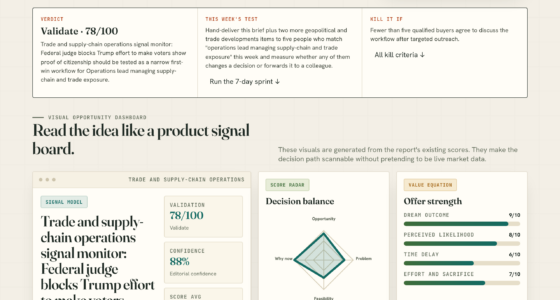
In its description, IdeaNavigator AI says the Argentina example was surfaced by GDELT with an 88/100 signal. The available description does not define what that score measures, how it was calculated, or whether it reflects news volume, prominence or another indicator. It also provides no dated series showing how coverage changed. The number should therefore be treated as a score reported in the proposal, not as a measured percentage increase or proof of a change in Argentina’s trade conditions.
IdeaNavigator AI proposes direct feedback from five potential users, with two additional developments included to test the format beyond one example. The proposal reports no results from that exercise and does not identify a launch date or an operating product.
As an affiliate, we earn on qualifying purchases.
Coverage Data and User Demand
The core claim that Argentina is surging in global coverage cannot be checked from the information provided by IdeaNavigator AI. Its description supplies no coverage count, time window, baseline or list of stories behind the characterization, and does not specify the meaning of the 88/100 score. It is also unclear which Argentina-related development prompted the signal or whether the coverage has any direct bearing on trade and supply-chain operations.
IdeaNavigator AI’s proposal does not explain how the service would judge relevance, verify alerts or prevent noisy or misleading items from reaching users. It offers no customer interviews, trial feedback, pricing research or evidence that recipients would pay for the service. The five-person validation is a suggested test, not a completed study, and the proposal reports no participant responses or decision changes.
As an affiliate, we earn on qualifying purchases.
A Five-User Validation Trial
IdeaNavigator AI proposes delivering three briefs—the Argentina example and two other geopolitical or trade developments—to five operations leads during the week, then recording whether recipients change a decision or forward a brief. The available information does not confirm that this test has started or specify an exact date.
Any findings would help determine whether the briefing format merits further testing, but the proposal gives no threshold for success or plan for checking alert accuracy over time. Until coverage data and user-test results are available, the Argentina signal remains an example used by IdeaNavigator AI to frame a product opportunity, not confirmation of a specific trade disruption or operational risk.
Source: IdeaNavigator AI
international trade decision support
As an affiliate, we earn on qualifying purchases.
As an affiliate, we earn on qualifying purchases.
Key Questions
What is the proposed development?
IdeaNavigator AI proposed testing a monitoring service that filters geopolitical and trade updates for supply-chain operations leads and turns relevant items into short briefs.
What does the Argentina signal establish?
IdeaNavigator AI’s proposal says GDELT surfaced an Argentina coverage signal scored 88 out of 100. It does not provide the underlying data or explain the score, so it does not establish how much coverage changed or whether trade conditions changed.
Has the monitoring service launched?
No launch is reported. IdeaNavigator AI presents a proposed MVP and a plan to test the idea with potential users.
How would the idea be tested?
IdeaNavigator AI proposes sending three briefs to five operations leads and tracking whether recipients change a decision or forward a brief. No results are available.
Source: IdeaNavigator AI
Fall Picks
fall essentials
As an affiliate, we earn on qualifying purchases.