🔍 Read the full analysis: The Assembly Line’s Five-Dollar Day: An Industrial Turning Point on ThorstenMeyerAI.com

Get business pricing on tech for your team
- Business-only prices and quantity discounts
- Tax-exempt purchasing
- Multiple users, one account, clear invoices
TL;DR
Ford introduced an eight-hour day and a minimum daily wage of $5 on January 5, 1914, after its new assembly-line methods sharply increased production but workers left at high rates. The figures in the source account indicate turnover dropped from 370% in 1913 to 54% in 1914, though the pay increase came with conditions and the source relies partly on Ford’s own later account.
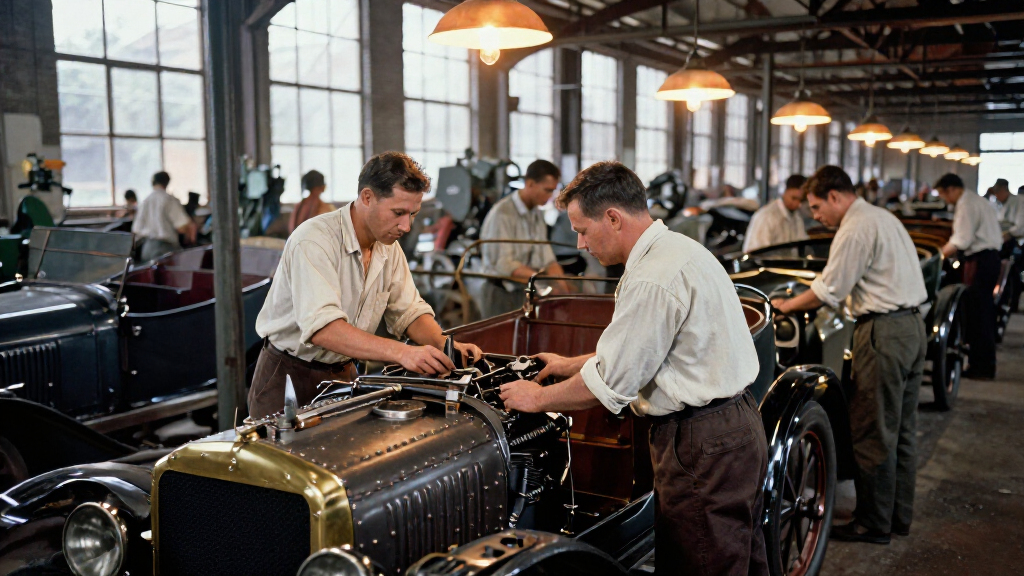
Ford Motor Co. raised its minimum daily pay to $5 and cut the workday from nine hours to eight on January 5, 1914, as the company struggled to keep workers on its rapidly mechanizing production lines. The move followed a year in which Ford hired 50,448 people to maintain an average workforce of 13,623, according to figures cited in a historical account published by ThorstenMeyerAI.com.
The pay change came after Ford introduced moving assembly-line methods that sharply reduced the labor time needed to build a car. Ford’s own figures, later published in Henry Ford’s 1922 book My Life and Work, put the time to assemble a Model T chassis at 12 hours and 28 minutes when the chassis stood still, compared with one hour and 33 minutes on the moving line by early 1914. The figures are the company’s account of its production gains, rather than an independent measurement.
The production changes coincided with extraordinary churn. The account cites a 1987 study by economists Daniel Raff and Lawrence Summers, which drew on earlier labor research and company surveys, for a 1913 turnover rate of 370%. A March 1913 company survey found that many workers classified as having left had missed five consecutive workdays; the account says roughly one in ten workers was absent on an average day.
Ford’s $5 minimum was described as “profit sharing” and came with strict conditions, according to the account. Turnover fell to 54% in 1914. The source presents the wage change as a response to the labor-retention problem, rather than evidence that Ford acted primarily to help workers afford the cars they built.
How the $5 Day Changed Ford’s Workforce
The episode illustrates a tension at the heart of Ford’s production gains: the assembly line reduced labor time, but repetitive, tightly divided work was accompanied by high rates of worker absence and departure. Increasing pay and shortening shifts were ways for the company to address a costly staffing problem while keeping production running.
The account says turnover fell from 370% in 1913 to 54% in 1914. That change suggests the policy was associated with a major improvement in retention, although the figures alone do not isolate the effects of higher pay from the shorter workday or other changes. The episode also cautions against treating the $5 day as simply a consumer strategy: the source says the company’s immediate challenge was keeping enough workers, not a shortage of buyers.
For workers, the policy meant the possibility of higher daily pay and shorter shifts, but access to the full payment was conditional. For employers, Ford’s decision became an example of using compensation to stabilize a workforce in an industrial system designed to make production faster and more standardized.
Products Worth Considering

Kindle Paperwhite Signature Edition 32GB (2024) – Auto-adjusting front light, wireless charging, weeks of battery life – Metallic Black

Kindle Paperwhite 16GB (2024) – 7 Glare-Free Display, Weeks Battery Life – Black

Samsung Galaxy Tab A11 Wi-Fi Tablet, 8.7-Inch, 64GB, 4GB RAM, Gray (SM-X133, International Version)
As an affiliate, we earn on qualifying purchases.
From a Moving Line to a Pay Change
Ford’s assembly-line experiments began with a small component, the flywheel magneto, in 1913. In his 1922 account, Ford said the company divided the work into separate operations and moved the part past workers. He credited the general idea to overhead rails used in Chicago meatpacking plants. The company’s reported time to assemble a magneto fell from about 20 minutes to 13 minutes and 10 seconds, and later declined further as the line and work methods changed.
Ford then applied the approach to the Model T chassis. An early trial pulled a chassis along a 250-foot path with a rope and windlass; workers moved alongside it. Later changes raised the line and divided the work into smaller tasks. Ford described the objective as reducing workers’ thinking and movements, a description that underscores how thoroughly the production system broke assembly into repeated, specialized actions.
The output improvements did not mean factory employment immediately shrank. The source account says U.S. factory jobs rose by about one-third between 1910 and 1920. It also notes that Ford employed about 14,000 people and built roughly 250,000 cars a year around 1914. These figures place the pay decision within an expanding industrial operation, not a simple story of machines replacing workers.
““the reduction of the necessity for thought on the part of the worker and the reduction of his movements to a minimum.””
— Henry Ford, quoted in My Life and Work (1922)
What the Turnover Figures Can Show
The precise causes of the fall in turnover are not established by the figures alone. Ford changed pay and working hours at the same time, and the source does not provide evidence that separates the effect of each change or rules out other factors. The $5 payment also had conditions, but the account does not detail how many workers qualified or how the rules were applied in individual cases.
Several production and staffing figures come from Ford’s own retrospective account, while the turnover estimate is attributed to later researchers drawing on historical labor data and company surveys. The account notes that the Henry Ford museum gives a somewhat higher 1913 turnover estimate, about 380%. These differences make clear that the historical numbers should be treated as estimates with differing source bases, not as perfectly settled measurements.
The Legacy Beyond Ford’s Plant
The source account places the five-dollar day within a longer industrial history in which assembly lines spread and factory employment continued to grow through the following decade. It ends by pointing to automation: the assembly line remains, while robots now perform more of the work once done by hand.
For this historical report, no new company announcement or upcoming decision is identified. The next questions are chiefly about interpretation: how much the pay and hours changes each contributed to retention, how the conditions shaped workers’ actual earnings, and how Ford’s methods influenced other employers. The available account presents the policy as a response to severe turnover but does not resolve those questions fully.
Key Questions
What did Ford announce in January 1914?
Ford cut the workday from nine hours to eight and raised minimum daily pay to $5, described as profit sharing with conditions.
Why did Ford introduce the five-dollar day?
The account says Ford was facing severe worker turnover and absenteeism as assembly-line production expanded. It presents the pay and hours changes as a workforce-retention measure.
How much did assembly-line work reduce chassis labor time?
Ford’s own figures put chassis assembly at 12 hours and 28 minutes before the moving line and one hour and 33 minutes by early 1914. Those figures come from Ford’s later account.
Did turnover fall after the pay change?
The source account reports that turnover fell from 370% in 1913 to 54% in 1914. The figures show a sharp decline, but they do not establish how much was caused by pay, shorter hours, or other factors.
Was Ford’s main goal to help workers buy cars?
The account says that explanation is a legend and argues that the immediate problem was workers leaving, not a lack of customers. It does not present the $5 day as primarily a plan to create buyers for Ford cars.
Source: ThorstenMeyerAI.com