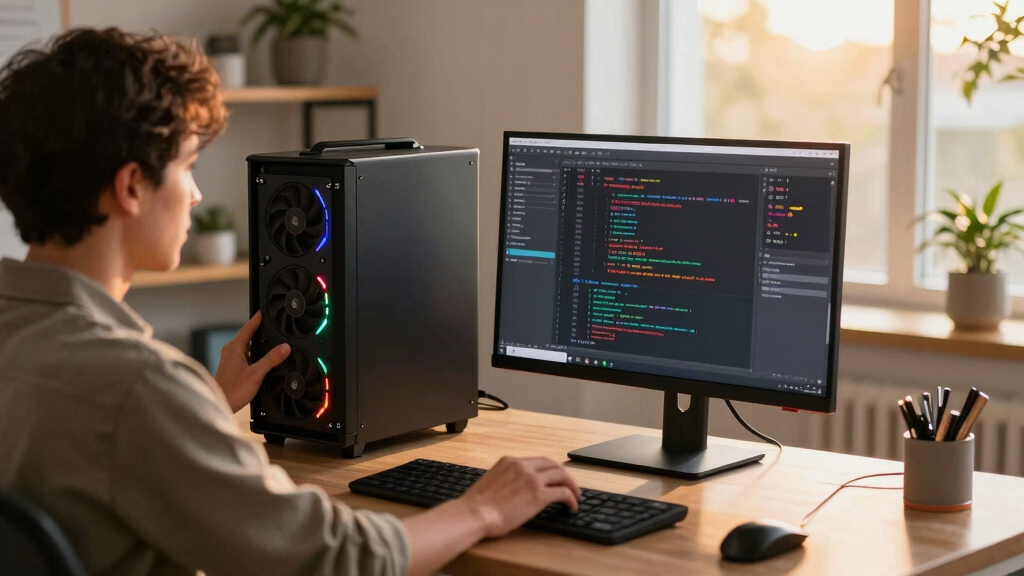

Choosing the best GPU workstation for machine learning development in 2026 requires balancing raw GPU power, system stability, and budget. Top picks include high-end workstations with cutting-edge GPUs like the NVIDIA RTX 4090 or A100, which excel in training large models but come at a premium. Meanwhile, more affordable options might feature mid-range GPUs like the RTX 4080, offering good performance with fewer features. Each option involves tradeoffs: higher performance often means higher cost and power consumption, while budget models may struggle with the largest datasets. Here, I highlight key considerations to help you find the best fit for your machine learning workload and budget constraints.
Key Takeaways
- High-end GPUs like NVIDIA A100 deliver unmatched performance but come at a steep price and require robust power supplies.
- Mid-range GPUs such as RTX 4080 or 4090 provide excellent performance for most ML tasks at a more accessible cost.
- System stability, cooling, and expandability are critical for sustained ML workloads, especially in high-performance setups.
- Budget options may suffice for smaller projects or development phases, but can bottleneck large-scale training.
- Choosing a workstation with good thermal management and power efficiency can extend hardware lifespan and reduce operational costs.
| Height Adjustable RGB GPU Stand with Temperature Display, 5V 3PIN Video Card Support Holder, Anti Sag Bracket & Magnetic Base for PC Graphics Cards |  | Best Accessory for GPU Support and Monitoring | Support Height Range: 35-157mm | Lighting: ARGB RGB support | Material: Metal and plastic | VIEW LATEST PRICE | See Our Full Breakdown |
More Details on Our Top Picks
Height Adjustable RGB GPU Stand with Temperature Display, 5V 3PIN Video Card Support Holder, Anti Sag Bracket & Magnetic Base for PC Graphics Cards
This support stand stands out for its real-time GPU temperature display, which is invaluable during intensive ML training sessions to prevent overheating. Its adjustable height and anti-sag bracket protect your GPU and motherboard, ensuring hardware longevity. Compared with typical support brackets, this model adds customizable lighting effects, making it a stylish addition to your rig. However, it’s not a performance component but a supportive accessory, so it’s best for users who want to maintain hardware health and aesthetics. It works well with standard GPUs but doesn’t influence computational power or system stability directly.
Pros:- Real-time temperature display for thermal management
- Adjustable height for versatile GPU sizes
- Anti-sag support preserves hardware integrity
- Magnetic base for easy installation
Cons:- Does not impact GPU performance
- Limited to support and aesthetic enhancement
- Requires compatible RGB controllers for lighting effects
Best for: Enthusiasts wanting to monitor GPU health and prevent sagging
Not ideal for: Users seeking a high-performance GPU for heavy ML workloads
- Support Height Range:35-157mm
- Lighting:ARGB RGB support
- Material:Metal and plastic
- Weight:0.6 pounds
- Dimensions:3.67 x 1.3 x 0.04 inches
- Compatibility:Various GPU sizes
Bottom line: A practical accessory for maintaining GPU health and aesthetics but not a performance upgrade.
How We Picked
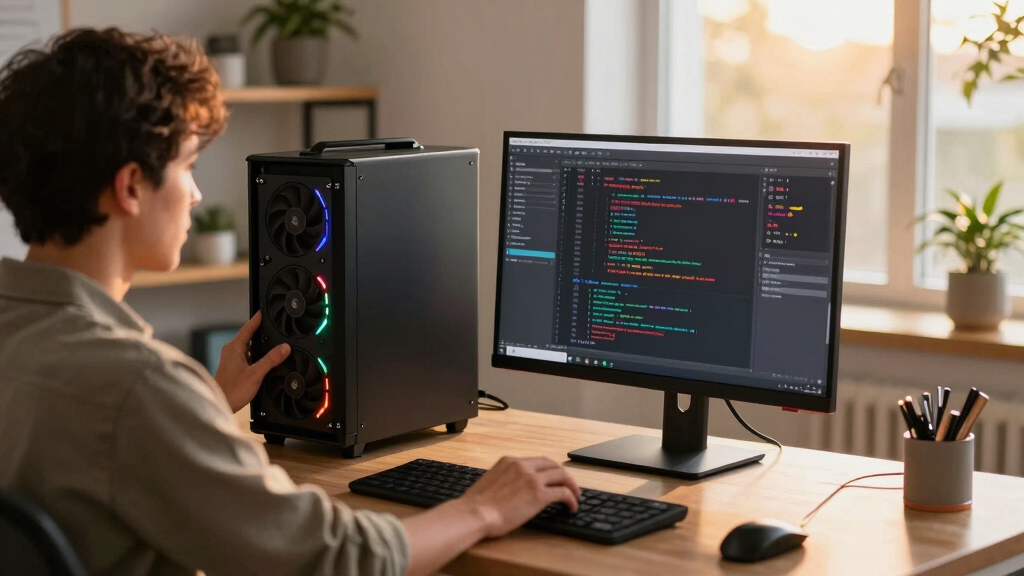
Our selection process focused on balancing GPU performance, system reliability, and suitability for machine learning. We prioritized workstations with top-tier GPUs like the NVIDIA RTX 4090 and A100, as well as those with ample VRAM and robust cooling systems. Cost-effectiveness and expandability were also key factors, ensuring options for different budgets and future upgrades. We considered user reviews, technical specifications, and compatibility with ML frameworks like TensorFlow and PyTorch. The goal was to identify systems that deliver consistent, high-speed training while remaining accessible for a range of users from hobbyists to enterprise researchers.
Factors to Consider When Choosing Best Gpu Workstation For Machine Learning Development
When selecting a GPU workstation for machine learning, it’s vital to balance GPU power, system stability, expandability, and budget. The ideal system should support the latest high-performance GPUs, have enough VRAM for large datasets, and include features like efficient cooling and power supplies. Compatibility with popular ML frameworks, future upgrade potential, and overall reliability are also key considerations. This guide will walk through core aspects to evaluate in your decision-making process, helping you identify a system that can handle demanding ML workloads over time.
GPU Performance and VRAM
The core of any ML workstation is its GPU. For large models and datasets, GPUs like the NVIDIA RTX 4090 or A100 offer massive VRAM (up to 80GB or more), enabling faster training times and handling more complex models. Mid-range options such as the RTX 4080 provide solid performance for smaller projects or development stages. When choosing, consider your specific model size and dataset scale—more VRAM reduces bottlenecks and improves training efficiency.
System Stability and Cooling
ML workloads generate significant heat, so robust cooling solutions and a stable power supply are essential. Look for workstations with high-quality airflow, liquid cooling options, or well-designed case airflow. A reliable power supply with headroom for future upgrades ensures system stability during prolonged training sessions. Neglecting cooling can lead to thermal throttling, reducing performance, and risking hardware damage.
Expandability and Future-proofing
Future ML projects may demand more GPU power, additional RAM, or faster storage. Systems with multiple PCIe slots, extra RAM slots, and support for NVMe SSDs are preferable. Consider power supplies rated at 80 Plus Gold or higher to ensure efficiency. Investing in a slightly more capable system now can save costs later when upgrades are needed, especially if you plan to scale your ML workloads.
Budget and Cost-effectiveness
High-end GPUs like the A100 or RTX 4090 command premium prices but provide unmatched speed. For smaller teams or individual researchers, mid-range GPUs such as the RTX 4080 offer excellent value, delivering good performance without the hefty price tag. Balance your needs against your budget—sometimes a slightly older or less powerful GPU can meet your requirements at a fraction of the cost, especially if your projects are less intensive.
Frequently Asked Questions
What GPU should I choose for large-scale machine learning training?
For large-scale training, high-end GPUs like the NVIDIA A100 or RTX 4090 are ideal, offering maximum VRAM and processing power needed for complex models and big datasets. The A100, in particular, is designed for enterprise-level workloads, providing up to 80GB of VRAM and optimized tensor cores for deep learning. However, these come at a significant cost and require a compatible system with adequate power and cooling.
Can I use consumer GPUs for professional ML workloads?
Yes, consumer GPUs like the RTX 4080 or 4090 are capable of handling many ML tasks, especially for smaller projects or development. They offer excellent performance at a more accessible price point compared to enterprise GPUs. However, they may lack features like ECC memory or multi-GPU support optimized for large-scale training, which can be a limiting factor for very demanding applications.
How important is VRAM in a machine learning workstation?
VRAM is critical because it determines how large a dataset or model can be processed directly on the GPU. Insufficient VRAM leads to data swapping, significantly slowing training. For deep learning, 24GB or more is recommended for large models, while smaller projects can often be handled comfortably with 12-16GB. Always match your VRAM choice to your dataset size and model complexity.
Should I prioritize CPU performance over GPU for ML work?
While the GPU is the primary component for training deep learning models, the CPU also plays a vital role in data preprocessing, feeding data to the GPU, and running supporting tasks. A balanced system with a high-performance CPU, ample RAM, and fast storage will prevent bottlenecks. For most ML workloads, investing in a powerful GPU yields more significant performance gains than focusing solely on CPU upgrades.
What features make a workstation suitable for machine learning?
A suitable ML workstation should have a high-performance GPU with plenty of VRAM, robust cooling, and a reliable power supply. Expandability options like extra PCIe slots and RAM slots help future-proof the system. Fast SSD storage reduces data loading times, and compatibility with ML frameworks ensures smooth operation. Overall, stability and scalability are key to handling demanding training tasks efficiently.
Conclusion
If you are an individual researcher or small team working on moderate-sized projects, a workstation with a high-performance consumer GPU like the RTX 4080 or 4090 will provide excellent value and speed. For enterprise environments or large-scale training, investing in a system with the NVIDIA A100 or similar data center GPU offers unmatched performance but comes with higher costs and complexity. Budget-conscious users can start with mid-range GPUs and upgrade later, while those needing maximum throughput should prioritize systems with enterprise-grade hardware. Overall, matching your workload size and future plans to your hardware will ensure a productive and scalable ML development environment.