Choosing the best portable generator for small business backup power involves balancing power output, portability, and reliability. The Oxseryn Power Equipment 4400 Watts Inverter Generator stands out as the overall best due to its quiet operation and fuel efficiency. For those prioritizing budget, the PowerSmart 3800 Watt Portable Inverter Generator offers solid performance at a lower price point. The Westinghouse 12500 Watt Dual Fuel Generator excels for larger power needs with its dual-fuel flexibility. Keep in mind, tradeoffs often include size, noise levels, and fuel consumption. Continue reading for a detailed comparison to find the best fit for your business needs.

Get business pricing on tech for your team
- Business-only prices and quantity discounts
- Tax-exempt purchasing
- Multiple users, one account, clear invoices
Complete the kit


Key Takeaways
- Power output varies significantly; larger businesses need higher wattage models like the Westinghouse 12500 Watt Dual Fuel Generator.
- Inverter generators provide cleaner power, ideal for sensitive electronics, but may come at a higher cost.
- Fuel type flexibility, such as dual-fuel options, adds versatility for backup scenarios.
- Portability depends on weight and size; lightweight models are easier to transport but may offer less power.
- Cost and features often trade off; premium models include advanced features like remote start and CO sensors.


| portable generator for small business backup power | Wattage | Fuel Type | Power Source | Output Wattage |
|---|---|---|---|---|
| Oxseryn Power Equipment 4400 W | 3400 watts | Gasoline | Fuel Powered | 4400 |
| PowerSmart 3800 Watt Portable | 3200 watts | Gas | Fuel Powered | 3200 |
| Oxseryn 4400-Watts Inverter Ge | 4400 watts | Gasoline | Fuel Powered | 4400 |
| Jackery Explorer 1000 v2 Porta | — | — | — | — |
| Westinghouse 12500 Watt Dual F | — | — | — | — |
| Anker SOLIX S2000 Portable Pow | 2010 watt-hours | Battery Powered | Battery Powered | 1500W |
| Westinghouse 6600 Peak Watt Po | — | — | — | — |
More Details on Our Top Picks
Oxseryn Power Equipment 4400 Watts Inverter Generator Gas Powered, Portable Open Frame Generator, Low Noise with ECO Mode, RV Ready, Emergency Home Backup
This Oxseryn inverter generator offers a compelling blend of power, portability, and quiet operation, making it ideal for small businesses that need reliable backup without noise disruptions. Compared to the PowerSmart 3800 Watt inverter, it provides slightly higher peak wattage and a more robust fuel capacity, which can be critical during extended outages. However, it still maintains a lightweight profile at 56 lbs, unlike larger models, ensuring easy transport to job sites or backup locations. Its inverter technology ensures clean power, suitable for sensitive business electronics, unlike traditional generators that may produce surges. The main tradeoff involves a limited runtime of around 14 hours and reliance solely on gasoline, which might not suffice for prolonged outages without refueling. Overall, this pick makes the most sense for small businesses prioritizing portability and quiet operation.
Pros:- High peak wattage suitable for small business essentials
- Low noise level under 72 dBA for unobtrusive operation
- Lightweight at 56 lbs for easy transport and setup
- Multiple outlets and RV-ready connection
Cons:- Limited runtime of about 14 hours at 25% load may require frequent refueling
- Gasoline-only fuel source may be restrictive during long outages
Best for: Small business owners needing portable, quiet, and reliable backup power for critical electronics and equipment
Not ideal for: Businesses requiring extended runtime without frequent refueling or alternative fuel options, or larger power loads
- Wattage:3400 watts
- Fuel Type:Gasoline
- Power Source:Fuel Powered
- Voltage:120 volts
- Output Wattage:4400
- Runtime:14 hours
Our verdict“This generator is ideal for small businesses that need portable, quiet backup power with sufficient wattage for essential devices.”
PowerSmart 3800 Watt Portable Inverter Generator for Home Use
The PowerSmart 3800 Watt inverter generator excels at providing clean, stable power with minimal noise—only 59 dBA—making it a great fit for small businesses with sensitive electronics like laptops or POS systems. Unlike the Oxseryn, this model supports parallel connection, allowing for increased power if needed, though it requires an additional kit, which is an extra step and expense. Its compact size and multiple outlets, including USB ports, enhance versatility, but its relatively small 1.19-gallon tank means frequent refueling could interrupt longer backup periods—less ideal for continuous operation. While it’s quieter and supports a wider range of electronics, its weight is on the heavier side for a portable unit, impacting ease of movement. This pick makes the most sense for small businesses prioritizing quiet operation and sensitive device compatibility.
Pros:- Extremely quiet operation at only 59 dBA
- Supports parallel connection for extra power
- Multiple outlets including USB ports for versatile device charging
- Reliable safety features like low oil shutdown
Cons:- Limited 1.19-gallon tank requires frequent refueling
- Heavy for a portable generator, affecting ease of transport
Best for: Small businesses needing quiet, clean power for sensitive electronics during outages or outdoor events
Not ideal for: Businesses requiring long runtime or heavy power loads without frequent refueling or parallel setup
- Wattage:3200 watts
- Fuel Type:Gas
- Power Source:Fuel Powered
- Voltage:120 volts
- Output Wattage:3200
- Runtime:Not specified, approximately 4-6 hours at full load
Our verdict“This generator is well-suited for small businesses that need quiet, clean power for sensitive electronics and short-term backup needs.”
Oxseryn 4400-Watts Inverter Generator, Gas Powered, Emergency Home Backup, RV Ready 30A Outlet, EPA Compliant
This Oxseryn inverter generator combines high power output with a lightweight design, weighing just 56 lbs, making it a practical choice for small business backup or mobile operation. Its inverter technology and ECO mode promote fuel efficiency, and the 4400 peak watts easily handle multiple devices, surpassing the PowerSmart’s capacity for larger or combined loads. Its RV-ready 30A outlet adds versatility, especially for mobile businesses or emergency setups. Compared with larger, less portable models like the Westinghouse, it sacrifices some runtime—about 14 hours—and has no alternative fuel options but excels in portability and ease of use. It may emit a slight gas smell upon arrival, a common trait with factory-testing, but overall, it offers strong power in a compact form. This makes it perfect for small businesses that need a portable yet powerful backup option.
Pros:- High peak wattage and inverter technology for sensitive electronics
- Lightweight and portable at 56 lbs
- Includes RV-ready 30A outlet for mobile applications
- Fuel-efficient ECO mode
Cons:- Limited runtime of approximately 14 hours at 25% load
- May emit a slight gas smell after factory testing
Best for: Small businesses requiring portable backup power with high wattage and RV compatibility for mobile or emergency use
Not ideal for: Long-term power needs or businesses that prefer dual fuel options or extended runtimes without frequent refueling
- Wattage:4400 watts
- Fuel Type:Gasoline
- Power Source:Fuel Powered
- Voltage:120 volts
- Output Wattage:4400
- Runtime:14 hours
Our verdict“This generator suits small businesses that need portable, high-capacity backup power with RV compatibility and fuel efficiency.”
Jackery Explorer 1000 v2 Portable Power Station, 1070Wh, 1500W
The Jackery Explorer 1000 v2 stands out for its massive 1070Wh capacity and 1500W AC output, making it ideal for small businesses that need sustained power during extended outages or outdoor operations. Its fast charging technology, capable of reaching full charge in just an hour, plus a durable battery rated for over 10 years and 4,000+ cycles, ensures long-term reliability—something traditional gas generators can’t match. Unlike the inverter generators, it’s silent, clean, and free of emissions, but it requires solar panels or wall outlets for recharging, which limits its immediate usability in some scenarios. Its weight (23.8 lbs) is manageable for most setups, but less convenient for frequent transport. This makes it a strong choice for businesses prioritizing long-term, maintenance-free power solutions over outright wattage.
Pros:- Huge capacity at 1070Wh for extended power supply
- Fast recharge in just one hour
- Long battery lifespan with over 10 years and 4,000+ cycles
- Multiple ports including USB-C PD 100W
Cons:- Requires solar panels or external power for recharging, not plug-and-play
- Relatively heavy at 23.8 lbs for frequent on-the-move use
Best for: Small businesses seeking long-term, sustainable backup power for sensitive devices and extended outages
Not ideal for: Businesses that need immediate, high-wattage power for heavy loads or on-the-go setups without solar access
- Capacity:1070Wh
- AC Output:1500W
- Surge Peak:3000W
- Battery Type:LFP (Lithium Iron Phosphate)
- Charge Cycles:Over 4,000
- Weight:23.8 lbs
Our verdict“This power station is perfect for small businesses that value long-term, maintenance-free backup with high capacity and quiet operation.”
Westinghouse 12500 Watt Dual Fuel Portable Generator with Remote Electric Start
The Westinghouse WGen9500DF peaks at 12,500 watts, providing ample power for larger small business loads or multiple devices simultaneously. Its dual fuel capability—gasoline and propane—offers flexibility that the inverter models lack, making it well-suited for long-term outages or remote job sites. The remote electric start feature adds convenience, especially during emergencies. Compared to the inverter-based Oxseryn models, it’s significantly larger, less portable, and has a more complex setup, but it delivers much higher wattage, capable of running entire small business operations. The main tradeoff is the lack of detailed weight information and potentially higher noise levels. Overall, this generator is best for businesses with substantial power needs and the capacity to handle a larger, less portable unit.
Pros:- High peak and running wattage suitable for full business loads
- Dual fuel flexibility enhances operational resilience
- Remote electric start for quick, convenient operation
- Multiple outlets including transfer switch-ready connections
Cons:- Weight and size likely impact portability (specific weight not provided)
- Potentially higher noise levels compared to inverter options
Best for: Small businesses needing high wattage, dual fuel options, and remote start for backup or mobile operations
Not ideal for: Businesses with limited space or requiring frequent transport, or those seeking less noisy, more compact solutions
Our verdict“This generator is best suited for larger small businesses with high power demands and the need for fuel flexibility and remote operation.”
Anker SOLIX S2000 Portable Power Station, 2010Wh, 3000W Peak, Home Backup
The Anker SOLIX S2000 stands out for its impressive 2010Wh capacity packed into a lightweight, portable design, making it ideal for small businesses needing reliable home backup during outages. Unlike larger generators such as the Westinghouse 6600, this station is easier to move and store, but it’s limited to a continuous 1500W output, which might restrict running multiple high-power devices simultaneously. Its support for solar charging offers flexibility for off-grid or emergency use, yet the absence of a 12V DC port can be a drawback for some setups. This pick makes the most sense for small retail shops, offices, or cafes that need quiet, maintenance-free backup power without the bulk of traditional generators.
Pros:- Impressive 35-hour runtime for essential devices like fridges
- Compact, lightweight design for easy transport
- Supports multiple charging options including solar, enhancing flexibility
Cons:- Limited to 1500W continuous output, restricting high-power device use
- No dedicated 12V DC port, limiting certain device connections
Best for: Small business owners who prioritize portability, quiet operation, and a long runtime for essential appliances.
Not ideal for: Businesses that require high wattage for multiple heavy-duty devices or larger equipment, as the 1500W continuous limit may be restrictive.
- Wattage:2010 watt-hours
- Fuel Type:Battery Powered
- Power Source:Battery Powered
- Output Wattage:1500W
- Total Power Outlets:8
- Runtime:35 hours
- Item Weight:35.7 pounds
- Dimensions:8.19″L x 11.1″W x 12.7″H
Our verdict“This station is perfect for small businesses needing quiet, portable backup power for critical appliances without heavy lifting.”
Westinghouse 6600 Peak Watt Portable Generator with CO Sensor and Transfer Switch Ready 30A Outlets
The Westinghouse WGen5300cv offers robust power with 6,600 peak watts and a long runtime of up to 14.5 hours, making it suitable for larger small businesses or those with higher power needs. Compared with the Anker station, it provides a much higher wattage capacity, enabling the operation of multiple appliances or even small machinery, but it’s noticeably bulkier and heavier, which could complicate portability. Its multiple outlets, including transfer switch readiness and RV connections, expand its versatility for various backup scenarios. Safety features like the CO sensor and automatic low oil shutdown add peace of mind during extended outages. This generator makes the most sense for businesses that need substantial backup capacity and are prepared for the weight involved.
Pros:- Powerful 6600 peak watts suitable for multiple devices and equipment
- Long runtime of up to 14.5 hours on a full tank
- Includes safety features like CO sensor and automatic low oil shutdown
Cons:- Potentially heavy and bulky, reducing portability
- Weight not specified, which may affect handling and storage
Best for: Small businesses with higher power demands, such as retail stores or clinics, that can accommodate a portable, heavier unit for reliable backup power.
Not ideal for: Owners of very small or space-constrained businesses who prefer a lightweight, more portable solution or only need minimal backup power.
- Peak Watts:6600
- Running Watts:5300
- Fuel Tank Capacity:4.7 gallons
- Run Time:Up to 14.5 hours
- Engine:274cc 4-Stroke OHV
- Outlets:One 5-20R 120V 20A, One RV-Ready TT-30R 30A, One L14-30R 30A
- Features:CO Sensor, Transfer Switch Ready, Fuel Gauge, Automatic Low Oil Shutdown
- Weight:Not specified
Our verdict“This generator is well-suited for small businesses that require high power capacity and can manage its size and weight for reliable backup during outages.”
How We Picked
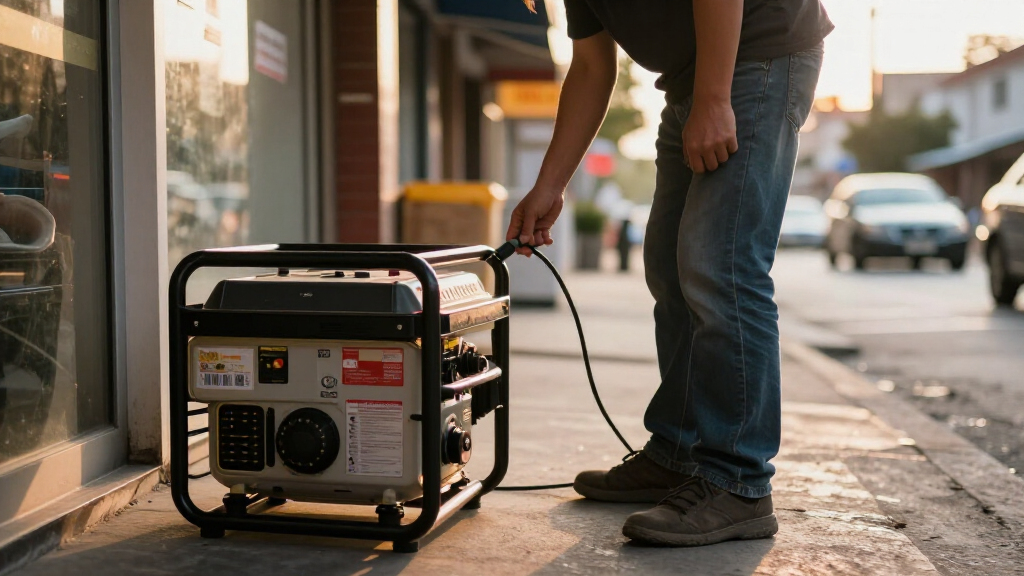
These products were evaluated based on their power output, portability, noise levels, fuel efficiency, ease of use, and durability. We prioritized models that are reliable for small business backup scenarios, balancing performance with affordability. The rankings reflect a combination of user reviews, technical specifications, and real-world usability to identify options suitable for various business sizes and needs. Our focus was on ensuring each product offers a clear advantage in a specific category, making it easier for buyers to choose based on their priorities.| portable generator for small business backup power | Fuel Type | Power Source |
|---|---|---|
| Oxseryn Power Equipment 4400 W | Gasoline | Fuel Powered |
| PowerSmart 3800 Watt Portable | Gas | Fuel Powered |
| Oxseryn 4400-Watts Inverter Ge | Gasoline | Fuel Powered |
| Jackery Explorer 1000 v2 Porta | — | — |
| Westinghouse 12500 Watt Dual F | — | — |
| Anker SOLIX S2000 Portable Pow | Battery Powered | Battery Powered |
| Westinghouse 6600 Peak Watt Po | — | — |
Factors to Consider When Choosing Best Portable Generator For Small Business Backup Power
When selecting a portable generator for small business backup power, several factors influence the best choice. Understanding your specific power needs, ease of operation, and budget can help narrow options. Consider how often you’ll need backup power, where you’ll use the generator, and what features matter most to your business continuity. Making informed decisions prevents overpaying for features you won’t use or selecting underpowered models that can’t handle your load.Power Output and Size
Assess your essential equipment’s wattage to determine the minimum power capacity needed. A generator with too little power will struggle to run your critical devices, while an oversized unit can be cumbersome and waste fuel. For small businesses, models in the 3000-5000 watt range often strike a good balance, providing enough juice without excessive bulk. Larger models may be necessary for more extensive setups, but they come with increased weight and cost.
Fuel Type and Efficiency
Fuel options like gasoline, propane, or dual-fuel systems influence convenience and running costs. Gasoline offers quick refueling but can be less stable long-term, while propane provides cleaner burning and longer shelf life. Dual-fuel generators add versatility, especially if fuel availability varies. However, keep in mind that fuel efficiency and capacity impact how long your generator can run during an outage, so look beyond just the tank size.
Portability and Size
Portability is vital if your business needs to move the generator between locations or store it easily. Lighter units with built-in handles or wheels make setup simpler. Conversely, larger, more powerful units tend to be heavier but offer more power. Think about where you’ll use the generator most often — a compact model might suffice for stationary backup, but mobile setups require more portable options.
Noise Levels
Lower noise levels improve the working environment and reduce disturbance to clients or neighboring businesses. Inverter generators excel here, often operating at quieter decibel ranges, making them suitable for indoor or close-quarters use. Larger open-frame models tend to be noisier, which could be a concern if noise restrictions apply or if the generator will run during business hours.
Additional Features and Safety
Features like remote start, CO sensors, and transfer switches add convenience and safety, especially for continuous operation. CO sensors automatically shut down the generator if dangerous fumes are detected, preventing health hazards. Transfer switches simplify connecting to your existing electrical system, which is critical for seamless backup power. Weigh the importance of these extras against your budget and operational complexity.
Frequently Asked Questions
How much power do I need for my small business backup?
Calculate the total wattage of all essential equipment you want to run simultaneously during an outage. Add some buffer for startup surges, typically 20-30% above running wattage. For most small businesses, a generator in the 3000-5000 watt range covers common needs like POS systems, lighting, and small appliances, but larger setups may require more capacity. Knowing your exact power requirements helps avoid under or over-investing in a generator.
Is inverter technology necessary for small business backup power?
Inverter generators produce cleaner, stable power that is safe for sensitive electronics such as POS systems, computers, and other digital devices. If your business relies on such equipment, an inverter model is worth the extra cost, as it prevents damage and data loss. For basic lighting or non-sensitive appliances, traditional generators may suffice, but inverter models often offer quieter operation and better fuel efficiency.
How important is fuel efficiency in choosing a backup generator?
Fuel efficiency directly impacts operating costs and runtime during outages. A more efficient generator consumes less fuel for the same power output, extending your backup time and reducing refueling frequency. This is especially important if fuel supplies are limited or if outages tend to last several hours. Comparing fuel consumption rates at different load levels can reveal which model offers the best value for ongoing use.
Should I prioritize portability over power output?
It depends on your specific setup. If your business requires moving the generator between locations or storing it frequently, portability features like wheels and handles matter greatly. However, sacrificing some power capacity for portability might mean choosing a smaller unit that can’t handle all critical loads. Conversely, if your setup is stationary, a larger, less portable model can deliver more power without the inconvenience of frequent moving.
What safety features should I look for?
Safety features such as carbon monoxide sensors, automatic shutoff, and transfer switches enhance operational safety and compliance. CO sensors are especially important if the generator runs indoors or in semi-enclosed spaces, as they prevent dangerous fume buildup. Transfer switches allow safe connection to your electrical system, preventing backfeeding risks. Prioritizing these features ensures your backup power setup is both reliable and safe.
Conclusion
For small business owners seeking a reliable all-around solution, the Oxseryn Power Equipment 4400 Watts Inverter Generator offers a balance of quiet operation, portability, and sufficient power. If budget constraints are key, the PowerSmart 3800 Watt Portable Inverter Generator delivers dependable backup without breaking the bank. Larger operations or those with more critical power needs should consider the Westinghouse 12500 Watt Dual Fuel Generator for its high capacity and fuel flexibility. Beginners or infrequent users will benefit from models with simple controls and safety features, while experienced operators should prioritize capacity and additional functionalities to ensure seamless continuity during outages.
Halloween Picks
halloween
As an affiliate, we earn on qualifying purchases.