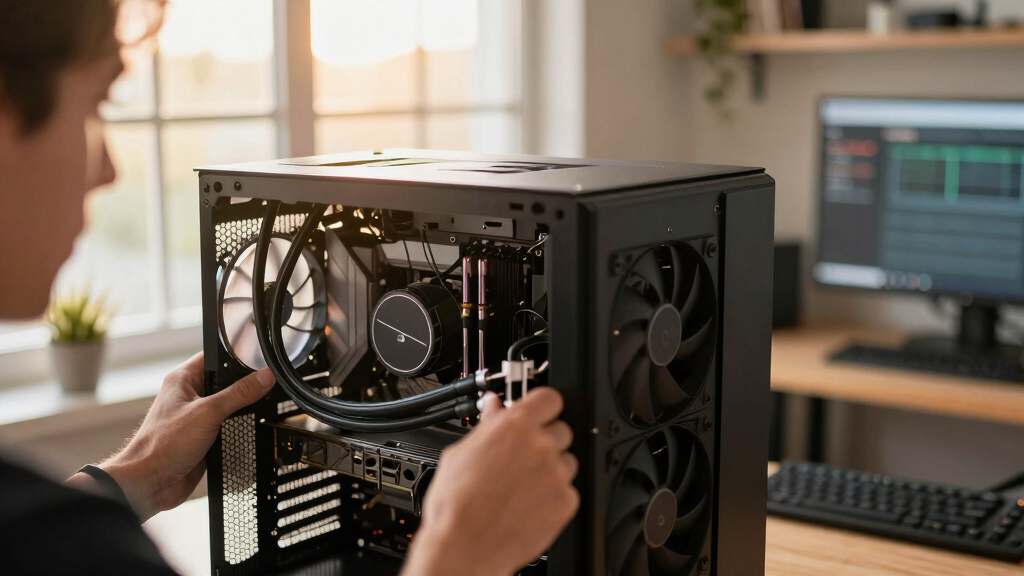

📊 Full opportunity report: Liquid vs Air Cooling for 24/7 Inference Rigs on ThorstenMeyerAI.com — validation score, market gap, and execution plan.
Listen free for 30 days with Audible
Thousands of audiobooks and originals — cancel anytime.
Start your free trialAs an affiliate, we earn on qualifying purchases.
TL;DR
For 24/7 AI inference rigs, air cooling generally offers greater reliability, lower cost, and quieter operation. Liquid cooling provides higher thermal headroom but introduces potential failure points. The choice depends on workload and case constraints.
For continuous AI inference rigs running 24/7, air cooling remains the preferred choice due to its simplicity, reliability, and lower total cost of ownership, according to hardware experts.
Most AI inference systems operate unattended for extended periods, making reliability a critical factor. Air coolers, with only one moving part—the fan—are less prone to failure and easier to maintain, often lasting over a decade with minimal intervention, as noted by hardware reviewer Thorsten Meyer.
In contrast, all-in-one (AIO) liquid coolers contain a pump and sealed loop components that can degrade over time, with a typical lifespan of 5–7 years. Leaks, seal hardening, and coolant permeation are potential failure modes, although modern units are generally reliable.
Cost analysis shows air coolers are significantly cheaper upfront and over the lifespan, with high-end dual-tower air coolers matching the performance of mid-size AIOs for most workloads. Noise levels tend to be lower with quality air coolers, which operate at 40–45 dBA under load, compared to 45–55 dBA for AIOs due to pump hum.
While liquid cooling excels in high thermal headroom, capable of handling CPUs with TDPs exceeding 360W, this is typically unnecessary for most inference workloads, where the CPU does not reach such extremes. AIOs are beneficial in compact cases or setups requiring heat export out of the case or room.
Liquid vs air
for a 24/7 inference rig.
For an always-on machine the question isn’t “which cools better” — it’s which one still works in three years without you thinking about it. That reframing makes air the default for most rigs. Answer three questions in Part 2 to find yours.
- Nothing to fail — fan swaps in minutes
- Lasts a decade+; lower total cost
- Quieter floor — no pump hum (~40–45 dBA)
- Trivial maintenance — wipe & repaste
- Tall — can block RAM, dumps heat in case
- Best headroom — ~360W TDP sustained
- Compact block — fits tight cases, clears RAM
- Exports heat out the radiator & room
- Pump fails at 5–7 yrs; replace whole unit
- Costs 2–3× more over its life; pump hum
- You run it 24/7 and want set-and-forget.
- Your CPU is mainstream-to-high-end (or power-capped).
- A big tower fits your case.
- You value lower cost and a quieter floor.
- Your CPU is too hot for air under sustained all-core load.
- A big tower won’t fit (compact / multi-GPU case).
- You need to export heat out of a warm room.
- RAM clearance is tight.
Why Reliability and Cost Matter for Long-Term AI Systems
For AI inference rigs intended to run continuously without interruption, reliability is paramount. Air cooling's simplicity reduces failure risk and maintenance costs, making it the safer choice for unattended operation. Additionally, lower initial and ongoing costs make air cooling more accessible for many users. Understanding these tradeoffs helps practitioners choose the most effective cooling solution aligned with their operational needs.
As an affiliate, we earn on qualifying purchases.
Evolution of Cooling Solutions for AI Inference Hardware
Traditionally, high-performance computing systems relied on liquid cooling for maximum thermal headroom. However, the focus for inference rigs has shifted toward reliability and low maintenance, especially as these systems often run in remote or unattended environments. Recent evaluations indicate that high-quality air coolers can match or surpass AIOs in many scenarios, challenging the assumption that liquid cooling is always superior for sustained workloads.
"An air cooler has exactly one moving part—the fan—and if it fails, you replace it in minutes. The heatsink itself is a solid block that will outlast the rest of your system."
— Thorsten Meyer, hardware reviewer
As an affiliate, we earn on qualifying purchases.
Unresolved Questions About Long-Term Performance
While current data supports the reliability of air cooling for 24/7 inference rigs, long-term real-world performance beyond 10 years remains less documented. The actual lifespan of AIO pumps and seals in continuous operation under varying environmental conditions is still being studied, and failure modes may differ across brands and models.
24/7 AI inference cooling solution
As an affiliate, we earn on qualifying purchases.
As an affiliate, we earn on qualifying purchases.
Future Testing and Industry Adoption Trends
Further long-term testing of both cooling methods in diverse operational environments is planned to better quantify failure rates and maintenance needs. Hardware manufacturers may also develop more durable liquid cooling solutions, potentially shifting the balance in favor of liquid cooling for specific use cases. Users should monitor these developments to inform future upgrades.
As an affiliate, we earn on qualifying purchases.
Key Questions
Is air cooling sufficient for all AI inference workloads?
For most workloads, high-quality air coolers can handle the thermal demands of AI inference CPUs, especially if they are not overclocked or running at maximum TDP continuously.
How often would I need to replace an AIO pump in a 24/7 setup?
Typically, AIO pumps are designed to last 5–7 years, but running them continuously may accelerate wear. Replacement might be needed sooner depending on usage and maintenance.
Are there specific cases where liquid cooling is clearly better?
Yes, in compact cases with limited airflow, or when heat needs to be exported outside the case or room, large AIOs can provide advantages over air cooling.
What maintenance is required for air cooling over time?
Cleaning dust from the heatsink fins and reapplying thermal paste every few years are the main tasks, which are straightforward compared to liquid cooling maintenance.
Source: ThorstenMeyerAI.com
Flea & tick season Picks
flea and tick prevention
As an affiliate, we earn on qualifying purchases.
![GPT-5.6 Sol Ultra Produces Proof Of The Cycle Double Cover Conjecture [Pdf]](https://goodsidekick.com/wp-content/uploads/2026/07/gpt-5-6-sol-ultra-produces-proof-of-the-cycle-double-cover-conjecture-pdf-featured-560x300.jpg)