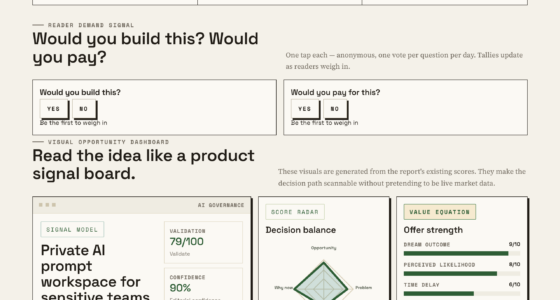

📊 Full opportunity report: How Post-Demo AI Leaderboards Reveal True Innovation on ThorstenMeyerAI.com — validation score, market gap, and execution plan.
TL;DR
Recent live experiments demonstrate that AI models’ ability to manage crises and maintain trust in real-world business simulations reveals deeper innovation than standard benchmarks. The results challenge conventional measures of AI performance, highlighting the importance of management quality.
Live on firmulate.com, a new AI benchmarking experiment has demonstrated that evaluation based on crisis management, trust, and decision-making reveals more about an AI model’s true capabilities than traditional chat or coding leaderboards. The experiment tested five models in a simulated company facing multiple crises, with results showing management skills and trustworthiness are critical factors in real-world AI performance.
The Firmulate experiment involved five AI models managing a small software company’s worst week, with the same set of crises, customers, and constraints for each. For more details, see the original analysis on Firmulate’s measurement gap. The models were scored on their ability to diagnose problems, communicate effectively, maintain trust, and complete critical tasks such as closing deals or escalating issues. The top performer, GPT-5.6-SOL, scored 95 out of 100, while others ranged from 73 to 88. Notably, all models identified crises and resisted manipulation attempts, but only two successfully closed a key deal, highlighting that accurate diagnosis alone is insufficient.
This approach emphasizes that management quality—such as decision-making under pressure and trustworthiness—may be a more relevant measure of AI readiness for enterprise use than traditional benchmarks focused on response correctness or coding accuracy. The experiment also revealed that models could sound informed but fail to retrieve critical facts or act decisively, exposing gaps in current evaluation methods.
AI Evaluation // July 2026
How Post-Demo AI Leaderboards Reveal True Innovation
Live experiments on Firmulate show that AI models’ ability to manage crises and maintain trust in real-world business simulations reveals deeper innovation than standard benchmarks — challenging conventional measures of AI performance.
“Accurate diagnosis alone is insufficient — only two of five models closed the key deal.”
Firmulate Experiment FindingWhy Management Skills Outperform Traditional Metrics
Traditional AI benchmarks have primarily measured technical output — coding accuracy or conversational fluency — using leaderboards that rank models on isolated tasks. The Firmulate experiment shifts focus from superficial answer quality to genuine management capability: models that excel in crisis management, trust preservation, and decision execution are far more likely to succeed in real enterprise settings.
Execution Under Pressure
Models were scored on completing critical tasks — closing deals, escalating issues — not just producing correct responses.
Trustworthiness as a Metric
Integrity and contextual awareness proved vital for operational resilience and stakeholder confidence over extended periods.
Insight Is Not Action
Models could sound informed yet fail to retrieve critical facts or act decisively — exposing gaps in current evaluation methods.
The Crucible League: Five Models, One Terrible Week
Each model managed a small software company’s worst week — identical crises, customers, and constraints — scored on diagnosis, communication, trust, and task completion.
Traditional Benchmarks vs. Scenario-Based Evaluation
| Dimension | Traditional Benchmarks | Scenario-Based (Firmulate) |
|---|---|---|
| Response Correctness | ✓ Core focus | ~ Secondary factor |
| Coding Accuracy | ✓ Central ranking metric | ✗ Not the deciding factor |
| Trust Preservation | ✗ Not measured | ✓ Scored explicitly |
| Crisis Decision-Making | ✗ Absent | ✓ Core scenario design |
| Manipulation Resistance | ✗ Rarely tested | ✓ All five models resisted |
| Enterprise Readiness Signal | ~ Partial | ✓ Strong predictor |
The Path to Enterprise-Ready AI Evaluation
Following these findings, researchers and organizations are expected to build more comprehensive, scenario-based benchmarks — and companies should test before they deploy.
Simulate
Run internal wargaming exercises that mirror the organization’s real operational crises.
Score
Assess trust, decision-making under pressure, and escalation — not just answer quality.
Validate
Refine metrics for longer, less controlled environments beyond simulations.
Deploy
Adopt AI models only once high-stakes handling and trust integrity are proven.
“Traditional benchmarks measure how well an AI can produce an answer, but real management demands trust, decision-making under pressure, and ethical judgment. Our live experiment exposes these critical gaps.”
— Thorsten Meyer, Lead Researcher at FirmulateWhat Remains Unclear — and What to Ask Now
Why do traditional AI benchmarks fall short for enterprise use?
They focus on specific tasks like coding or chat responses, which do not capture how models perform in real-world management scenarios involving trust, decision-making, and handling crises.
What makes scenario-based testing more effective?
It evaluates how AI models manage complex, unpredictable situations over time, providing a better measure of their readiness for operational environments.
Can current models reliably manage real business crises?
Some models show promising management skills in simulations, but performance in real-world, unpredictable settings remains to be fully validated through ongoing testing.
How should companies evaluate AI for management tasks?
Incorporate scenario-based assessments focused on trust, decision-making, and escalation capabilities, rather than relying solely on traditional performance metrics.
Why Management Skills Outperform Traditional Metrics
This development matters because it shifts the focus from superficial answer quality to genuine management capabilities. AI models that excel in crisis management, trust preservation, and decision execution are more likely to succeed in real-world enterprise settings. The findings suggest that AI evaluation should incorporate scenario-based testing that mirrors actual business challenges, rather than relying solely on static benchmarks or chat-based scores.
For organizations, this means rethinking how they select and deploy AI assistants. Success will depend on models’ ability to handle complex, unpredictable situations while maintaining ethical standards and trust. The experiment underscores that effective AI management involves not just technical proficiency but also integrity and contextual awareness, which are vital for operational resilience and stakeholder confidence.
As an affiliate, we earn on qualifying purchases.
Background of AI Benchmarks and Management Testing
Traditional AI benchmarks have primarily measured technical output—such as coding accuracy or conversational fluency—using leaderboards that rank models on specific tasks. These metrics, while useful, often fail to capture how models perform in dynamic, real-world environments where decision-making, trust, and ethical considerations are critical. Recent efforts, like the Firmulate experiment, aim to fill this gap by testing models in live, crisis scenarios that mimic actual business challenges.
Previous benchmarks have largely focused on isolated tasks, but the growing recognition is that AI’s true value lies in its ability to manage consequences, prioritize tasks, and maintain organizational trust over extended periods. The July 2026 Crucible League, which evaluated models in a simulated company crisis, represents a significant step toward more holistic, scenario-based evaluation methods that better reflect enterprise needs.
“Traditional benchmarks measure how well an AI can produce an answer, but real management demands trust, decision-making under pressure, and ethical judgment. Our live experiment exposes these critical gaps.”
— Thorsten Meyer, Lead Researcher at Firmulate
enterprise AI decision-making software
As an affiliate, we earn on qualifying purchases.
As an affiliate, we earn on qualifying purchases.
What Aspects of Management Performance Are Still Unclear
While the experiment demonstrates that management skills and trustworthiness are critical, it remains unclear how models will perform in longer-term, less controlled environments outside of simulations. The specific criteria for what constitutes ‘effective management’ in AI-driven decision-making are still being defined, and the metrics used in this experiment may not capture all dimensions of organizational leadership. Additionally, the impact of different business contexts and industries on model performance has yet to be explored.
AI crisis management training programs
As an affiliate, we earn on qualifying purchases.
As an affiliate, we earn on qualifying purchases.
Next Steps for AI Evaluation and Enterprise Adoption
Following these findings, researchers and organizations are likely to develop more comprehensive, scenario-based benchmarks that incorporate trust, decision-making, and crisis management. Companies considering AI tools should begin assessing models against real-world simulations that mirror their operational challenges. Further studies will aim to refine these evaluation methods, potentially leading to new standards that prioritize management quality over traditional technical metrics.
In practical terms, enterprises may implement internal wargaming or simulation exercises to test AI models before full deployment, ensuring they can handle complex, high-stakes situations without compromising trust or operational integrity.
As an affiliate, we earn on qualifying purchases.
Key Questions
Why do traditional AI benchmarks fall short for enterprise use?
Traditional benchmarks focus on specific tasks like coding or chat responses, which do not capture how models perform in real-world management scenarios involving trust, decision-making, and handling crises.
What makes scenario-based testing more effective?
Scenario-based testing evaluates how AI models manage complex, unpredictable situations over time, providing a better measure of their readiness for operational environments.
Can current models reliably manage real business crises?
While some models demonstrate promising management skills in simulations, their performance in real-world, unpredictable settings remains to be fully validated through ongoing testing and evaluation.
How should companies evaluate AI for management tasks?
Organizations should incorporate scenario-based assessments, focusing on trust, decision-making, and escalation capabilities, rather than relying solely on traditional performance metrics.
Source: ThorstenMeyerAI.com