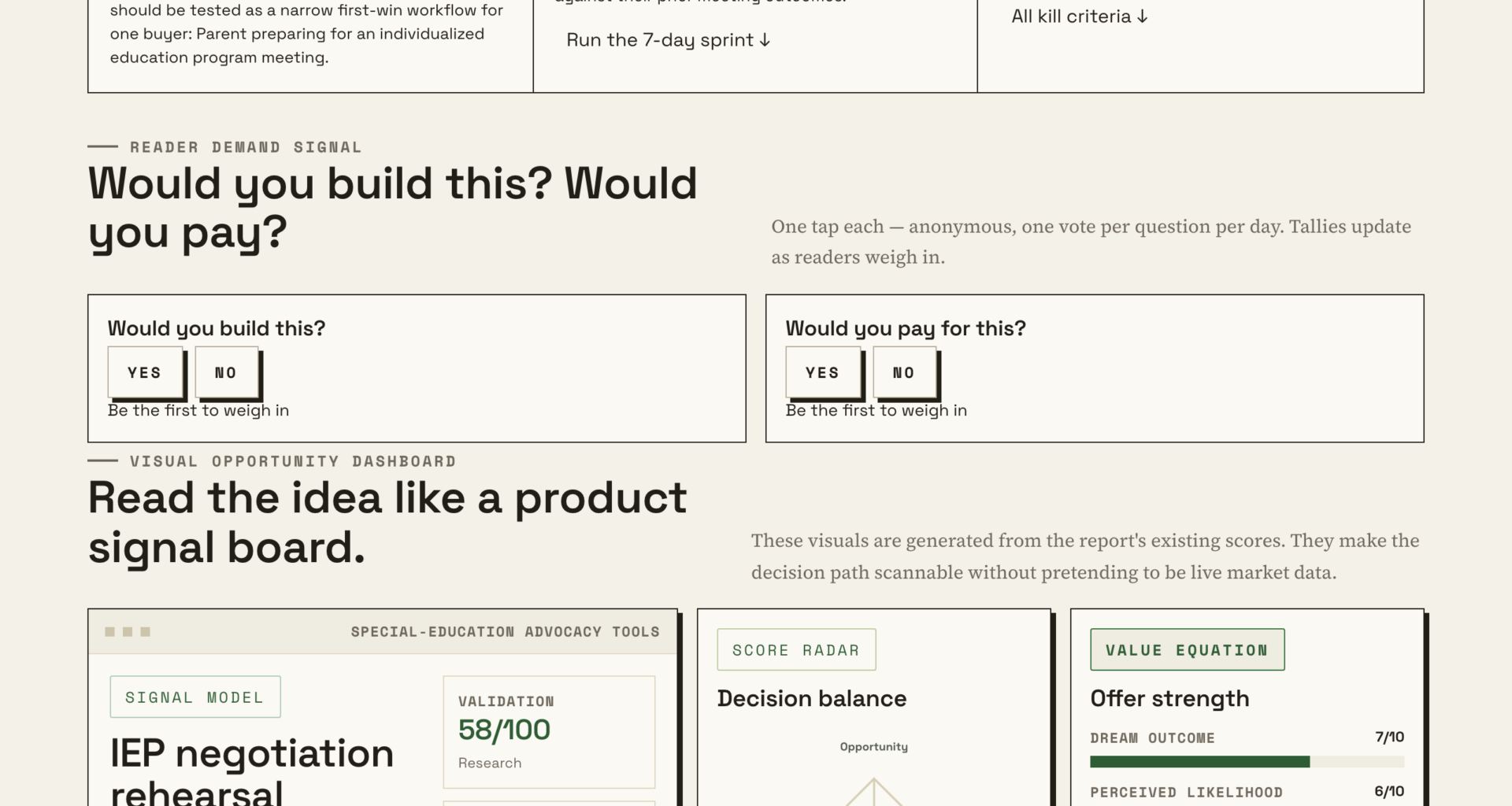
📊 Full opportunity report: How To Get Started With An IEP Negotiation Simulator As A Parent on IdeaNavigator AI — validation score, market gap, and execution plan.

Get business pricing on tech for your team
- Business-only prices and quantity discounts
- Tax-exempt purchasing
- Multiple users, one account, clear invoices
TL;DR

IdeaNavigator AI has outlined a proposed simulator to help parents prepare for individualized education program meetings by reviewing documents, explaining rights and rehearsing conversations. The concept has not been shown to improve services, and its suggested test would compare outcomes for 40 parents with their prior meeting results.
IdeaNavigator AI has proposed an IEP negotiation rehearsal simulator for parents preparing for individualized education program meetings, a tool intended to translate school documents into plain language and let families practice making requests. The proposal describes a product concept and validation plan; it does not establish that a simulator is available or that it improves the services students receive.
The proposed workflow would let a parent upload a current IEP and evaluation reports. The simulator would explain the documents and relevant entitlements in plain language, produce a list of potential requests with legal grounding, then role-play a meeting with realistic pushback from school staff. Parents could repeat the exercise to practice holding to their positions, according to IdeaNavigator AI’s outline.
The intended customer is a parent preparing for one IEP meeting. The proposal frames the product as preparation support in a process where families may face professionals familiar with special education procedures and terminology. It also identifies professional advocacy as a possible alternative that can cost more than $150 an hour, but gives no sourcing or geographic details for that figure.
Potential pricing models include per-meeting preparation or an annual family subscription covering an IEP cycle. To test whether the idea is useful, the proposal calls for preparing 40 parents before real meetings and comparing the services they request with what schools provide, alongside each family’s prior meeting outcomes. No test results, recruitment details or outcome measures have been reported.
A Practice Tool Before IEP Meetings
IEP meetings can shape the services and supports a student receives. A tool that helps parents understand documents, organize questions and rehearse responses could make preparation more accessible, particularly for families who cannot afford individualized advocacy. That is the potential value described in the proposal, rather than a demonstrated result.
The suggested 40-parent test matters because its central question is practical: whether preparation changes the services families request or obtain. A comparison with prior meetings could offer an early signal, but would not by itself show that the simulator caused any difference. Students’ needs, school decisions and the circumstances of each meeting can vary. A useful evaluation would need to explain how those differences are accounted for and how outcomes are measured.
From Document Review to Role-Play
The proposal combines three functions: document explanation, request preparation and meeting practice. It is presented as a narrow first product for one buyer and one situation, rather than a general special education platform. The idea assumes that language models can now produce sufficiently realistic role-play, but no model, performance evaluation or example conversation is specified.
The outline also points to rising special education identification rates and tighter district resources as reasons to explore the idea. It provides no figures, time period or supporting references for those trends, so they remain part of the proposal’s rationale rather than independently documented facts here. The immediate plan is to test the workflow with parents facing actual meetings before drawing conclusions about demand or impact.
Testing, Accuracy and Safeguards
There is no reported evidence yet that the simulator has been built, tested with families or shown to improve meeting outcomes. The proposed comparison with prior outcomes does not specify how parents would be selected, what counts as a service received, or whether a comparison group would be used. Those details will affect how much can be inferred from any results.
The proposal also leaves open how legal explanations would be checked and updated, how the tool would handle differences in applicable rules, and how sensitive student records would be protected after upload. It does not describe whether a qualified human reviewer would be involved or how parents would be told when an answer is uncertain. These questions are especially relevant because families could rely on the tool when preparing requests tied to a student’s education.
A 40-Parent Outcome Test
The next stated step is to prepare 40 parents for real IEP meetings and compare requested and received services with their earlier meeting outcomes. The proposal does not give a schedule or say that recruitment has begun. Before results can be assessed, organizers would need to define the outcome measures and report how the test was conducted.
If the test proceeds, findings could help determine whether the simulator is understandable and useful enough to warrant further development. Any claims about effectiveness would require evidence from the test, including its limits; the current proposal alone cannot show that families will secure different services or that the tool can replace individualized professional advice.
Source: IdeaNavigator AI
Key Questions
Is the IEP simulator available now?
The proposal describes a product concept and a possible test. It does not confirm that the simulator is available or that a test has started.
What would the proposed tool do?
Parents would upload an IEP and evaluation reports. The simulator would explain them in plain language, suggest requests with legal grounding and provide practice through a role-played meeting.
Has it been shown to improve services?
No results are reported. The suggested validation plan would prepare 40 parents and compare meeting outcomes with their prior experiences, but the proposal gives no findings.
Would it replace an education advocate?
The proposal presents the simulator as a preparation tool and does not establish that it can replace an advocate or provide individualized legal advice.
Source: IdeaNavigator AI
Fall Picks
fall essentials
As an affiliate, we earn on qualifying purchases.