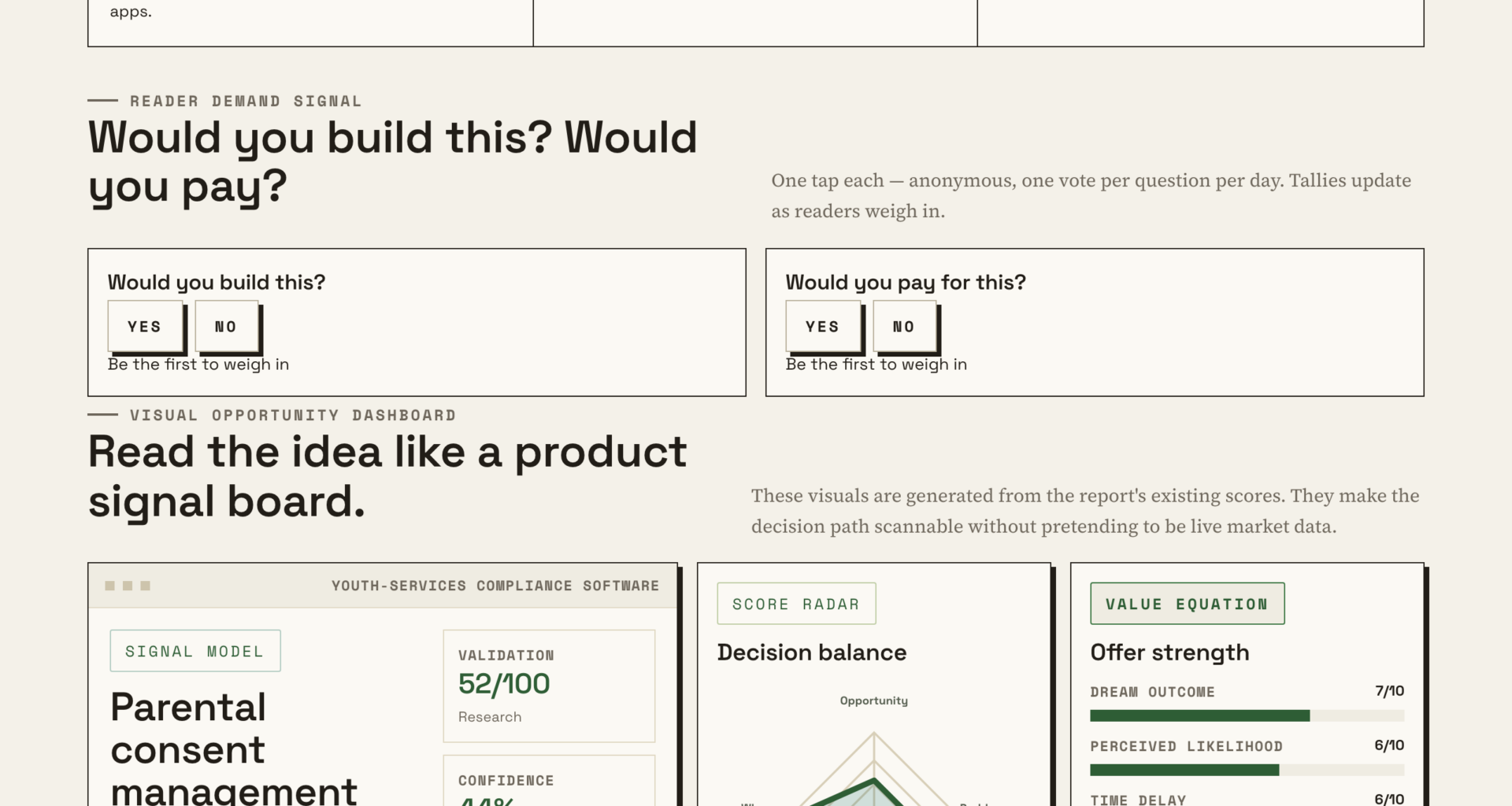

📊 Full opportunity report: Parental Consent Management For Products Used By Children on IdeaNavigator AI — validation score, market gap, and execution plan.

Get business pricing on tech for your team
- Business-only prices and quantity discounts
- Tax-exempt purchasing
- Multiple users, one account, clear invoices
TL;DR
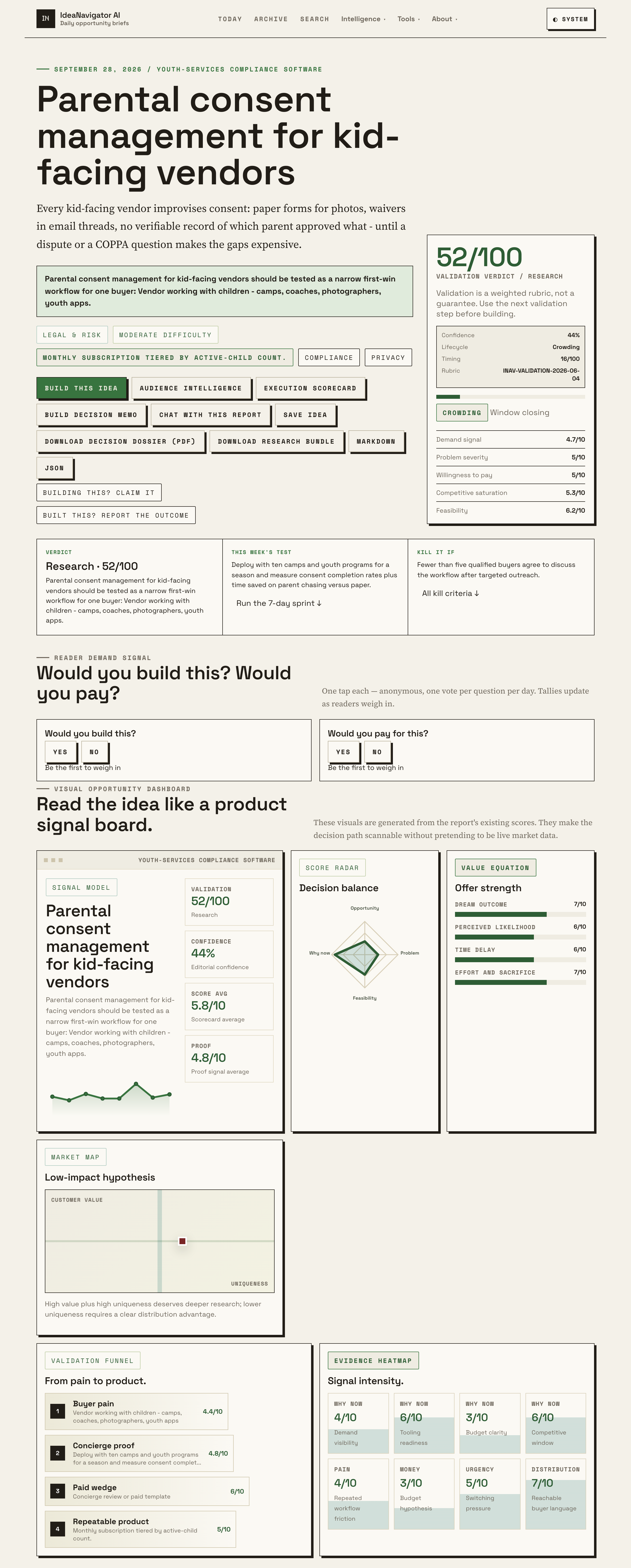
IdeaNavigator AI has outlined a proposed parental consent management product for camps, coaches, photographers and youth apps. The concept would replace scattered forms and email approvals with mobile consent flows and per-child records, but no launch, pilot results or customer commitments are reported.
IdeaNavigator AI has proposed a parental consent management product for businesses and programs working with children, with a suggested first test involving ten camps and youth programs over one season. The concept would give parents phone-based forms and give vendors a per-child record of approvals, but there is no reported product launch, pilot outcome or confirmed buyer commitment.
The proposal targets camps, coaches, photographers and youth apps, which may need permission for different activities, including photo use, data collection, medical information and liability waivers. It describes a vendor-branded mobile flow for parents, with identity checks matched to the perceived risk of each request. A record would track consent for each child, including when an approval expires, and vendors could export an audit record.
IdeaNavigator AI describes the current problem as fragmented consent practices: paper forms, approvals buried in email threads and limited ability to verify which parent approved which use. The proposal says those gaps can become costly during a dispute or a question about compliance. It does not provide examples of specific disputes, estimates of losses, or evidence quantifying how often vendors lack adequate records.
The proposed business model is a monthly subscription tiered by active-child count. To assess demand and usefulness, the proposal recommends deploying the product with ten camps and youth programs for a season. It suggests tracking consent completion rates and the time staff spend chasing parents compared with paper-based processes. No participating programs, pricing, results or schedule are identified.
Consent Records Could Reduce Staff Work
For a youth program, getting permission is only one part of the job. Staff may also need to know which parent approved which activity, for which child, and whether that approval remains valid. A consistent record could make it easier to answer those questions and find an approval when a parent raises a concern. The proposed audit export is intended to support that recordkeeping, although the proposal does not establish that using the product would by itself meet any legal requirement.
The idea also connects administrative work with a testable operational question: whether mobile forms improve completion and reduce follow-up. If a pilot shows parents complete requests more readily and staff spend less time chasing forms, that could support a subscription case for small organizations. If the workflow adds friction, fails to reach families or costs more than the time it saves, vendors may have little reason to adopt it. Those outcomes remain unknown.
Families have a direct interest because consent can cover distinct uses of a child’s image, personal information or medical details. Separating approvals could make requests clearer than a single broad form, but the proposal does not describe the wording, default settings or choices parents would see. The quality of those details would shape whether the system offers meaningful control or simply moves existing forms onto a phone.
A Proposed First Market in Youth Services
The concept is positioned as a narrow first product for vendors that work with children, rather than a general-purpose consent platform. Camps and youth programs are suggested as initial customers; coaches, photographers and youth apps are also named as potential users. That focus would let a pilot examine a defined set of permissions and workflows before any broader market is considered.
IdeaNavigator AI cites expanding children’s privacy enforcement, updates to the federal Children’s Online Privacy Protection Act, state laws and parent challenges to photo or data use as reasons the problem may be timely. Those points are presented as the rationale for the proposal, not as a detailed account of any recent enforcement action or a legal assessment. The proposal does not name a particular rule, state, case or date, and it does not specify how requirements would vary across customer types.
The proposed product combines form delivery with identity checks, consent tracking, expiry notices and audit exports. These are suggested features, not confirmed capabilities in an available service. The proposal also leaves open how a vendor would configure different permission types, who could access a child’s record, and how families could change or withdraw a decision.
Product, Rules and Pilot Still Undecided
The proposal does not say whether a product has been built, whether any vendor has agreed to use it, or when a pilot might begin. Its recommendation to test with ten programs is a proposed validation step, not evidence that the test is underway. There are no reported completion rates, time savings, customer feedback or pricing data.
It is also unclear how identity verification would work at each risk level, how consent could be withdrawn, who would retain records, or how long records would be stored. The proposal names photo, data, medical and liability permissions but does not explain how their different purposes or applicable rules would be handled. No legal review or compliance certification is described, so the system’s ability to meet any specific obligation cannot be assessed from the information available.
Finally, the suggested comparison with paper forms does not define a measurement method or baseline. A useful evaluation would need to specify what counts as a completed consent, how staff time is recorded, and whether the programs and families represent the broader market. Those details could affect how much weight future pilot results deserve.
A Season-Long Test Would Settle Demand
The next step proposed by IdeaNavigator AI is a season-long trial with ten camps and youth programs. Such a test could compare consent completion and staff follow-up time with existing paper processes, while gathering feedback from both vendors and parents. The proposal does not give a start date or say who would run the trial.
Before results could establish whether the concept is useful, the trial would need to report its participants, measurement period and comparison method. It would also need to show how the mobile flow handles distinct permissions and how the records are managed. Until a pilot or product announcement is reported, the idea remains a proposed workflow and business model rather than a demonstrated service.
Source: IdeaNavigator AI
Key Questions
Has the consent management product launched?
No launch is reported. The available description outlines a proposed product and a possible pilot, but does not say a service is available.
Who is the proposed product for?
It is aimed at camps, coaches, photographers and youth apps, with camps and youth programs suggested for an initial test.
What would parents be asked to approve?
The proposed forms could cover photo use, data collection, medical information and liability. The exact form design and parent choices are not described.
What would a pilot measure?
The suggested season-long test would track consent completion rates and staff time spent following up compared with paper processes. No results have been reported.
Source: IdeaNavigator AI
Fall Picks
fall essentials
As an affiliate, we earn on qualifying purchases.